


Moadim L’Simcha! First off, thank you to everyone who has subscribed. I am truly grateful. You only have two days left to get 36% off paid subscriptions. That’s the price of two overpriced shawarmas in Tel Aviv or two everything bagels with lox in NYC. Paid subscribers get access to Notes From Tel Aviv, my weekly series of personal dispatches from Israel. I’m excited to see what we can do at The Middle Ground in 5787.
If you were to ask me at the start of the year whether or not I would write a piece on The Middle Ground about Ed Miliband in 2026, I would say no way. Twice in one month, absolute insanity, but that is where we are. Yesterday, the foreign secretary said at a Labour Conference: “I want to say to the millions of people in this country and indeed elsewhere, who have been moved and outraged by the plight of the Palestinian people. We hear you. You were right.”
On one hand, this is troubling; millions of British citizens have marched in the streets chanting “Free Palestine.” This happened almost immediately after the October 7 attacks. These protests didn’t call for a two-state solution, the release of the hostages, or the removal of Hamas — they were hate marches directed at Israel.
On the other hand, the organizers of these marches were provided the perfect recruitment tools not only because of Israel’s war on Gaza, but because of its government, statements from its ministers, and the policies promoted in the West Bank.
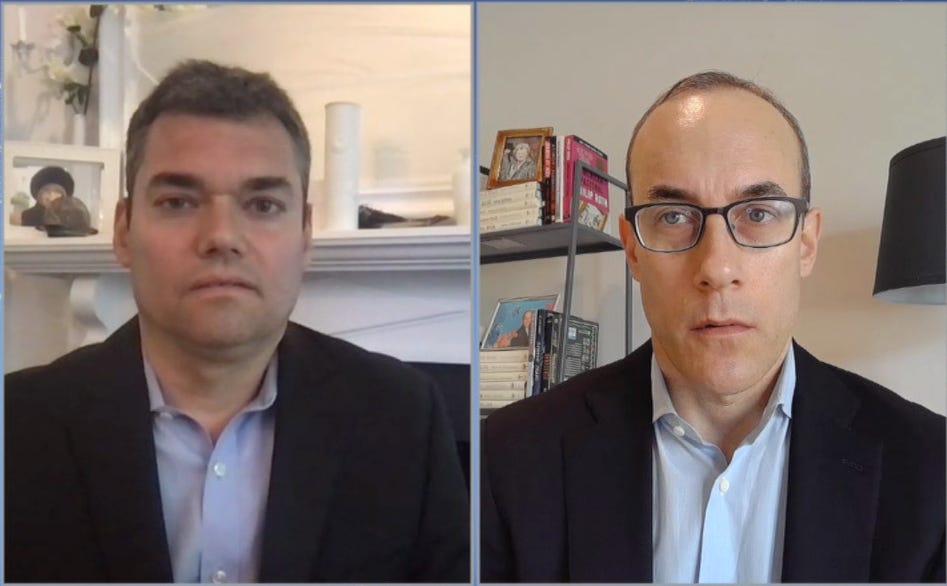
That is why I found responses from two prominent Jewish commentators on Israel, on opposite ends of the conversation, interesting. And I hope both of them are wrong. One is Dan Senor, the host of the excellent podcast Call Me Back. Senor said on X that “this is an impossible standard no Israeli government could meet.” In many ways, this is a continuation of the debate he was having with award-winning author of The Gates of Gaza, Amir Tibon, which I wrote about last month. On the other side of the spectrum is Peter Beinart. He said that Miliband’s speech was a preview of the Democratic National Convention in 2028. Earlier this week, Beinart said every potential Democratic contender should be calling for Marwan Barghouti’s release from prison. That’s not a fringe position anymore—it’s where the argument is heading if this government stays in power.
How to Prove Mehdi Hasan Wrong

If you follow the Israel conversation on social media, you might have caught an interesting three-way debate last week. In a series of exchanges on X, American Jewish commentator and Call Me Back host Dan Senor, Haaretz Opinion Editor Amir Tibon, and anti-Zionist pundit Mehdi Hasan argued a questi…
First, let’s look at Senor. I understand the gut reaction to be defensive and think of this as intentionally caving into an antisemitic mob. It’s the predictable cost of a government that’s given settler violence a pass, backed by a finance minister who said this week Israel should “go to war” in the West Bank and “do there what we did in Gaza,” and a national security minister who unveiled a plan this month to remove 1.86 million Palestinians from Gaza as a condition for joining the next coalition. Miliband is reading the room, but this Israeli government wrote his speech.
Sure, there are other factors, UK politics among them, and the disproportionate global focus on Israel is real. Miliband needed that line for his Labour base. Labour has lost support to the Greens and their anti-Zionist Jewish leader, Zack Polanski, and this is part of new leader Andy Burnham’s leadership reset, which seems to be working. He’d have wanted this regardless of what Israel’s government did this month. All that is right, and yet none of that changes who supplied the material.
Imagine an Eisenkot government that cracked down on settler violence, had no ministers trying to resettle Gaza and floating the idea of nuking it, ended the war earlier with more hostages back alive, and backed a US-led plan to disarm Hamas in Gaza. In this scenario, there would most certainly not have been sanctions placed on the West Bank by the UK and eleven other countries, and the anti-Israel crowd would be arguing from the pre-war debate over occupation and apartheid accusations, not the fresh material this government has supplied it since.
Beinart’s comment is more interesting because in a worst-case scenario, he could be right. If this Israeli government is reelected, the DNC in 2028 could look exactly like the Miliband speech, and that is what Beinart likely wants, but this government has shown the world, as Noam Tibon put it when I spoke to him last week, “an ugly face of Israel.” Over the past decade, Beinart has gone from liberal Zionism to advocating a one-state outcome, to the point that he apologized for prioritizing the chance to speak to Israelis over what he called his solidarity with Palestinians, after giving a talk at Tel Aviv University. His argument today depends on Zionism being the furthest thing from liberal, and that is what this government delivers.
The reality is that the outcomes of both are intrinsically tied to specific policy choices made by the Israeli government; one can debate them on the merits, and there are compelling arguments to be made on both sides. But the idea that any Israeli government would meet the same fate is at best naive, and at worst willfully ignorant.
We have a tendency to be reflexive. On Israel, I am much closer to Senor than Beinart. Beinart no longer believes in a Jewish, democratic Israel, while Senor does. But our gut tells us that when we hear a speech like Miliband’s, we react: this is Israel hate, pure and simple; it doesn’t matter which government, Netanyahu or not, this is what it looks like. And I understand the temptation. It is the easy out. The reality is, this government has done so much damage to Israel, and you simply cannot leave that out of the conversation even if there are many other real factors at play.
I hope both of them are wrong, because if the Milibands of the world are blind Israel-haters that want to dismantle the world’s only Jewish state, then we are in trouble, and if all Democrats are as well, that is something I refuse to believe. Call me naive, call me blind, but I believe that Democrats that have shifted over the past few years are reachable, and a different Israeli government that makes different decisions can bring them back.
And I sound like a broken record, but that is why the stakes are so high in this Israeli election. The Israel that can afford to see Beinart’s vision for the 2028 DNC come to fruition is an Israel that doubles down on Netanyahu, Ben Gvir, and Smotrich’s politics—which leads Israel down the course of international isolation and “Super Sparta.” That Israel has no good outcome for any of us—just ask Sparta. And that is why we can’t be a Beinart and give up on Israel, but we also can’t be a Senor and fail to look in the mirror despite the temptations.
I think it’s very simple. The only way Israel can possibly win the argument is if it makes a serious effort to resolve the conflict with the Palestinians and to end the situation where they live under a violent military occupation. Micah Goodman can’t ride in on a horse with his Catch 67 to save us anymore.
On the one hand you are completely right. It is essential for Israel to move away from a messianic right wing Government, first of all for internal reasons. On the other hand, Israel must understand that European countries are going to become more and more like Arab countries in the 80s. This is the choice they have made and this is the ideology they have imported. Israel hatred is the pressure valve that will be used more and more by Western governments. So I think that Israel needs to do better for its own sake while finding new alliances in addition to the Western ones, which will probably be less and less reliable.