


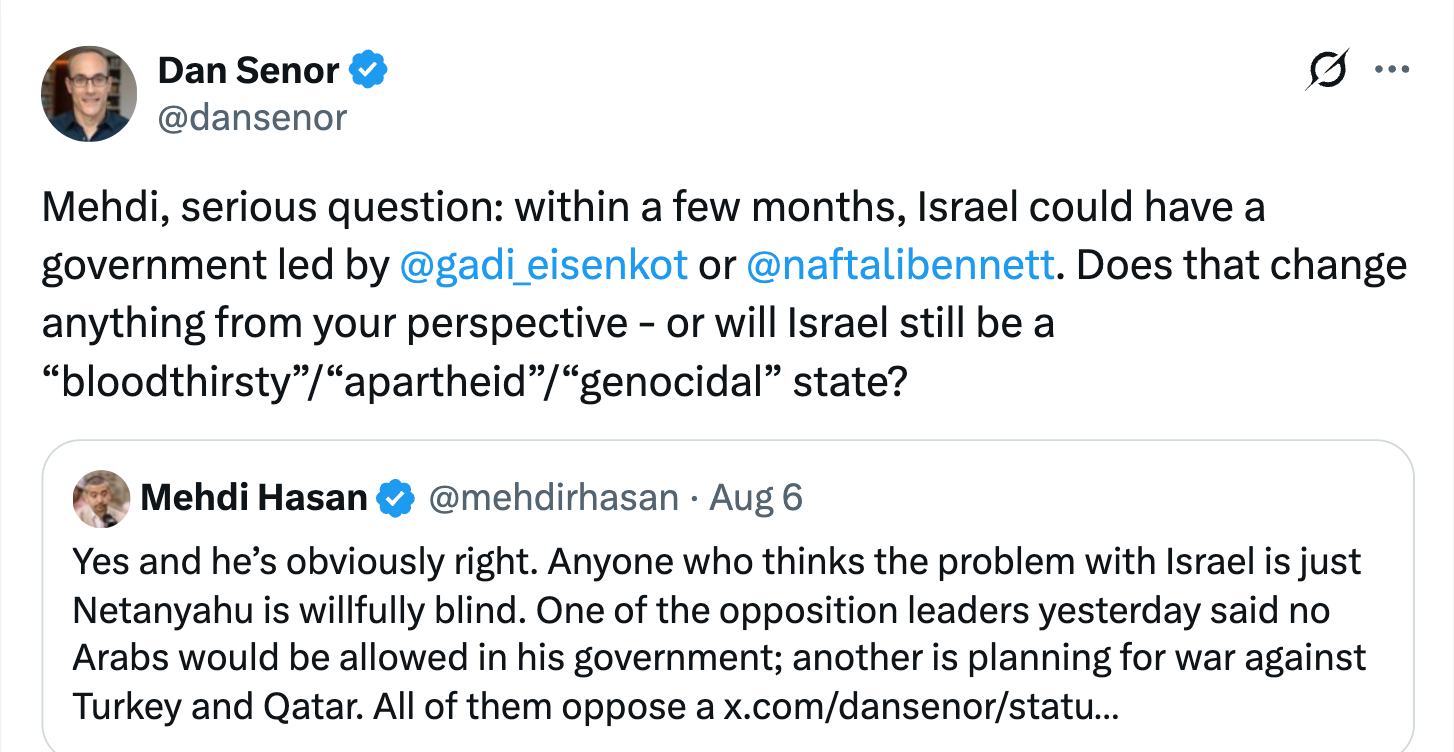
If you follow the Israel conversation on social media, you might have caught an interesting three-way debate last week. In a series of exchanges on X, American Jewish commentator and Call Me Back host Dan Senor, Haaretz Opinion Editor Amir Tibon, and anti-Zionist pundit Mehdi Hasan argued a question that may prove very consequential when Israelis vote for a new Knesset in two months’ time: How much of the popular American hostility toward Israel can be pinned on Benjamin Netanyahu?
Senor, whose podcast I highly recommend, kicked things off by posing a fair question to Hasan. Gadi Eisenkot or Naftali Bennett could soon replace Benjamin Netanyahu as Israel’s prime minister. Would that change anything about Hasan’s perspective on Israel?
“Would Israel,” Senor asked, “still be a ‘bloodthirsty’ / ‘apartheid’ / ‘genocidal’ state?”
Mehdi Hasan’s answer was that nothing would change. His problem was never just Netanyahu.
Here, Amir Tibon stepped in. According to Tibon, Mehdi was the wrong person to ask. Sixty percent of Americans view Israel negatively now, up from around 30% a few years ago. Mehdi Hasan was always in the original 30% who are fundamentally opposed to the Jewish state. It’s the newer 30% who piled on after October 7 that matter most.

Tibon is right, but I’ve watched a lot of smart people spend the past week trying to explain why he isn’t.
Amir Tibon’s argument is about the numbers, not optimism. If America’s anti-Israel population doubled in the past couple of years, half of those who dislike Israel today are recent arrivals. Whatever activated them is not the same deeply held anti-Zionist ideology that animates someone like Mehdi Hasan. They did not oppose Israel before Smotrich and Ben Gvir became influential in Israeli policy.
Senor pushed back against Tibon by arguing that the Progressive Caucus is the new face of the Democratic Party. He quoted Jon Favreau, a former Obama speechwriter and mainstream liberal podcast host, saying, “Tell us again how Netanyahu is the only reason we should question our relationship with the State of Israel.” Senor’s reasoning is that if Jon Favreau, as cookie-cutter a Democrat as they come, now sounds like Mehdi Hasan, then perhaps Mehdi Hasan is a representative sample.
There’s another way to read Favreau. Mehdi Hasan’s position isn’t spreading; his audience is. Hasan has held this view long before October 7, and what has changed is that ministers in the Netanyahu government keep handing him material that makes it seem as though his anti-Zionist worldview is moderate and even reasonable. Bezalel Smotrich told the Yesha Council that Israel could halve Gaza’s population in two years through voluntary migration, and floated the same approach for the West Bank. Minister Amichai Eliyahu floated dropping a nuclear bomb on Gaza; Smotrich also said starving two million people would be justified. If that is what Zionism is interpreted as in the progressive left, then of course people will be open to Mehdi Hasan’s views. Extremists like Ben Gvir, Smotrich, and co. do more for Mehdi’s reach in one evening than Mehdi does in a month. A new prime minister won’t convert Mehdi himself. Nothing will, and that isn’t how you prove him wrong. What it takes away is the supply.
Tibon’s math holds. There’s public opinion data to back him up. According to Gallup, from the collapse of the Camp David talks in 2000 to the terror of the Second Intifada and Prime Minister Ehud Olmert’s two-state offer near the end of the aughts, a majority of Americans sympathized more with Israel than with the Palestinians. Israel even retained its support in the first decade after Netanyahu returned to office in 2009.
But the ground began to shift in 2019, when Bibi first campaigned on annexing the Jordan Valley—the eastern chunk of the West Bank—while the Trump Plan turned the idea of a Palestinian state into a cartographic joke. Israel no longer looked like it was interested in compromise, regardless of whether the Palestinians said “yes” or “no” to a deal. This was the foundation for many Americans’ impressions of Israel going into the October 7 attacks and the Gaza War.
All of this to say: much of the break with Israel is a recent, rapid phenomenon.
Amir Tibon asserted that a new Israeli government is “our best shot” at recapturing the 30% of Americans who turned their backs on Israel. I agree, but we should also be realistic. Since the shift coincided with Israel’s formal abandonment of the two-state solution, it’s worth noting that Gadi Eisenkot has said he does not support two states at the moment, and Naftali Bennett is a longtime proponent of Israel annexing Area C, 60% of the West Bank.
Yet there is reason to be positive. Yoav Segalovitz, a former Yesh Atid MK and former deputy public security minister, is in advanced talks to join Ra’am, making it likelier that Arab citizens will be represented in the next government. He has said he will not join a party that does not recognize Israel as a Jewish and democratic state. Eisenkot is not an ideologue. He warned as early as 2020 that Israel was drifting toward a one-state reality and called for separation from the Palestinians through a gradual, supervised process with permanent Israeli security responsibility. Bennett has moderated in recent years. Their hardline rhetoric is viewed as a campaign-season necessity: fighting for the former Netanyahu voters contemplating whether to change sides.
That positioning may be tactical, but Americans don’t grade on Israeli electoral context, and the same line that may win swing votes in Israel will still get quoted in the American press. It also isn’t just positioning. The Israeli electorate remains deeply traumatized by October 7, and that is the part Favreau doesn’t grasp. Israelis withdrew from Gaza, understood it as a gesture toward peace, and got October 7. Proposing the same thing in the West Bank is not a winning slogan here, no matter what it sounds like from the other side of the ocean.
On October 7, Amir Tibon and his family hid in a safe room in Nahal Oz while Hamas gunmen moved through their kibbutz. His parents drove down from Tel Aviv to reach them, his father Noam, a retired major general armed with a private pistol. Tibon wrote about this experience in The Gates of Gaza, which won the Sami Rohr Prize. He still believes that a new government is our best chance.
Someone like Mehdi Hasan will interpret any result from the October 27 elections to fit his long-held anti-Israel views. That was always going to be true.
The question is whether the next government keeps handing him material. A prime minister who confronts settler violence and unlimited settlement expansion, who says out loud that the goal is for the Palestinians to one day govern themselves, is already doing something Netanyahu and his extremist ministers won’t. And a coalition without them cuts off Mehdi’s supply.
Notes from Tel Aviv, my weekly dispatch for paid subscribers, goes out Thursdays. The most recent one is about naming our newborn son.

Eli, I think you’ve identified the distinction that matters. The goal isn’t to persuade Mehdi Hasan. It’s to make Mehdi Hasan less persuasive to everyone else.
I’d add only this: removing Ben-Gvir and Smotrich cuts off an enormous supply of ammunition, but it won’t by itself recover the Americans Israel has lost. Some of that newer 30% are reacting not to anti-Zionist ideology but to what they have seen in Gaza and the West Bank. A new government will need to offer something affirmative as well: confront settler violence, restrain settlement expansion, and make clear that Jewish self-determination and Palestinian political dignity are not mutually exclusive.
That may never change Mehdi Hasan’s mind. But as you say, he was never the audience.
"The Israeli electorate remains deeply traumatized by October 7, and that is the part Favreau doesn’t grasp. Israelis withdrew from Gaza, understood it as a gesture toward peace, and got October 7."
Part of the solution is demonstrating to Israelis that the Gaza withdrawal was not a gesture towards peace, but an attempt to buy time with the international community (which worked) while decreasing the costs of the occupation (which also somewhat worked).