


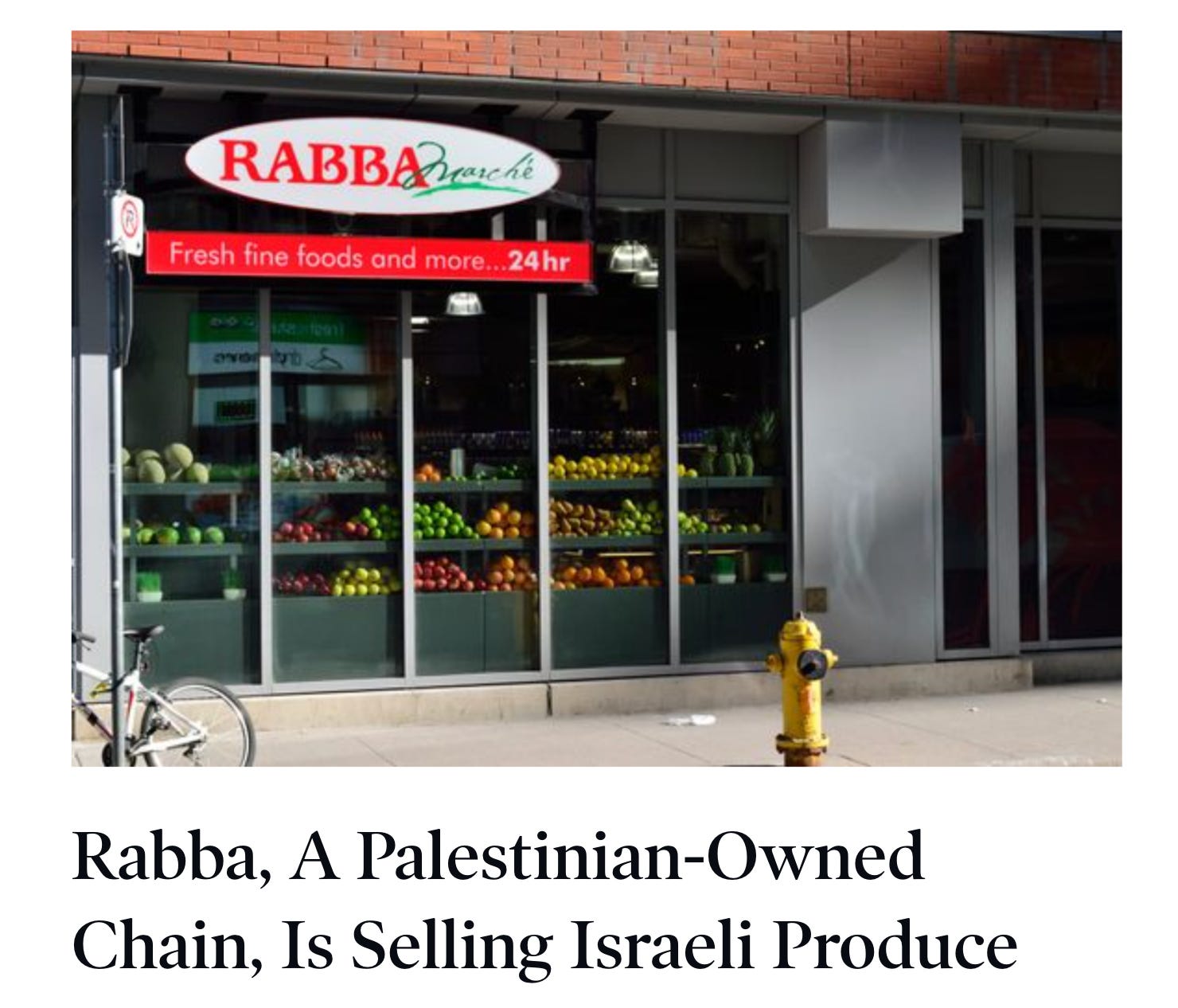
A reporter for a left-wing outlet in Toronto went hunting for Israeli produce and found it: grapefruit stamped Product of Israel, stacked on the shelves of a local Palestinian-owned grocery chain. He filed it as a scoop. A grown man spent an afternoon catching a Palestinian grocer selling the wrong fruit, then wrote it up like a win for Palestine.
It is the latest, and surely not the last, absurd stop of a boycott that began with a massive factory of 1,300 workers and worked its way down, over a decade, to a single jar of tahini and a lone citrus fruit.
When I read about that policed grapefruit, it wasn’t the produce aisle I pictured. I thought about my Savta’s kitchen counter.
My Savta kept a row of funny bottles on her kitchen counter. Squat, ridged plastic with a screw-on cap, the kind of object that looked like it had wandered in from a laboratory. Savta Aliza was Iraqi, from a family that left Baghdad and Basra with what they could carry.
They moved to Israel in 1951, but the phone stayed rotary well into the 2000s. She said letalfen, the older word for making a call, never lehitkasher. The remote was still wrapped in plastic. What I could never work out was how this woman, allergic to anything with a plug, had mastered the one futuristic act I ever witnessed in her home: turning ordinary tap water into soda.
To a six-year-old it was sorcery. You filled the bottle, twisted it into the machine, pressed down, and the whole thing hissed and fizzed like she’d caught a small storm and put it to work. I drank an indefensible quantity of her soda. Sometimes she added petel, before SodaStream came out with the fancy syrups. I love soda to this day, and I’ve decided she gets the credit.
The machine was a SodaStream, not that I knew the name or would have cared. In Israel, it wasn’t a brand so much as furniture. Half the country had one. It sat in kitchens like hers for decades, as Israeli and as dull as the rotary phone beside it, years before anyone abroad had an opinion about it.
Then it caught on in North America, with Super Bowl ads and Scarlett Johansson as its face. The endorsement cost her a long-held Oxfam ambassadorship in 2014, after the charity objected to trade from the settlements and she picked SodaStream over the post.
The main factory sat in Mishor Adumim, an industrial zone past the Green Line, which made it the boycott movement’s favorite target. For years, activists worked to get the little machines pulled from shelves around the world, and it worked. The company announced it would move production inside Israel, to the Negev, and the boycott took the win.
Here is the part that didn’t make the flyers. The Mishor Adumim plant employed about 1,300 people: a few hundred Israeli Jews, a few hundred Israeli Arabs, and roughly 500 Palestinians from the West Bank, all on the same pay for the same work, by the account of the company and the workers both. When the plant moved, most of those Palestinians couldn’t get the permits to follow their jobs across the Green Line. About 500 were let go. One of them, a line worker who’d been earning around fifteen hundred dollars a month, ended up selling vegetables off a cart for a quarter of that.
A boycott organizer in Ramallah called the lost jobs part of the price worth paying to end the occupation, which is at least honest about the arithmetic. The other half of the honesty: those last workers lost their jobs because Netanyahu’s government wouldn’t grant them permits, partly, the company’s CEO said, so it could pin the whole thing on the boycott. Caught between the two were 500 people who only wanted to keep a job.
I thought about my Savta’s funny bottles again last month, when the Park Slope Food Coop in Brooklyn finally voted to boycott Israeli products, after fifteen years of trying. They lowered the bar to pass it first, from a three-quarters supermajority to a simple majority, then passed it easily. The Coop carries, by its own count, only a handful of Israeli items. One of them is Al Arz Tahini, made in Nazareth by an Arab-founded company so progressive that conservative Arabs boycotted it once already, in 2020, for funding a hotline for gay Arab teenagers. A Palestinian product, swept off a Brooklyn shelf in solidarity with Palestinians.
None of this means a boycott can’t be aimed honestly. There are honest targets. Chalav Ha’aretz, “Milk of the Land,” is a goat dairy with soft hipster labels that runs out of Susya, a settlement in the South Hebron Hills where settlers have spent years driving Palestinian shepherds off their land while the army watches. The people pushing hardest to boycott it are a group of Israeli mothers who went down there and saw what the yogurt sits on top of. That is a boycott of the occupation.
It is also nobody’s headline. The campaigns that made the news went the other way. They pulled tahini founded by an Arab family from Nazareth, well inside the pre-1967 lines. They chased a Palestinian grocer’s grapefruit in Toronto. They hollowed out a factory full of the Palestinians they meant to protect. The occupation had nothing to do with any of it. Each was simply Israeli, or close enough that the boycott couldn’t tell, and close enough was usually a Palestinian.
That isn’t an accident, and Omar Barghouti, who founded the movement, will say so himself if you let him. Officially, BDS takes no position on how the conflict ends and targets nobody for being Jewish or Israeli. Unofficially, Barghouti has spent years saying he opposes a Jewish state in any part of the land, that a full right of return would end Israel as a Jewish state, and that what he wants is not two states but, in his words, a Palestine next to a Palestine. The movement keeps that conclusion off its brochure. The man who wrote the brochure says it out loud. You don’t need to take a Zionist’s word for it: Norman Finkelstein, who has spent his career attacking Israel, called the movement a cult and said its demands, taken together, leave “no Israel.”
Read him that way and the lost jobs, the pulled tahini, the policed grapefruit stop looking like the misfires of a movement that means well. They look like the thing working as designed. It was built to come for the country, whatever the people voting for it in Brooklyn think they are voting for.
The boycott began by emptying a factory of 500 Palestinians. A decade later its target is a jar of tahini and a grocer’s single grapefruit. The aim behind it hasn’t shrunk at all. Barghouti has said for years that the point was the end of the Jewish state, and a movement with that aim does not pause over the Palestinian who happens to be holding the jar. My grandmother turned tap water into soda and thought she was making her grandson a drink. That is all she was doing.
Thirty years later, people who’d never met her looked at the same machine and saw an occupation to defeat. The same conviction, in a room in Brooklyn, reached past every minister and general and soldier in Israel to pull a tahini off the shelf that an Arab family in Nazareth had made.
They believed they were helping. The Palestinians they kept hurting had been telling them so all along. The movement had decided long ago it could live with that.
The price has no floor. There will be a next jar and a next grocer. It hurts my soul to think where we might be if a fraction of that effort had gone toward helping Palestinians build their own future and working with Israelis toward a real peace, instead of being spent against them. A cause you cannot advance without harming Palestinians is not theirs, no matter how loudly it claims them.
Even when I am sympathetic to their goals (for example I think the actions of settlers and enablers in IDF & government are awful), I find most of the pro-Palestinian movement repellent because their actions disregard the impact they have on Palestinians in Gaza or the West Bank. You raise good examples.
The goal is not peace. As you say it’s the destruction of Israel. BDS is coming along nicely, helping Palestinians was never their intention.