


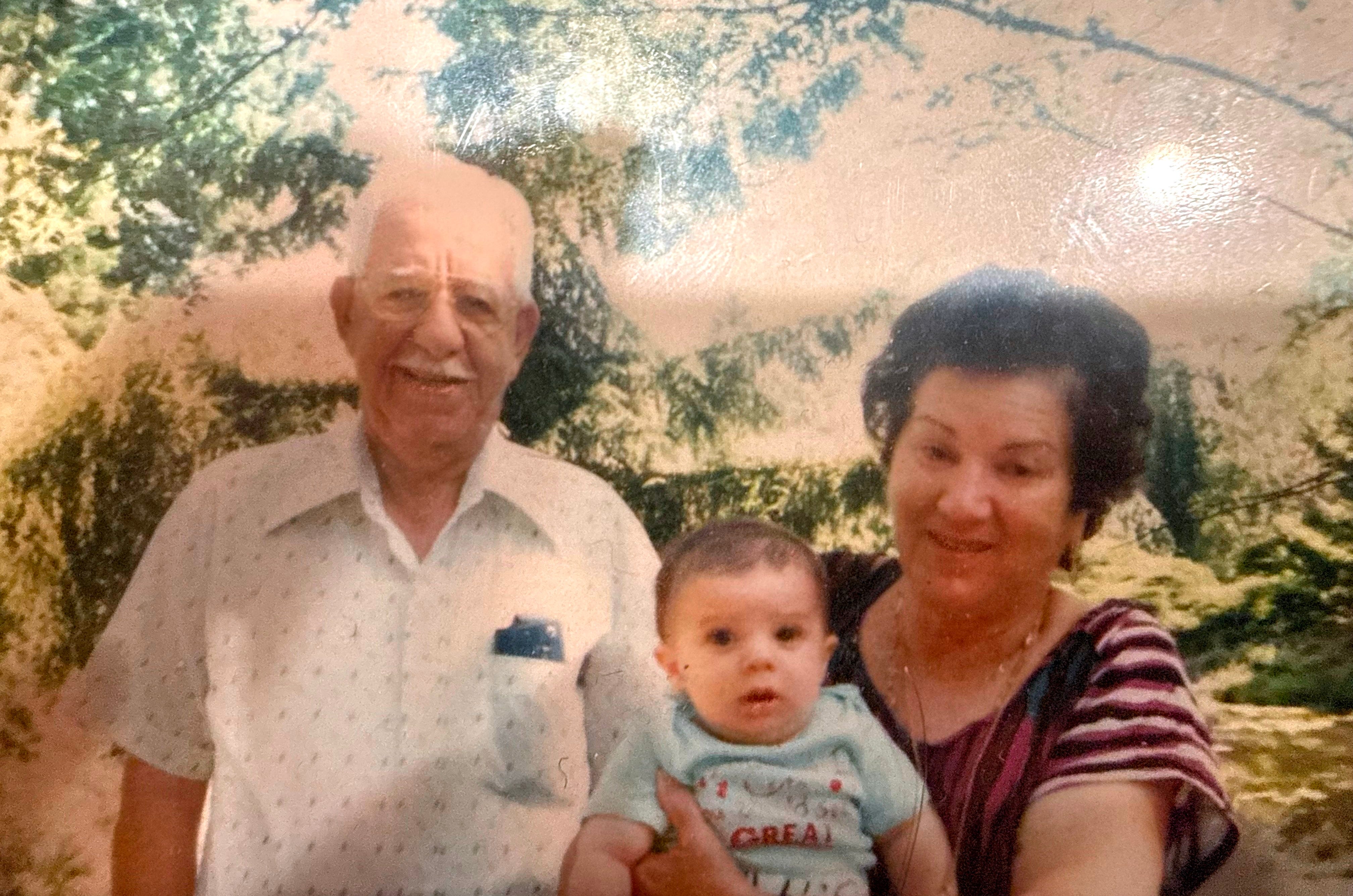
My family had been in Iraq for two thousand years before they were forced to leave. My grandparents didn’t pack — they fled. My aunt Leah remembers being dressed in seven layers of clothes. That was the extent of what they could bring. What they had built over generations in Basra and Baghdad — businesses, property, a life woven into the fabric of two great Iraqi cities — was seized. They gave Iraq everything.
Iraq expelled them anyway.

They were among 850,000 Jews driven from Arab lands between 1948 and the early 1970s. You wouldn’t know it from anything posted about Nakba Day this week.
On Thursday, New York City Mayor Zohran Mamdani marked Nakba Day from City Hall, introducing his video with a “Nakba survivor” — a term coined in activist circles to place Palestinian displacement on the same moral plane as the Holocaust, of which only a third of those targeted survived. The video featured a “Visit Palestine” tourism poster from 1936, designed by Franz Krausz — an Austrian Jewish refugee who fled antisemitism in Berlin, whose brother was murdered in a Nazi death camp, and who emigrated to British Mandate Palestine and spent his career making posters urging Jews to come home. The mayor of New York used a Zionist refugee’s art to commemorate Palestinian displacement without appearing to notice, or care, what it was.

Mayor Mamdani wasn’t alone. Ilhan Omar, Ro Khanna, and Rashida Tlaib all marked the day — Tlaib introducing H.Res.1289, a congressional resolution explicitly calling for the right of return. The official State of Palestine UN account posted a video captioned “78 years of ongoing Nakba,” featuring images it presented as Palestinians on their ancestral land. The images were of Yemenite Jews en route to Israel.
None of this is to say the Palestinian displacement didn’t happen — it did. But it happened in a context that Nakba Day’s commemoration systematically erases.
In November 1947, the United Nations proposed partitioning British Mandate Palestine into a Jewish state and an Arab state. Jewish leadership accepted. Arab states rejected it and declared war, explicitly to destroy the newly founded Jewish state before it could take root. The displacement of Palestinians happened in the course of that war.
It was not a single story. Some Palestinians fled fearing violence. Some were expelled by Israeli forces. Some were encouraged to leave by Arab leaders who promised a quick victory and a swift return. That return never came — and surrounding Arab states chose to keep Palestinians in camps rather than absorb them, preserving the refugee status as a political weapon.
850,000 Jews were driven from Arab lands in the same years. They were absorbed — by Israel, by Western countries — and rebuilt their lives. Their displacement produced no UN resolutions, no congressional recognition, no official commemoration from the politicians who marked Nakba Day this week.
Walk through a refugee camp in Bethlehem or Ramallah and you’ll see what this commemoration has become. The key is everywhere — displayed on walls, worn as jewelry, printed on posters. The actual iron key to a house in Haifa or Jaffa, passed from grandfather to grandchild, to great-grandchild, to someone born in Amman or Chicago who has never set foot in Israel. Alongside it, a map — not of a future Palestinian state in the West Bank and Gaza, but of the entire land, from the river to the sea.
This is what the right of return looks like as a lived political culture. It isn’t grief preserved privately across generations. It is grief institutionalized as a demand — that the descendants of 1948 refugees, however many generations removed, however many citizenships acquired, return not to a Palestinian state but to Israel itself. The demographic consequence of that demand, if met, would be the end of Israel as a Jewish state. No official Palestinian peace plan has ever included recognition of Israel as a Jewish state — the very character that the right of return, if implemented, would erase.
The Syrian historian Constantin Zureiq, who coined the term “Nakba” in 1948, used it to describe the Arab states’ catastrophic failure to defeat the newly founded Jewish state. The disaster, in his telling, was that Israel survived. That origin hasn’t disappeared — it lives in every map from the river to the sea, every demand for a return that would demographically undo what 1948 failed to undo militarily.
The definition itself has been transformed. Unlike any other refugee population in the world, Palestinian refugee status passes through generations indefinitely — administered by UNRWA, which uniquely extends the designation to all descendants, regardless of citizenship or country of birth. A claim that began with 700,000 people in 1948 now encompasses millions who have never seen the land they are said to be returning to.
There is something worth honoring in the preservation of memory — my family holds its own. But grief transmitted across generations is not the same as a political program designed to undo a state. When that transmission is designed to produce a specific political outcome — the dismantlement of a state rather than the establishment of one alongside it — it stops being commemoration and becomes strategy.
The Palestinian displacement was real, it was painful, and it produced suffering that echoes across generations. So did the Jewish displacement from Arab lands, the war that produced both displacements, and the rejection of a partition plan that would have given Palestinians a state in 1948 — a state they were offered and that Arab leaders refused on their behalf.
The minimum acceptable outcome cannot be the dismantlement of Israel. When it is — when the floor of the conversation is a map that erases a country rather than a plan that builds one alongside it — there is no negotiation possible.
What happened this week was not remembrance. Mamdani, Tlaib, and the State of Palestine UN account turned history into a political argument by removing the inconvenient parts: my grandparents’ expulsion, the war, the partition rejection, the Yemenite Jews removed from their own photograph.
November 30 is the official annual Day to Mark the Departure and Expulsion of Jews from the Arab Countries and Iran. It will be marked only in Israel and the Jewish diaspora. Most of the world will be silent. Mamdani, Omar, Tlaib, and Ro Khanna will say nothing — they never do.
My aunt Leah still remembers those seven layers of clothes. That memory belongs in this conversation. So does everything else that was left out.
I’m not sure if any of this belongs in the conversation. These things happened so long ago! It would be much better for Palestinians to adopt the Mizrahi attitude of just moving on than vice versa.
Likewise I cringe when I hear about Jews who still won’t buy a German car. It’s 2026, not 1946. Get a grip. The Holocaust is an important piece of history and we should learn about it, but it’s history.
I’m not much of a fan of historical victim narratives when done by anyone. They suck. Perhaps you can pay reparations but the point is that once you pay the reparations it should be a done deal and we should all move on with our lives.
I'm waiting for those same politicians to advocate for the right of return for all indigenous tribes who were forcefully removed from their lands or betrayed by treaties that were not kept. "Land acknowledgements " don't cut it. Add to that parts of the US that were once Mexico. Not holding my breath.