


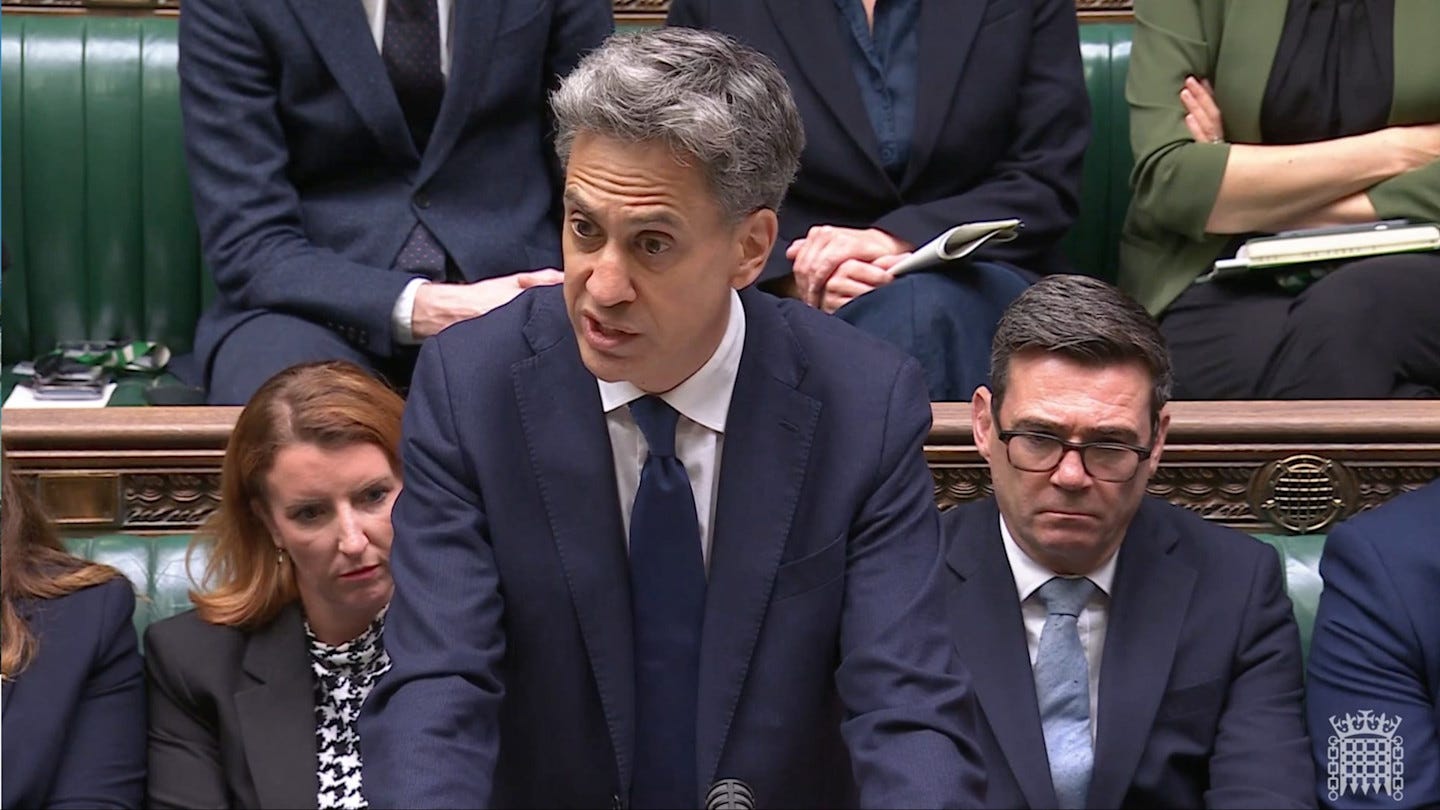
We live in interesting times. Things that once belonged to the realm of science fiction are here. And no, I’m not talking about AI and self-driving cars; I’m talking about the Israeli government and the BDS movement in agreement. Both think that boycotting wine from Psagot in the West Bank is the same as boycotting Tel Aviv. One side calls that antisemitism and the other calls it a good start, but not nearly enough.
British Foreign Secretary Ed Miliband, who announced a ban on settlement goods in the Commons on Tuesday, thinks they’re both wrong. That makes him a Zionist, whether or not he’ll use the word to describe himself, and both sides are going to have to deal with it.
Miliband is Jewish and a member of the Labour Party. I remember when he was the next big thing in British politics, before he disappointed greatly in the 2015 general election.
Ed’s older brother, David, also served as foreign secretary. I always preferred how David spoke about Israel. When the Gaza war started in December 2008, David, then foreign secretary, opened his statement with the rockets being fired at Israel. Two years later, in his first conference speech as Labour leader, Ed called for lifting the Gaza blockade without mentioning the rockets at all.
Ed seemed to be pandering to the left flank of Labour, the same left that made Jeremy Corbyn leader after Ed’s resignation as party leader. Under Corbyn, antisemitism in Labour got so bad that the UK's equality watchdog found the party had broken the law. During a 2013 Q&A with a British Jewish audience, Ed Miliband was asked if he was a Zionist. “Yes,” he answered, before adding that it “doesn’t mean I support everything Israel’s government does.”
Miliband’s office walked back the statement the next day, and he’s avoided the Z-word since.
The Zionist label has been hijacked, made toxic, used by critics of Israel in an attempt to paint the entire country as ethno-supremacist colonizers.
So Miliband’s announcement on settlements this past week was a pleasant surprise. It wasn’t pandering, and it didn’t avoid the justice and legitimacy of the Jewish state’s existence.
Of course, the loudest critics didn’t bother to watch Miliband’s full speech in the House of Commons. It is easier to post a picture of him eating a bacon sandwich, as pro-Israel advocate Eylon Levy did. Perhaps Levy has forgotten that David Ben-Gurion admitted to eating a ham sandwich, and Theodor Herzl had a Christmas tree.
Miliband spent the first part of his speech on the settlement-product ban thanking Israel for sheltering his grandmother after the Nazis murdered his grandfather and sixty other relatives. He declared that anyone who denies Israel’s right to exist as the Jewish homeland is wrong and highlighted their eliminationist motivations. He sanctioned Hezbollah’s financing arm, reimposed sanctions on Iran, rejected BDS, and left trade with Israel inside the Green Line untouched.
The Israeli government naturally rejected Miliband’s move out of hand. Israel’s case depends on the Smotrich-led West Bank policy being an integral part of Zionism. When Smotrich approved E1, he called it “Zionism at its best – building, settling and strengthening our sovereignty in the Land of Israel.” Any measure taken against this policy is one directed against Zionism and the Jewish people. US Ambassador to Israel Mike Huckabee did the same thing when he accused Britain of Jew-hatred days before the ban, and then called the ban itself discrimination against Jews.
Interestingly, the BDS movement also depends on this definition of Zionism; if the Smotrich-led West Bank policy is Zionism, then Zionism is an illegitimate settler-colonial movement that must be defeated as a whole.
Miliband is making things harder for both the Israeli government and the BDS movement. He is saying that there is a difference between Israel within the Green Line and the settlements on the other side; he is accepting Israel’s right to exist as a Jewish state. Miliband’s speech rejects their definition and that is exactly why neither can afford to let him count as a Zionist. Only a few fringe radicals have noticed Miliband’s Zionist bona fides (Ali Abunimah at Electronic Intifada has already attacked the foreign secretary’s speech as fake support for Palestine).
Israel’s response showed how much the government will give up to defend its narrow definition of Zionism and made clear we are in the heart of election season. Within hours, it announced it would close the British consulate in Jerusalem and expel the British Support Team in Ramallah, the UK’s contingent in the American-led mission that has trained Palestinian security forces since 2005. The IDF has long called security coordination with the PA one of the few things keeping the West Bank from collapse. Britain wasn’t acting alone: eleven other countries, including France and Canada, announced restrictions on settlement trade the same day, but Israel aimed its retaliation at London.
Netanyahu Has No Path to 61

My 15-minute recap on where the Israeli election stands seven weeks out.
Surprisingly, Huckabee’s boss in Washington hasn’t signed on to the Israeli government’s meltdown. Asked about the ban, Trump said he had just seen it and would speak to Israel to find out their thinking. A Western official says Trump was told about it in advance and didn’t ask Britain to wait. Marco Rubio declined to condemn it. If the ban is discrimination against Jews, the president Netanyahu calls Israel’s greatest friend has so far declined to say so.
Many Israelis make Miliband’s argument. E1 and the rapid settlement expansion in the West Bank are designed to make a Palestinian state impossible (Smotrich, who directs much of Israel’s West Bank policy, has said as much). Without a path to two states, Israel has no route to lasting security. Prime Ministers Yitzhak Rabin and Ehud Olmert both made that argument. When Miliband said Palestinians were being ethnically cleansed from parts of the West Bank, he quoted Olmert and Ephraim Sneh, a retired IDF general.
We can debate the effectiveness of Britain’s new approach as a matter of policy. I have serious questions as to whether such sanctions will actually push Israel toward two states.
I have critiques about the design of the British ban. It covers every settlement, so Modi’in Illit, a Haredi city just over the Green Line that the Geneva Initiative and Olmert’s 2008 map both left inside Israel, lands in the same category as Avigayil, an outpost in the South Hebron Hills. Even Mahmoud Abbas’s 2008 counteroffer left Modi’in Illit inside Israel. Just as the Israeli government and BDS erase the distinction between Israel and the West Bank, the settler movement deliberately erases the distinction between these major settlements along the border and outposts deep in the territories. A policy built on rejecting the settlers’ definition of Zionism shouldn’t adopt their map. The timing didn’t help either: Seven weeks before an election, Britain handed Netanyahu a foreign distraction on the day Haaretz reported that the prime minister had been warned before October 7, a report his office denies.
The timing also pushes Israel’s opposition leaders to play by Netanyahu’s rules and condemn the ban, as Yair Lapid did on Tuesday. Meanwhile, the phrasing could have been sharper. Instead of hammering repeated mentions of a two-state solution when support among the Israeli public is at an all-time low, the framing could have focused on the dangers of West Bank annexation and what that means for Israel. That is an argument that would resonate more with the Israeli public, and it would deflate the Netanyahu government’s argument that foreign governments are trying to reward the Palestinians for October 7 by granting them a state.
A British official said this week that the scope of the sanctions could depend on how the next Israeli government behaves. Whoever forms a coalition after October 27 will be dealing with a foreign secretary who believes in Israel and thinks the settlements are destroying it, which is what I think too. Keeping a two-state window open is essential, even if a negotiated solution is not immediately in the offing. Ultimately Israel will need to choose between two of three things: its Jewish character, its democracy, and its control of all the land. It needs to give up on one.
Shana Tova! Thank you for all of your support in 5786. Your generosity has allowed me to push out more content and even hire, yes, a real, human editor. To celebrate the new year, I’d like to offer 36% off paid subscriptions, now through the end of September. Paid subscribers get access to Notes From Tel Aviv, my weekly series of personal dispatches from Israel. I’m excited to see what we can do at The Middle Ground in 5787.
— Eli
To be generous Miliband is the sort of Zionist that existed around Oslo and his worldview has been shown to be more of an anachronism by the day. This was true even before October 7. The top-line for people like him is that only Israel has agency and therefore only Israel needs to make the necessary changes whilst the enlightened Europeans look on with an appropriate selection of carrots and sticks to persuade the two parties to sign a final agreement. This is pure fantasy.
UK domestic politics provides the backdrop to much of this; the rise of the greens, the increasing sectarian nature of politics and the genuine fear of inflaming "community tensions". Thus, policing has a very colonial feel to it. I could point out that the previous PM (driven by an activist Attorney General (jewish naturally) acted according to the ICC and threatened to arrest Bibi. That certainly constitutes antipathy towards Israel. We could throw in the football debacle too.
Underpinning all of this is the assumption that trade and security co-operation will continue as usual. That is a big assumption.
Anyway Happy New Year!
It's more the colonial mindset and the bullying for domestic use that infuriates one.