What NAZA Could Have Been
Kan’s investigation into the “Mosquito Protocol” did what NAZA wouldn’t, and some of Israel’s leaders tried to bury it anyway.

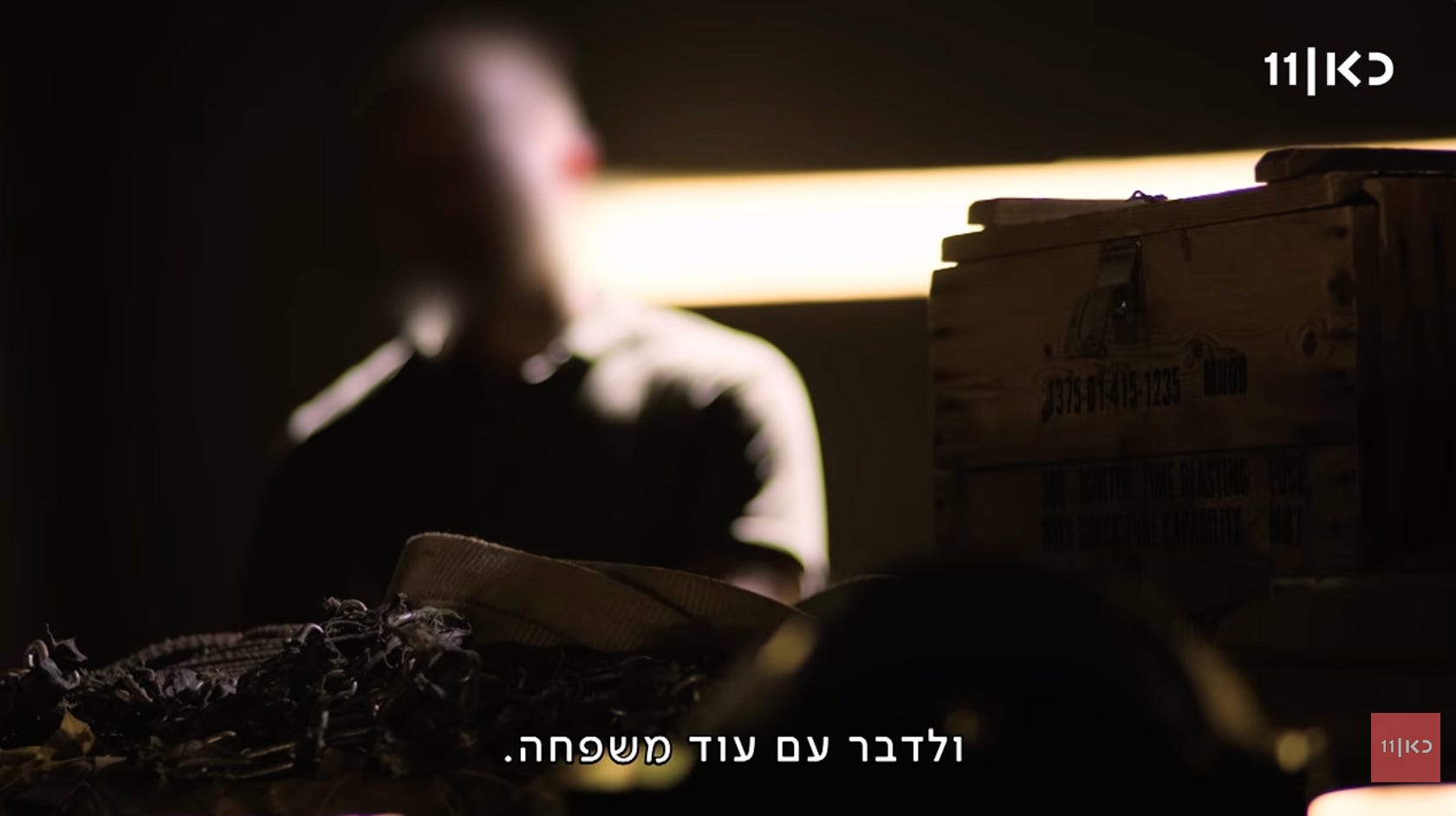
When NAZA was released, I wrote at length about what I thought it missed and why it would only make Israelis double down and give real detractors of Israel ammunition. On Wednesday, I watched “The Protocol,” Kan 11’s Zman Emet investigation into the “Mosquito Protocol,” about Palestinian detainees and civilians being sent into buildings so they’d hit terrorists’ booby traps first.
It was produced with the highest standards of journalistic integrity and presented to Israelis. It asks us to look in the mirror: even in a war against a vile terrorist organization, we should still ask questions, even if we don’t have answers. It is exactly what NAZA missed.
That didn’t stop Netanyahu’s allies, and even some of his opponents, from trying to stop it. The channel that aired it, Kan, is Israel's public broadcaster, and the Netanyahu government spent years trying to privatize or shut it down. Activists petitioned the High Court and protested outside Kan. The show aired anyway. You’ll remember NAZA’s 25-minute ovation in Venice and the threats to revoke the filmmakers’ citizenship. The debate that followed was not about the content of the film but about what it meant.
I first heard about this story in 2024 and, at the time, refused to believe it. It was first reported by Haaretz in August 2024, and CNN named the “Mosquito Protocol” later that year. This week, Haaretz revealed that the IDF had opened at least 16 criminal probes through 2025, and no one has been indicted. The High Court banned the “neighbor procedure” in 2005. That was an IDF policy during the Second Intifada in which Palestinian civilians were made to approach buildings or knock on doors ahead of military operations or arrests.
When I talk to friends who served in Gaza, they tell me about the terrible realities and decisions they had to face. I know they weren’t killing Palestinians for fun, as some of Israel’s critics claim. They were sent into areas the IDF had ordered evacuated, so they treated anyone they found there as a possible threat. Hamas kept that line blurry on purpose, with its fighters dressed as civilians, fighting out of homes and holding hostages in apartments. At the start of the war, Hamas told Gazans to ignore the evacuation orders and blocked some who tried to leave.
Some of the people they found in those areas were Hamas terrorists. Many were civilians who couldn’t leave, or wouldn’t. Trying to differentiate between civilians and terrorists, in a building that might be rigged to explode at any moment, is exactly the kind of decision soldiers shouldn’t be left to make alone. But none of that justifies sending any of them in first. Using Palestinians as human shields is illegal and wrong, and using people who weren’t even suspected of anything makes it worse.
I have said many things about NAZA, and I wrote about it here. And yet, the film used real testimony and raised legitimate questions, and the Israeli government’s response was embarrassing and shameful.
But there was plenty to challenge on the film’s merits. Collateral damage estimates, in Hebrew nezek agavi (NAZA), are standard NATO practice, and most Western militaries use them. They determine who signs off on a strike, not a kill quota, as the movie implies. One of the film’s directors, Yuval Abraham, told reporters in Venice the killing was “systematic, not by mistake but by planning.” The testimony doesn’t show that. Israeli journalist Raviv Drucker noted it offers no date, no place and not one case that can be checked. The army wasn’t even asked for comment.
After seeing NAZA, the larger problem, in my view, is what it does with its material. As Tomer Persico also pointed out, NAZA intercuts the testimony with Tel Aviv nightlife, and near the end cuts from the train to Treblinka in Claude Lanzmann’s Shoah to a train in Tel Aviv. Next to that cut, even the title starts to sound like “Nazi.” There is something about Western nightlife set against Palestinians being killed like it’s a video game that appeals to an Israel-hating audience and its oppressor-versus-oppressed story. It also fits what people want to hear about Israel, especially the Israel of Netanyahu, Ben Gvir and Smotrich. And still, there is a real difference between saying Israel committed crimes and saying Israel is criminal. Kan did the first. NAZA did the second.
Chen Liberman made the film NAZA could have been, but for her it wasn’t meant to delegitimize Israel abroad or provide its critics with more ammunition. I don’t speak for her, but in my view her goal was the opposite. The film explores one specific practice in great detail; it is clearly laid out and based on testimony from the soldiers who carried it out. Young Palestinians were forced ahead of the troops, then held between searches, sometimes for days, so they’d be ready for the next one. Many of the soldiers knew it was wrong, yet in some units it became routine. The military censor reviewed the investigation and cut parts, and the High Court refused to stop it.
As Liberman put it, the IDF soldiers who were in Gaza have the right to tell what happened, and the public that sent them there has the right to know. A soldier sent into a tunnel with a Palestinian civilian in front of him, with no written order, is the one exposed if this ever reaches a court. Asking IDF soldiers to act against their conscience carries its own cost, and the moral damage is not something we can ignore. Israel’s PTSD cases have skyrocketed since the war.
But none of that mattered to the politicians. Defense Minister Israel Katz said the broadcast would “damage the good name” of our soldiers and expose them to legal risk abroad. Even Avigdor Liberman, who chairs the Knesset’s Foreign Affairs and Defense Committee, called it collaboration with the enemy. According to Haaretz, neither had seen more than the teaser! Surprise, surprise.
Katz, Israel’s outgoing defense minister, has it backward. A credible, independent Israeli investigation is the best protection our soldiers have against the ICC and foreign courts, which is exactly what Israel’s own legal advisers told Netanyahu in 2024. It was advice Netanyahu, of course, ignored. The people afraid of these investigations aren’t the soldiers.
The sad truth is that most Israelis didn’t watch. The documentary drew just a 3.9 rating. That is telling. The public doesn’t want to look in the mirror, and it has been trained for three years not to. Since the Hamas massacre, what Israelis saw from Gaza was hostage videos, soldiers’ funerals and October 7 testimony. As Drucker admitted, Israeli media reported very little on the suffering, hunger or destruction in Gaza. That’s why so many Israelis couldn’t understand how the world turned against us. Some of it was hostility and antisemitism. But much of it was a reaction to images Israelis never saw. This time, Israelis were shown a piece of it by their own journalists, in Hebrew.
This matters today because Israel is at a crossroads. Netanyahu and his allies are waging a campaign delegitimizing Israel’s Arab citizens and labeling them the enemy. But even Liberman, likely to be the next defense minister, tried to block the investigation and refuses to bring Arab parties into the government. The next government will have to decide whether it engages with investigations like this or attacks the people who make them. I am hopeful that we will see a change here, at least from parts of the coalition, should an Eisenkot-led government be formed.
Make no mistake, Israel was forced into this war against an enemy with no rules, and our soldiers carried its weight. Israelis have a right to know what was done in their name, and soldiers have a right to commanders who give clear orders and answer for them. Watch it before you decide what you think. (Readers outside Israel may need a VPN.)
Keep making apologia for the narcissistic grifters of the Antizionist mob.