


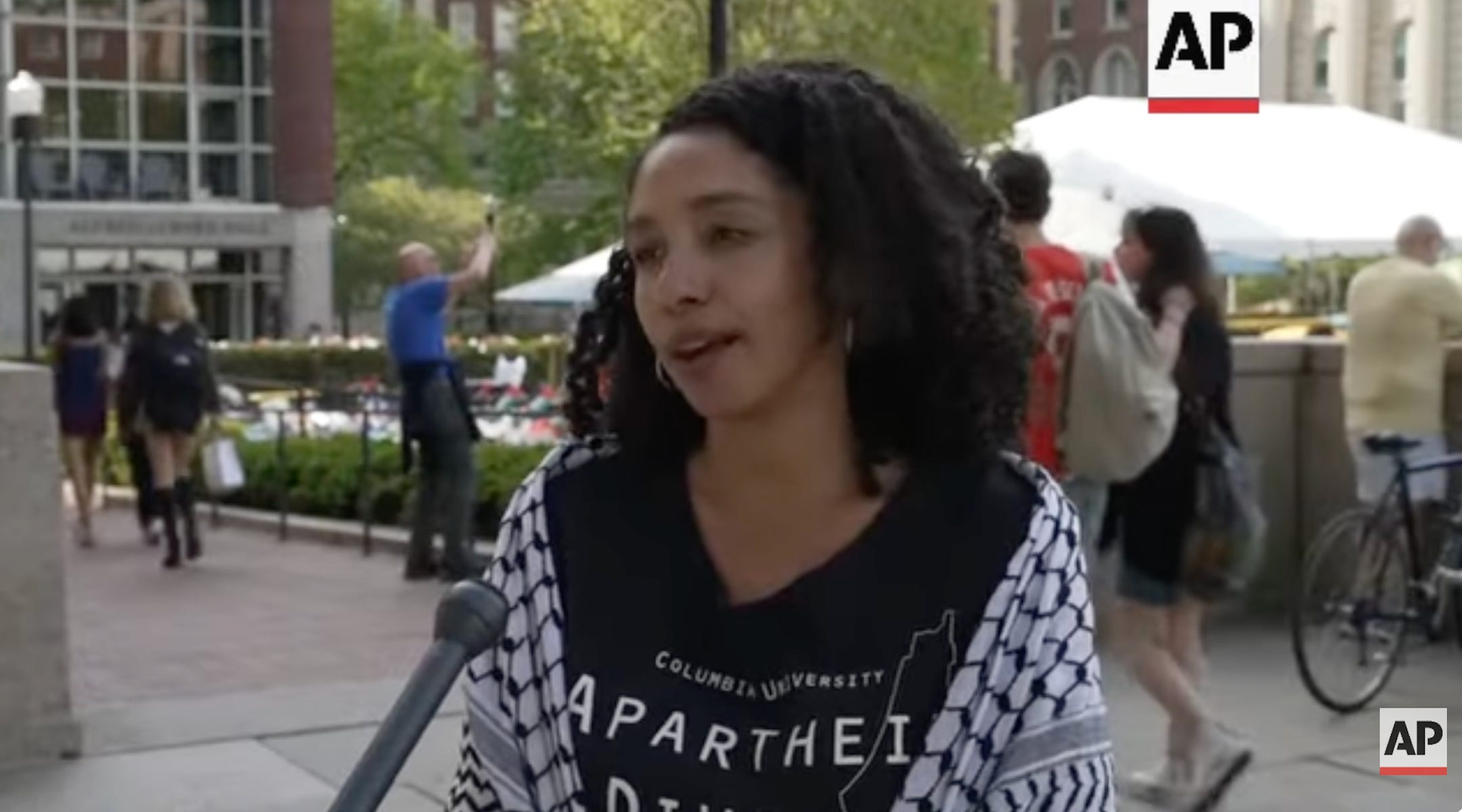
On October 8, 2023, the day after the largest massacre of Jews since the Holocaust, Avila Chevalier stood in Times Square at a rally where signs read "Resistance is Justified when People are Occupied," photographed beside one that said, “Zionism is genocide.” Brad Lander condemned the rally at the time; Mamdani skipped the rally, but twelve days later, he was onstage at a DSA ceasefire rally calling the war a genocide. On Tuesday, with Mamdani’s endorsement, she retired Adriano Espaillat — a five-term incumbent and chair of the Congressional Hispanic Caucus — in the Democratic primary for New York’s 13th.
She didn’t do it alone, and that is key. Avila Chevalier was one seat in a slate. Mamdani spent the capital of his mayoral win on a row of House endorsements, and the machine swept the safe-blue city. Claire Valdez, a democratic socialist, took the open Brooklyn-and-Queens seat Nydia Velázquez is vacating, over the successor Velázquez wanted. In Lower Manhattan and Brooklyn, Brad Lander buried Dan Goldman by more than thirty points. Mamdani had privately promised Espaillat his backing, then reneged and went with the challenger, and that small betrayal is the shape of the whole night. The coalition that used to make room for an Espaillat or a Goldman spent the evening clearing them out. This is one city on one night. But it’s what the shift looks like once it has somewhere to land — and New York got there first because it had both the density and the machine to convert it.
The Lander-Goldman race is the one that should worry those who share my concerns, and I wrote it up here last week, before a vote was cast.

My case then was that Dan Goldman was the only sincere Zionist in the race. Goldman is a liberal Zionist of the critical kind — he co-led letters calling for sanctions on violent West Bank settlers, was an early backer of humanitarian pauses in Gaza, and opposed the war in Iran — but he believes plainly in a Jewish state and won’t call the war a genocide or the occupation apartheid. Lander claims the label too, and I argued that his is a Zionism hollowed from the inside: a card-carrying membership in IfNotNow, which files Zionism next to apartheid on its list of things to grapple with; an alliance with the most prominent anti-Zionist politician in the country; a son blessed at his brit milah as “a Jew without the Right of Return.” On the campaign trail, Lander used the words genocide and apartheid and ran on cutting military aid. Goldman wouldn’t, and Goldman lost by thirty points.
This is the seam I described after Chris Van Hollen’s op-ed last month, now with the votes counted.

The Zionist who kept the substance and refused the vocabulary is out. The one who kept the label and let the substance go is in. At the far end of the same spectrum sits Avila Chevalier, who kept neither — not a Zionist of any kind, but the activist the vocabulary actually describes. She came up through Students for Justice in Palestine as a Columbia undergrad and came back as an alumna to help organize the 2024 encampment; in 2020, from an account she later deleted, she reposted a tweet that answered a prompt about Israel disappearing with “Trick question — Israel doesn’t exist.” She never said she celebrates October 7 — but the day after the largest massacre of Jews since the Holocaust, she stood in Times Square with people calling the slaughter justified resistance. Pressed in the debate, she said she’d gone anticipating Israel’s retaliation. What isn’t in dispute is where she chose to stand on October 8 and next to which signs.
Four years ago, being part of the October 8 crowd would have disqualified a candidate — campaigns would have hidden it or apologized. This week, it was openly part of three winning campaigns. The rally was not a problem anyone had to overcome. It was expected.
I lived in New York in 2018 when Alexandria Ocasio-Cortez defeated Joe Crowley, and it felt like a major shock. Crowley was the fourth-ranking Democrat in the House and a possible future speaker. Ocasio-Cortez was twenty-eight and had been a bartender the year before. Her win took both a rare talent and an establishment that didn’t see her coming. This Tuesday was different. The candidates who won this time are not AOCs, and that is the measure of this circumstance, not a knock on them. The movement that needed a standout leader in 2018 now wins without one, three times in one night. What surprised New York seven years ago is now just how the city votes.
The map of where the Oct 8 coalition wins is, for now, the map of where the machine reaches. The sentiment is everywhere. The conversion isn’t — yet. In New York’s 12th — the most Jewish district in the country — Micah Lasher won Jerrold Nadler’s old seat on a deliberately unflashy résumé campaign, telling voters he would not support a blanket ban on weapons sales to Israel. Mamdani didn’t endorse him. In Maryland, Adrian Boafo took a safe seat with more than five million dollars of AIPAC super-PAC money behind him, the lobby still buying outcomes where the electorate lets it. Tom DiNapoli crushed two challengers who ran on divesting the state pension from Israeli bonds. And in the Hudson Valley swing seat the party actually has to win in November, Democrats picked Cait Conley, a combat veteran with a West Point degree, not a socialist. The Oct 8 turn owns the young, dense, gentrifying, safe-blue districts and the city delegation they will send to Washington. It does not yet own the districts where Jewish voters are concentrated, where AIPAC outspends the field, or where the seat is genuinely contested in the fall.
What happened in New York is downstream of something national. The floor of all this is generational, and it’s not just among Democrats. A recent Pew survey found that only 23% of Americans aged 18 to 34 have a favorable view of Israel, while 74% view it unfavorably. The winners in this group are not unusual for their age — they represent the average young voter with resources to organize. This trend isn’t limited to Democrats. Pew’s March survey showed that 57% of Republicans under 50 now view Israel unfavorably, up from 50% the year before.
This feeling exists in both parties, but only one side has built the tools to turn it into election wins. The left created the system that turns generational attitudes into House seats. Young conservatives feel the same way, but they don’t have a candidate who can win a primary on those views.
So this is the choice I put to Democrats after Van Hollen, and now it’s being decided district by district by voters, not pundits. The sincere Zionist who won’t use terms like genocide and apartheid loses the safe seat, just like Goldman did. The ones who win either trade the substance for the vocabulary, as Lander has, or drop the pretense altogether, as Avila Chevalier has. The only sincere Zionist who won a contested primary on Tuesday, Micah Lasher, did so in the country’s most Jewish district, on a base of Jewish voters and a retiring congressman’s blessing.
Liberal Zionism is now something you can hold onto in office only where enough Jews live to defend it — a minority politics, protected in a few enclaves, rather than a claim that wins an ordinary Democratic primary. My side keeps treating that as a messaging problem, fixable by saying antisemitism and meaning Israel. But what we’re really seeing is a generational shift and a movement that has built what it needs to last. Every time we answer that movement by calling its voters bigots, we hand them the proof that we have nothing better to say. Welcome to the Oct 8 Democratic Party. We can still make the case, but not in the language we have been using — and the places where that case still wins are running out.
Had to exhale after reading this. Terrifying.
Excellent, if sad, analysis.
Just one very small factual clarification and some observations from a native NYer.
AOC’s win was a surprise but not a shock. The guy she unseated (Crowley) was ancient, disengaged, and the district’s demographics had shifted dramatically. That’s not a “gotcha,” just a local observation about how we natives had seen that things had changed and the incumbent was out of touch.
The real shock was Chevalier–Espaillat. Espaillat was the incumbent, Dominican, and originally came into Congress by unseating the chosen heir to Charlie Rangel — an institution in Harlem politics. One of the under‑told stories in New York is the long decline of the old Black Harlem machine, and this race was another marker of that shift. I have to admit I was stunned. I thought Espaillat was a shoo-in. My bad.
And the revolution goes deeper than the congressional level.
The DSA won nearly every competitive Assembly primary. The State Assembly (NY State's lower house) is already overwhelmingly Democratic, and in New York City a Democratic primary is effectively the election. It doesn’t take a political genius to see that these results will move the Assembly sharply left in the coming session. Nor does it take a political genius to see that the DSA platform goes beyond national politics -- it's reaching deep into the street.
The NYC Democratic machine has now been taken over by the DSA.