


A college senior graduating this spring was four years old when Benjamin Netanyahu returned to office in 2009. By the time they started paying attention to the news — say, around middle school — Bibi had already been prime minister for most of their conscious life. Maybe they watched the 2014 Gaza war. Probably they didn’t. The Iran deal fight, the Trump embrace, the four elections in two years, the brief Bennett-Lapid interlude, the return, the judicial overhaul, the Smotrich and Ben-Gvir cabinet, October 7, and the war that followed — most of it passed them by in real time. But if they knew anything about Israel, they knew he was the prime minister. One face, the whole time.
And the way they knew was the feed. TikTok, Instagram Reels, the algorithmic stream that supplied them with most of what they encountered about a country they had never visited. Clips of Netanyahu invoking Amalek. Cabinet ministers saying things on camera that were never meant to clear the language barrier and did. Hostage families crying in the rain. Gaza, endlessly. Then Lebanon. Then Iran. Some of it organic. Some of it produced and amplified by Qatari money, which has been flooding this conflict’s influence operations for years and which wants Netanyahu to look as bad as possible. The point isn’t that the feed lied. Most of those clips were real. The point is that the Israel a 22-year-old encountered was Netanyahu refracted through a medium designed to find his worst forty seconds and play them on loop.
That’s the dataset. When American twentysomethings think about Israel, if they think about it at all, they’re not thinking about a country with a complicated parliamentary history and shifting coalitions. They’re thinking about him. And they’re thinking about a version of him assembled by an algorithm.
The numbers tell the story. In Pew’s most recent survey, from March 2026, 70 percent of Americans aged 18 to 49 had an unfavorable view of Israel. Among Democrats under 50, the figure was 84 percent. A separate poll from last summer found that only 9 percent of Americans aged 18 to 34 approved of Israel’s military actions in Gaza, against 49 percent of Americans 55 and older. In 2022, 42 percent of Americans had an unfavorable view of Israel. By March 2026, the figure was 60 percent — an 18-point swing in four years.
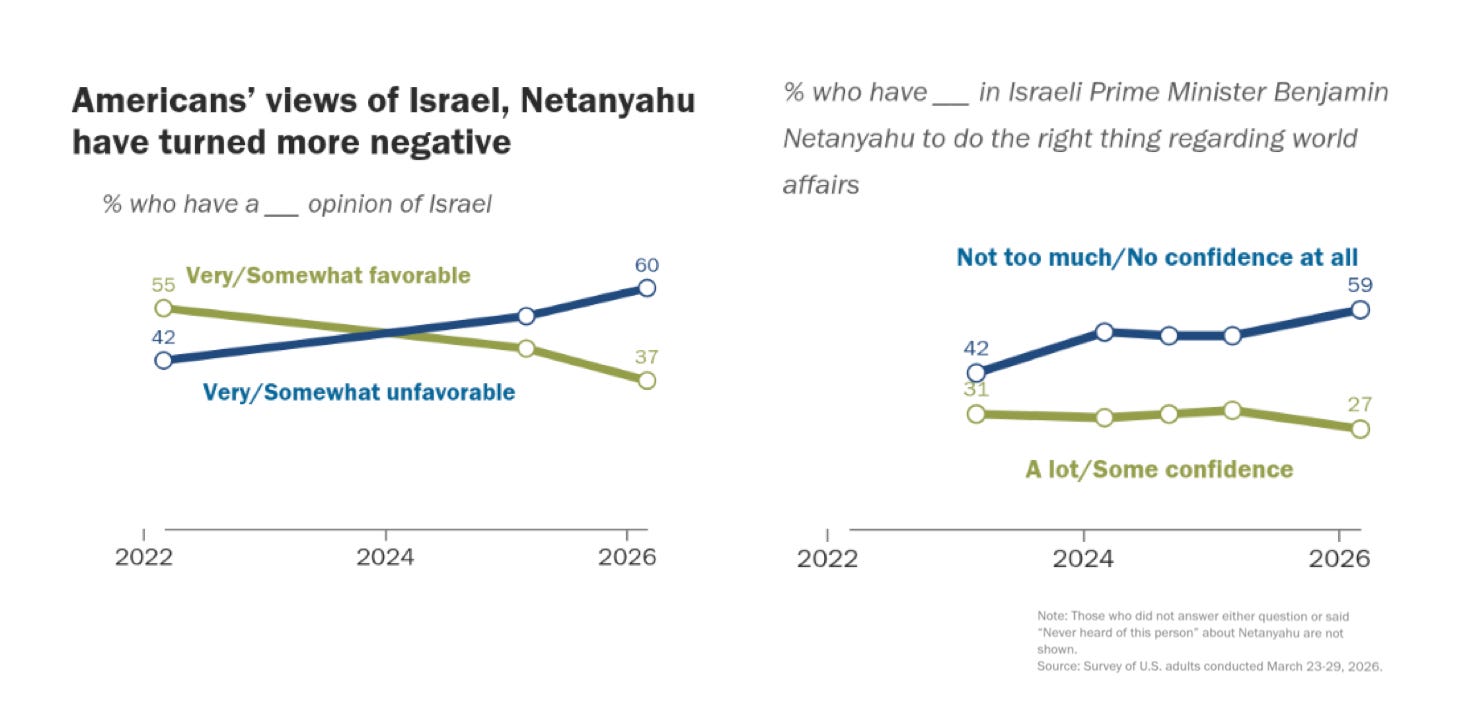
The disaggregation is also visible globally. Across 24 countries Pew surveyed last spring, the median share with no confidence in Netanyahu was 69 percent. The median share with an unfavorable view of Israel was 62 percent. The man runs seven points more unpopular than the country he leads, and the gap holds in nearly every Western democracy. That small gap is the point. The numbers are not running parallel by coincidence. Netanyahu's unpopularity is dragging Israel's down with it. Anti-Netanyahu sentiment becomes anti-Israel sentiment because in most people's minds, the two are now the same thing.
I am nearly 36, and even I mostly remember Israel as Netanyahu. There are moments before, scattered, the way memories from childhood are scattered. I remember exactly where I was when I heard Rabin had been assassinated. I remember being in Israel during the summer of the Gaza disengagement, the orange shirts opposed to the evacuation and the blue shirts in support. I remember Olmert’s speech as we went into the Second Lebanon War.
But those are discrete memories, not a continuous picture. For most of my adult life, Israel is Netanyahu and Netanyahu was Israel.
If that is true for me — born in Vancouver, in and out of this country since childhood, with whatever institutional knowledge I picked up along the way — it is more true, by an order of magnitude, for a 22-year-old American who has never been here and has no particular reason to distinguish the country from its prime minister.
This is the part of “Israel’s image collapse” the discourse has gotten wrong. The collapse is real. But the diagnosis underneath has compressed two very different layers of damage into one, and pulling them apart matters for what comes next.
The structural layer is what everyone fights about. Settlements, occupation, Gaza, the question of whether the Zionist project as constituted can coexist with Palestinian self-determination. The antizionist position is that the problem is the Zionist project itself, not its leader, Netanyahu. People who hold that view are not going to change their minds because Likud picks a new face. That damage is likely permanent.
But there's a second layer, sitting on top, that is specifically Bibi-coded. The exaggerated performances in Congress. A decade of cultivating evangelical Republican identification at the expense of the relationship with the Democratic Party. The May 2018 split screen — the embassy ribbon-cutting in Jerusalem on one side, Palestinians shot at the Gaza border fence on the other, on every American news channel simultaneously. The judicial overhaul as a recurring American news story for nine months. Cabinet ministers Americans had never heard of who suddenly were saying things on camera that were impossible to defend. The wartime decisions that read as coalition management — refusing hostage deals his security establishment supported, expanding settlements during the Gaza war, the surge in settler violence in the West Bank under Ben-Gvir. The personal corruption charges. The ICC arrest warrant. The sense — hard to articulate, not hard to feel — that the prime minister of a country in crisis was running it primarily as a survival operation for himself.
And the way all of it adds up, for a viewer who isn't tracking the details, into the same visual category as Orbán and Putin and Erdoğan. The comparison is unfair on the merits. Israeli democracy is real, the protest movement was real, the courts blocked the overhaul. But the comparison doesn't have to be fair to do the work. The image lands before the analysis does.
The second layer is different. It moves when he moves.
The Netanyahu of 2010 and the Netanyahu of 2026 are not the same political figure. The first Netanyahu government of his long tenure was a Likud-led coalition with Labor inside it. Ehud Barak was his defense minister. He gave the Bar-Ilan speech endorsing a two-state solution. He was a right-wing prime minister, but he governed inside a recognizable Israeli political center.
What followed was a slow erosion in roughly one direction. The coalitions got narrower and further right. Labor left, then collapsed as a force. The center-right partners — Kadima, Yesh Atid in its first iteration, Kulanu — cycled through and were burned. The 2015 government leaned harder on the religious-Zionist right. By 2019 he was running campaigns warning about Arab voters being bussed to the polls. The corruption indictments arrived that same year, and from that point forward every coalition calculation was bent around keeping him out of court. The four-elections-in-two-years deadlock was the country trying and failing to resolve whether a sitting prime minister under indictment could continue. He won that fight by assembling, in 2022, the most right-wing coalition in Israeli history, with Smotrich at Finance and Ben-Gvir at National Security — figures who in any prior Israeli government would have been considered unworkable.
The judicial overhaul in 2023 was the logical endpoint of that arc. A prime minister facing trial, governing with partners who wanted to remake the courts for their own reasons, attempted to remake the courts. Hundreds of thousands of Israelis understood what they were watching and filled the streets every Saturday night for nine months. Then October 7 happened, and the war that followed has been prosecuted by a government whose senior ministers have said, on the record, things about Gaza and the West Bank that no Israeli government had previously said out loud.
A 22-year-old American did not encounter “Netanyahu” as a fixed object. They encountered the late stage of a long degradation, concentrated through the algorithmic feed into its most damaging frames. The damage that can move is not seventeen years of accumulated impressions. It is what the last three years have looked like to the outside world.
There is a window. A narrow one. But real.
A Bennett-style figure takes over, governs competently, doesn’t pick fights with Democrats: modest rebound, mostly among Jewish institutional types and the soft middle who tuned out and might tune back in. A Bennett-Lapid-Eisenkot led coalition doing anything readable as diplomatic motion — a Saudi normalization deal that offers a political horizon for an eventual deal with the Palestinians, even the optics of an Israeli prime minister interested in reestablishing a bipartisan relationship with the United States — produces a bigger rebound. Not transformational. Meaningful.
The negative case cuts the other way. Netanyahu survives the election, or a successor he endorses takes over, or a Likud that stays in the Smotrich-Ben-Gvir orbit because that is where the votes are now. The rebound goes negative. Whatever can move works in both directions. The window can also close.
The obvious objection is the Bennett-Lapid year. Israel had a non-Netanyahu government for roughly eighteen months and there was no measurable rebound in young American views. If the argument were right, why didn’t that happen?
Because the damage was accelerating, not yet accelerated. The collapse in young American views concentrates in 2023 through 2026 — Pew shows the share of Americans with “very unfavorable” views roughly doubling over that period. The line was already moving in the Bennett-Lapid year, but it hadn’t yet bent. Bennett and Lapid governed before October 7, before the judicial overhaul, before the Smotrich-Ben-Gvir cabinet, before the war. The relevant question isn’t whether 2022 looked different from 2021. It’s what the post-October 7 picture looks like with someone other than Netanyahu in office. That experiment hasn’t been run.
There is a version of this argument that lets Israel off the hook. The version that says American Jews and Americans more broadly have been unfair, that the real Israel is more complicated than Netanyahu, that if only the messaging were better the relationship would heal. That is not what I am arguing. The damage is real, the structural critique is largely correct, and the country has earned a great deal of what is coming back at it.
Some of the criticism has not been fair. Israel gets held to standards that other countries fighting urban wars do not get held to, casualty figures get reported in ways that smuggle Hamas’s framing into mainstream coverage, and “genocide” has been applied with a casualness the word does not get applied with elsewhere. Noticing this is not the same as defending what it is deployed against. The existence of unfair criticism does not change what I am arguing. Even if you stripped out everything misreported or held to a double standard, you would still be left with a generation of young Americans who watched one man preside over a country for their entire conscious lives. That is a problem the coverage made worse but did not invent.
The strongest objection comes from the left, and it goes like this: Netanyahu is a reflection of Israeli society. If he weren’t, he wouldn’t keep winning. Treating him as a contingent figure, separable from the country that elected him six times, is a cope.
Some people making this argument are not arguing in good faith. They want the end of Israel. Set them aside. The serious version of the critique comes from people who do understand Israeli politics, and it deserves an answer.
That version is partly true. He has been prime minister for most of the last seventeen years. Israelis have, in some meaningful sense, kept choosing this. The center-left has been unable to construct a stable alternative. The rightward drift of the electorate is real, the settlement consensus extends well beyond Likud, and a successor government will inherit most of the policies the world is angry about.
But 'partly true' is doing real work in that sentence. Likud has never won a majority under Netanyahu. Even at its electoral peak — 36 seats out of 120 in March 2020 — it was nowhere close. He governs because he is the most skilled coalition assembler and campaigner in Israeli political history, not because a majority of Israelis endorse his program. The 2022 coalition exists because Meretz missed the electoral threshold by fewer than 4,500 votes and Balad fell short with it, wasting some 289,000 anti-Netanyahu votes — handing the right a majority it did not earn at the ballot box. The largest protest movement in Israeli history filled the streets against his judicial overhaul and to push him toward a hostage deal much of his coalition opposed. Recent polls show roughly three-quarters of Israelis want him to resign. A society in consensus with its prime minister does not look like that.
So yes, partly true. The country has drifted right, the structural critique stands, and a post-Netanyahu Israel will not be a different country. But the man is not simply the country in human form. He is also a politician who has been very good at staying in power in a system that has never given him a majority, and that distinction is what creates the window.
The sophisticated version of the objection points to the bloc rather than the party. The right-religious bloc — Likud plus Shas, UTJ, Religious Zionism, Otzma Yehudit — has consistently been the largest bloc in Israeli politics, hovering around 60 seats. Pointing to 32 Likud seats, the objection goes, misses the actual majoritarian phenomenon.
This is a serious point and it is partly right. The right-religious bloc has been the largest bloc, and a successor government will likely come from it. But the bloc is not Netanyahu, and the specific composition of the current bloc is. Sa’ar at Likud’s helm produces a different coalition. Bennett does. Lieberman does. The 2022 cabinet — with Smotrich at Finance and Ben-Gvir at National Security, two ministers Netanyahu himself once kept at the margins of his coalitions — is the cabinet a prime minister facing trial assembled because he needed exactly these partners to keep his prosecution stalled. A different right-wing leader, not facing trial, would not have needed them. That is what is contingent here. Not the right bloc’s existence. The shape it has taken under Netanyahu.
For American Jews, the argument is harder to hold. It asks you to stay angry at the right things — the structural problems, the conduct of the war, the coalition — without pretending the man at the top is incidental, and without pretending he’s everything.
There is something almost depressing about this argument for Israelis, which is that it suggests our domestic politics matter more for our standing in the world than we would like to admit. We tell ourselves that what gets translated into English by a hostile media is the problem. That if only people understood the security situation, the history, the attention asymmetries, the double standards. The truth is simpler and harder. A different prime minister would produce a different country in the eyes of a 22-year-old in Ohio. The structural problems would not disappear. The picture in front of her would still be a different picture.
Israelis go to the polls later this year. The polls will move a dozen times before then. Whether Netanyahu survives, whether Likud stays in the Smotrich-Ben-Gvir orbit or breaks from it, whether Bennett and Lapid can build a coalition without the Arab parties they have ruled out for now — these are open questions, and I do not pretend to know the answers.
But the answer matters. A successor government could articulate a day-after plan for Gaza that doesn’t include settler return — the policy Smotrich and Ben-Gvir have openly campaigned for and the policy that has done as much as anything to define Israel’s image abroad over the last two years. A successor government could engage with the Saudi normalization framework, which requires movement on a Palestinian horizon the current coalition cannot deliver. A successor government would also stop generating the daily clips of cabinet ministers saying things that travel — because those ministers would not be in the cabinet to say them. None of this is hypothetical. All of it is blocked, specifically and identifiably, by the man at the top and the partners he chose.
A 22-year-old in Ohio is going to look at Israel for the rest of her life — if she looks. The face she sees, the cabinet she sees, the country she sees — that picture has not yet been settled. We are the ones who settle it.
Eli,
I think that you should run for the Knesset given thoughtful, incisive, and articulate you are. Merely reading your columns over the past week is making me think that Zionism may not be so bad after all.
And I like your cautious optimism about the Israeli election scheduled for later this year and the possibility of resolving the conflict once and for all.
The wonderful folks at J Street have a similar vision as you about a 23-State Solution.
But, there is one specific point I disagree with you on in this piece. I don’t really see Israel or the United States as functioning democracies at this time because of the policies and conduct of the fools and degenerates who are “leading” them.
Hopefully, that will soon change, to some extent, for both countries.
L’Shalom,
David Hurwitz
Chicago, IL
P.S. FWIW, I entered a contest to win a free trip to Israel-Palestine with the pro-peace organization Standing Together.
But why is that 22 year old obsessed with Israel in the first place? And do you honestly think that the genocidal antisemites rampaging in the streets of New York last night will stop when there is another PM? For that matter, do you honestly think that pogrom really had anything at all to do with Israel?