


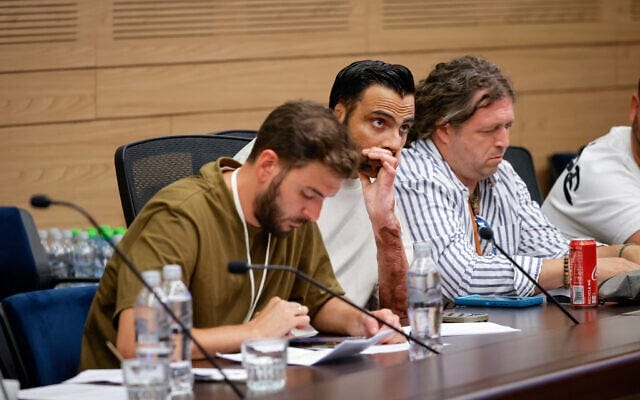
In 2021, Itzik Saidyan set himself on fire. An infantry veteran struggling with PTSD, he did so after years of being turned away by the Defense Ministry office that was supposed to help him. He survived, badly burned. His story forces us to ask an old question: what does a country owe the people it sends to war?
This week, Saidyan went to the Knesset, where lawmakers debated a new Basic Law that would make Torah study a core value of the state. The law aims to exempt tens of thousands of ultra-Orthodox men from being drafted into the IDF, even though the army says it desperately needs them. Saidyan reminded them who actually fights. He said that, while Torah study is important, the highest respect should go to those who risk their lives—the few who face danger, lose friends, and recover the fallen. He was not asking for a monument, just that the state not claim in its most important law that staying home to study is equal to what he and his comrades did.
I have tried to explain what’s happening here to my colleagues and friends whom I usually speak with on these topics. Most of them live in North America and have spent years defending Israel in tough places—on campuses and at dinner tables where being called a “Zionist” feels like an accusation. For years, we have prided ourselves on what made Israel unique in its neighborhood: Israel is the only democracy in the Middle East.
I have always known that this statement is not perfect, and neither is Israel’s democracy — not with the nation-state law, not under an occupation of millions of Palestinians without the vote. Still, I believe it, and so do most people who say it. They point to real things: inside the Green Line, there are independent courts, a free press, equal citizenship under the law, and real elections. That promise made defending Israel feel honest, especially when Israeli governments pursued peace. This month, in the last working weeks of the Knesset before it dissolves for an election, the government set out to finish what it started four years ago and hollow it out.
Let’s start with the courts. On Sunday, for the first time ever, the cabinet said it would not follow a High Court ruling. The case itself was minor—a decision allowing the commercial broadcasting regulator to continue operating despite lacking sufficient members. The government’s argument makes sense; maybe a body below its legal minimum should not make binding decisions. Let’s accept that. But the real issue is bigger: now the government decides which court rulings to follow. Justice Minister Levin said the law binds everyone, including the court, and Communications Minister Shlomo Karhi accused the justices of abusing their power.
This is more than just hypocrisy, and it is all on record. In 2019, Prime Minister Netanyahu criticized his own justice minister for saying the government did not always have to follow court decisions, writing that these decisions are binding on everyone. That was his clear position, in his own words. Seven years later, a different justice minister said the opposite and made it official policy, while Netanyahu said nothing. What changed was not the principle, but his need for it to disappear.
Now, the courts are only one front. The Knesset is set to dissolve on July 17, and in the days it has left, the coalition is racing to lock in the rest of its agenda—the product of a deal in which Netanyahu promised the ultra-Orthodox parties their priorities in exchange for keeping his government alive.
It is pushing the Torah Study Basic Law, which Saidyan opposed, toward passage, even as the chief of staff warns the army could collapse without the 80,000 men it would exempt from service. It is advancing a bill to split the attorney general’s powers, the only office that can independently investigate the government. It is moving the communications minister’s media bill toward final passage. And today, a bill headed for its final reading would let universities bar women from academic programs and, in one version, from libraries and labs, overriding the balance the High Court established in 2021. Each move has its own justification, but packed into the final two weeks before recess—when a dissolved Knesset can barely convene its committees—they are one coordinated act: a government stripping away every check on its power at once, before time runs out.
The government’s defenders insist that electoral victory is a mandate. Netanyahu’s coalition won; this is what its voters chose. They claim that an unelected court blocking an elected majority is the real threat to democracy. Winning confers the right to govern and to set policy, even if the opposition seeks to reverse it next time. But a mandate requires operating within the democratic system, and these two weeks—like much of this government’s tenure—have not.
More than a thousand days after October 7, Israel still doesn’t have an independent state commission to investigate the worst day in its history, even though a clear majority of Israelis want one. Instead, the coalition is pushing for a political commission it will appoint itself. In a recent Channel 14 interview, the prime minister boasted, “we brought back all the hostages, to the very last one,” then asked the room, “Is no one going to applaud?” When asked in the same interview what October 7 had cost him personally, he said he had lost a little weight. I wrote last week about what that answer revealed. The families of the murdered and the taken are still waiting for the one thing Netanyahu refuses to give them: the truth about what happened and who was responsible. A commission he appoints himself is designed to make sure they never get it. The October 7 Council calls it what it is: trading truth for political survival. This is the pattern of the week: a government deciding what it will forget, who it will abandon, which institutions it will silence, and which families will wait for answers that will never come.
This is why the real target isn’t the broadcasting regulator. As Haaretz’s Yossi Verter argues, Sunday’s defiance was a test run. Once a government shows it can declare a court ruling invalid “without authority,” the same logic could be used against a decision of the Central Elections Committee after the vote. The committee is chaired by a sitting Supreme Court justice, and coalition figures have already started attacking him. The ballot is the way out of this, which is exactly why the process around it is so important to watch.
But this doesn’t have to be the end of the story. On July 17, the Knesset dissolves, and Israelis go to the polls this October. The last two weeks aren’t a reason to lose hope, but they show what’s at stake. Israelis will decide the outcome. But the ballot isn’t the only thing being decided this year. It’s up to you whether the institutions you support and the conversations you have treat this as just another news story or as something that shapes what you are defending.
Saidyan asked what a country owes the people it sends to war. The answer, at a minimum, is a state worth the sacrifice—courts that bind everyone, a press it cannot silence, a vote it cannot ignore, and the honesty to investigate its own failures. That is what is on the ballot this October.
For years, we’ve relied on a single sentence in our toughest arguments: Israel is the only democracy in the Middle East. Now, this government is spending its final weeks turning the word “democracy” into a question—even for Israel’s most ardent defenders. Whether that remains true will be tested at the ballot box, and in what all of us who love this place are willing to say, between now and then, about the country we’ve spent so long defending.
Sitting in Australia & watching the Israeli news every day, learning of IDF soldiers being killed in Lebanon &/or Gaza, then learning of what’s being hatched in the Knesset, all just to protect Bibi’s mistakes, his lack of conscience of what he has “cost” the people of Israel in October 7’s 1200 innocent women, children, men, the elderly & IDF soldiers all brutally massacred & 251 abducted to Gaza’s bowels.
No formal governmental commission into what went wrong on October 7 2023?
How can Bibi live with himself, never once meeting with the parents mourning their sons & daughters who attended the Nova Festival?
How can Bibi sell his soul by evading his responsibility as PM?
G-d forbid that Netanyahu will do even more harm to what Israel represents :
the palpable conscience of the Jewish people, not just of Israel, but all the Jews of the Diaspora, as well.
Israel is not a democracy and has never been a democracy