


Two decades ago, on the soccer field at my Vancouver public high school, a friend of mine told me, “they are right, you Jews are so cheap.” I think I pushed him, and we moved on. I remember the comment because it was the only example of antisemitism I could produce from an entire Canadian childhood. I produced it as an anomaly.
On my mother's side, my grandmother, Sally Rogow, came from Brooklyn and my grandfather, Robert Rogow, from Newark, and they moved to Vancouver in the 1960s. He taught labor relations; she pioneered teacher preparation for blind and visually impaired children at UBC. They were among the first Jewish families in Burnaby; my grandfather was invited as a founding member of the Faculty of Labor Relations at Simon Fraser University.
The Canada they had chosen was not without antisemitism. My mother’s sister Fern was beaten up at a junior high school by teens looking for her horns. My mother was told as a child that her family had killed Christ and that the Jews had started the Vietnam War. The accusation about the Vietnam War was particular to her family’s arrival, since they were American. The horns and the Christ-killing were older material in wider circulation.
The decades after that were the period of integration. Leonard Cohen, Barbara Frum, and Mordecai Richler became part of the country’s cultural and civic fabric, and the Jewish presence in Canadian arts, business, and public life was something the country had stopped having to think about. By the time my friend said what he said, the old material had been quietly retired. What he was repeating had not been generated by Canada.
I have spent the last two and a half years watching the country my grandparents chose unmake itself. Canada is not the only country where this is happening, but it is the one I know best.
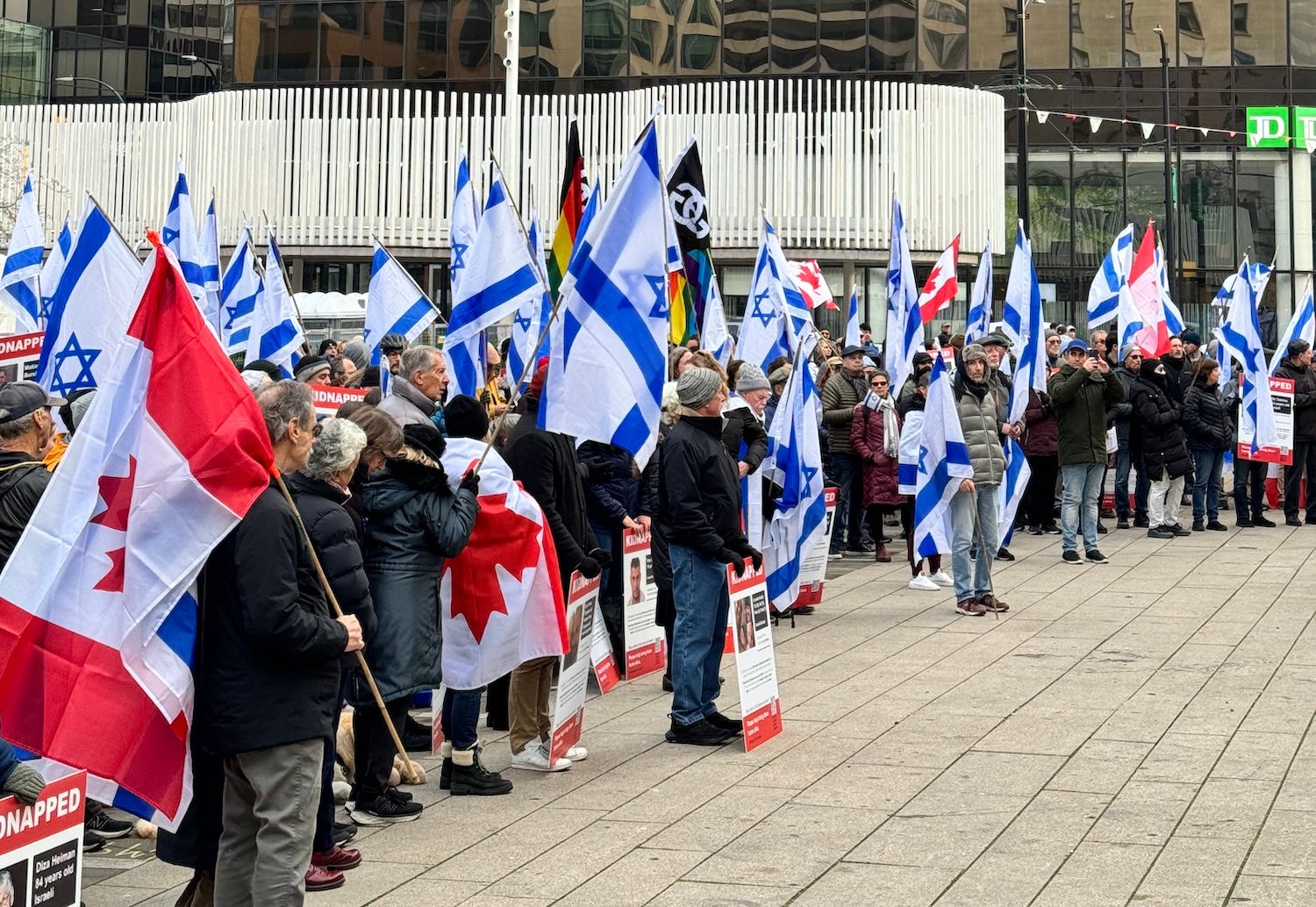
The posters were what I noticed first. I was visiting in the weeks after October 7, and on runs down Cambie Street I started to see the small white sheets put up on telephone poles by people I did not know, with the faces of hostages on them. Many of them had been torn down. The argument offered for the tearing was that the posters were Israeli propaganda. Most of the tearing was done on sight, before anyone had read what they were tearing.
That April, Charlotte Kates, the coordinator of Samidoun, a pro-Palestinian network later designated a terrorist entity by Canada, stood on the front steps of the Vancouver Art Gallery and told several hundred people that Hamas and the Popular Front for the Liberation of Palestine were resistance fighters and heroes, and led them in a chant of “long live October 7.” The Vancouver Police Department opened a criminal investigation. The BC Crown declined to lay charges. Canada listed Samidoun as a terrorist entity six months later, after a different Vancouver rally where the crowd burned the Canadian flag. The Kates speech was not charged.
Then there was the clothing store. It was a place I had been to many times, where you went because you needed a shirt and the staff knew you. On the cashier counter was a small box, the kind that holds the change you do not take, with a sign on it soliciting donations for the people of Gaza during the genocide. The word was not in quotation marks. The store was not staking out a contested position; it was acting as if the question had already been answered for everyone. The framing had arrived already settled, from somewhere I could not see. The same kind of arrival showed up at a 10K I ran at UBC, where another runner crossed the finish line beside me carrying a Palestinian flag.
A month after the Kates speech, on the night of May 30, 2024, someone walked up the front steps of Schara Tzedeck — the city’s oldest synagogue, founded in 1907, a synagogue I grew up in — poured accelerant on the doors, and set them on fire. A passerby alerted the congregation. A member took off his jacket and beat out the flames before they reached the second storey. Rabbi Andrew Rosenblatt told reporters at the scene that what struck him was the lack of effort to be discreet. “Somebody decided it was OK to just walk up these stairs,” he said. The fire was set at the front, at street level, on Oak Street.
Four things I noticed in roughly eight months, in the city where I grew up. The clothing store had not arrived at “the genocide in Gaza” through deliberation. The framing had arrived from somewhere upstream, in a register the store had no incentive to question. The shape was the same as the proposition my friend had repeated to me twenty years earlier, absorbed from somewhere he could not see and offered back to me to confirm. What had changed was the saturation, and the institutions that had begun to operate inside it.
On my most recent visit to Vancouver, I went to the Jewish Community Centre to work out and was questioned at the front entrance by police. The security at my synagogue resembled what I had only seen in Europe. It was foreign to me, in the city where I grew up.
I do not want to litigate the antizionism-versus-antisemitism distinction here, only to note that the Vancouver Art Gallery speech praised the killers of October 7, not the contours of Israeli policy. The clothing store donation was for “the genocide in Gaza,” a phrase whose deployment requires that the question of whether one is occurring has already been answered in the answerer’s favor. The hostage posters were the faces of kidnapped civilians. Whatever the man who poured accelerant on the doors of Schara Tzedeck believed himself to be doing, the building he chose to set on fire was a synagogue.
The institutional version was visible long before the second anniversary of October 7. Fred Hahn, the president of the largest public-sector union in Ontario, posted within hours of the massacre that he was inspired by “the power of resistance around the globe.” His union represented teachers, hospital workers, university employees. Eighty Jewish CUPE members filed human-rights complaints against him. The national executive board asked him to step down in August 2024. He declined. He stayed on as president of CUPE Ontario for more than two years, and announced in February of this year that he would not seek re-election. His own union could not remove him.
Toronto mayor Olivia Chow called Israel's conduct in Gaza genocide at the National Council of Canadian Muslims gala last November. She has provided Canada's largest city the mayoral legitimization Zohran Mamdani has provided New York's antizionists.
The Atlantic published a detailed account of the broader institutional picture early this year by the Canadian journalist Jesse Brown. He documents Jewish doctors quietly dropping their affiliations from the University of Toronto’s faculty of medicine, Jewish journalists leaving the Toronto Star, Jewish cultural figures disinvited from festivals, the Toronto District School Board adopting an “anti-Palestinian racism” framework. A professor of geriatric medicine at UBC who resigned in 2024 over the faculty’s refusal to address antisemitic harassment was told by his dean to submit his complaint through the DEI office; he searched the university’s equity and inclusion website for the words antisemitism and Jew and found neither.
In February of this year, a coalition of anti-Israel groups including Canada BDS launched a coordinated campaign to strip accreditation from seventeen Jewish overnight summer camps across the country. The campaign called the camps’ support for Israel “support for a genocidal state” and urged provincial camping associations to de-certify them. The Ontario Camps Association, which represents about 350 camps, condemned the campaign as antisemitic.
The Office of the Special Envoy on Preserving Holocaust Remembrance and Combatting Antisemitism commissioned a survey of antisemitism in Ontario K-12 schools, published in 2025. The survey covered the sixteen months from October 2023 to January 2025: 781 incidents reported by 599 Jewish parents. More than 40% involved Nazi salutes, “Heil Hitler” chants, or statements that Hitler should have finished his work — content unrelated to Israel. Nearly one in six incidents were initiated or approved by a teacher, or occurred during a school-sanctioned activity. About half the cases reported to school authorities went uninvestigated.
B’nai Brith Canada documented 6,800 antisemitic incidents in the country in 2025 — 18.6 per day, the highest annual total since the organization began its audit in 1982, and the third consecutive record year.
What my friend had repeated to me twenty years earlier was no longer an anomaly.
Carney's decision earlier this year to dismantle the envoy's office did not happen in a vacuum. The Canadian Muslim population more than doubled between 2001 and 2021, from roughly 2% to around 5% of the country, concentrated in electorally consequential suburban ridings. Polling shows that classical antisemitic beliefs find substantially higher support within that community than within the non-Jewish Canadian population. Robert Brym's 2024 survey found that 52 percent of Canadian Muslims with an opinion hold negative attitudes toward Jews — and on the proposition that Jews are “largely to blame for the negative consequences of globalization,” 48 percent agreed, compared to 5 percent of non-Jewish Canadians.
The Liberal Party has catered to antisemitism in its electoral coalition. The party’s recalibrations on Israel over the last two and a half years — its evolving position on Palestine statehood recognition, the prime minister’s campaign statements on Israeli conduct in Gaza, the dissolution of the antisemitism envoy in February — track an electoral math in which one minority’s votes are deemed indispensable and the other minority’s votes are deemed acceptable losses. That math is the precondition for everything else.
In February, Prime Minister Mark Carney’s government eliminated the Office of the Special Envoy on Preserving Holocaust Remembrance and Combatting Antisemitism and folded its responsibilities into a general council on rights, equality, and inclusion. Statistics Canada’s data the year before showed Jewish Canadians 25 times more likely than other Canadians to experience hate crimes. The Senate human-rights committee tabled a bipartisan report in April recommending that the office be restored. The government has not responded. The office that commissioned the data on Nazi salutes in Ontario classrooms was dismantled by the government that received the data.
The pattern extended beyond the envoy decision. In December of last year, a Conservative parliamentary inquiry revealed that the same Liberal government had struck an undisclosed settlement with Laith Marouf, a former Canadian Heritage anti-racism consultant. Marouf’s six-figure contract had been pulled in 2022 after the public surfacing of his posts describing Jews as “loud-mouthed bags of human feces” and stating that “Jewish white supremacists” deserved “a bullet to the head.” The terms of the settlement have not been disclosed.
In early March, three synagogues in the Greater Toronto Area (GTA) were shot at within five days. Two had appeared on a database titled “GTA to IDF,” published in December 2025 by the online magazine The Maple, which catalogued Jewish institutions the author identified as connected to the Israel Defense Forces. The Toronto Police Chief acknowledged at a March 8 press conference that investigators had been aware of the database before the shootings. No charges have been filed against its author, and The Maple has continued publishing through this year.
In Montreal earlier this week, at a pro-Palestinian demonstration that also displayed hanged effigies of Netanyahu, Ben Gvir, and Trump, a kippah-wearing effigy was raised on a pickup truck alongside the flag of the Montreal Canadiens.
On May 15, in the GTA, a fourteen-year-old girl named Esther, on the autism spectrum, went missing from her home in North York. The volunteer search has been operating out of the parking lot of Petah Tikvah Synagogue. A spokesman for Shomrim has told reporters there is no current reason to believe her disappearance is itself antisemitically motivated. What is antisemitic is that across midtown Toronto, on Yonge and Lawrence, Avenue and Wilson, Bathurst and Sheppard, residents have been physically tearing her missing-person flyers off lamp posts. Toronto Police have now confirmed they are receiving reports of the removals. The flyers are coming down because the name on them is Esther and the search is being run out of a synagogue.
The hostage posters in late 2023 were the leading indicator of what was coming; the torn flyer of a missing autistic fourteen-year-old eighteen months later is the lagging one. Whatever defense was on offer for the first — that the posters were political messaging, or Israeli propaganda, or context for a conflict — is unavailable for the second. The decision to tear the flyer down was a decision about the name on it.
The country my grandparents chose was not a paradise. It was the “none is too many” country, accepting just 5,000 Jewish refugees during the entire Nazi era — the worst record among Western nations. And yet, the achievement of the decades that followed my grandparents' arrival was that the material my mother grew up with was quietly retired, until being Jewish in Canada became an unremarkable feature of being Canadian. That achievement is being unmade. The institutions that were supposed to defend it — the unions, the school boards, the federal envoys, the prime ministers — have either operated inside the unmaking or accelerated it.
The friend who told me Jews were cheap, in a Vancouver public high school two decades ago, was repeating something he had heard. I have spent the years since watching what he heard become the country.
Updated May 26, 2026: The Montreal paragraph was revised to clarify that the demonstration also displayed hanged effigies of Netanyahu, Ben Gvir, and Trump.