


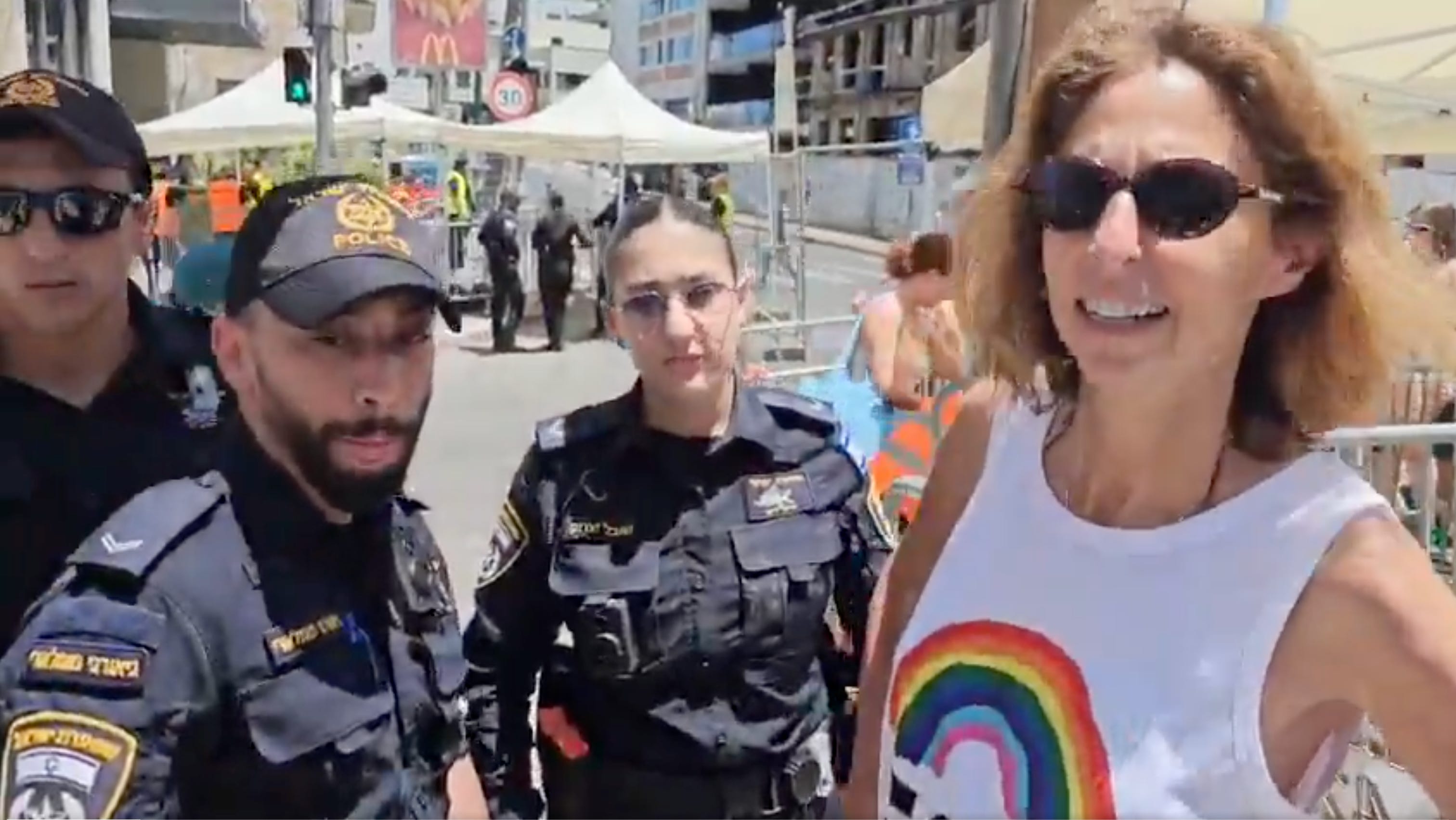
At the entrance to today’s Tel Aviv Pride march, the police Itamar Ben Gvir commands set up a checkpoint and, by marchers’ accounts and the footage from the scene, began pulling political signs. One woman was stopped because her shirt read “FCK BNGVR,” the slogan of a protest campaign run by Mehazkim, a left-wing group that has spread it on bumper stickers and shirts across the country. She was wearing its Pride edition, and the police let her through only after she took it off. The anti-government signs that have gone up in recent years were left with the officers at the gate.
None of this should have surprised the attorney general. Three days earlier, Gali Baharav-Miara had warned the Central Elections Committee that Ben Gvir was fusing the operational work of the police with the political messaging of his own party, and asked that he be barred from any more police-escorted campaign tours. She has become a state symbol herself: the cabinet voted to fire her last summer, the High Court reversed it as unlawful, and she remains in office as the most visible check on this government, and the one it most wants gone.
The Pride march his officers searched is itself a contested symbol. Israel’s defenders have long held it up as proof of a liberal democracy that endures despite its political turmoil and democratic backsliding, while its critics dismiss it as pinkwashing, an attempt to divert attention from controversial policies in the West Bank and Gaza. The defenders’ case rests on real ground: Israel recognizes same-sex marriages performed abroad, bars anti-gay discrimination in housing and employment, and lets gay couples adopt, far more than any of its neighbors allow. Both sides treat the parade as a prize, and this week the government, and Ben Gvir in particular, claimed it with the police.
Pride is only the latest target. Ben Gvir has spent his entire tenure teaching the police to treat opposition to him as a public-order problem. During the judicial-overhaul protests, he demanded water cannons and mass arrests, and when Tel Aviv’s district commander, Amichai Eshed, refused to use what he called disproportionate force, Ben Gvir engineered his removal; Eshed left the force saying he had paid a price for trying to prevent a civil war. The High Court had to remind the minister that he is not permitted to give police operational orders on how to handle demonstrations. When the hostage families began blocking roads to demand a deal — a deal Ben Gvir opposed at every turn, to the point of walking out of the government over one — it was his police who arrested them.
The clearest preview came from the soccer stands. For two years, officers have been confiscating the very shirt that was stopped at Pride: left-leaning Hapoel Tel Aviv fans barred from matches, their IDs recorded, detained for wearing “FCK BNGVR.” Last December, the club’s supporters were turned away from Bloomfield stadium in Tel Aviv for a shirt branding the police, Maccabi, and the outlawed Kach movement “scum,” in the same stretch that Beitar Jerusalem fans waved Kach’s flag at a match and were left alone. The fans who called the banned Kahanist movement scum were turned away; the fans who flew its flag, the movement Ben Gvir himself came up in, were waved through. Ben Gvir is one of those fans. He sits with La Familia, Beitar’s most notorious fans, and poses for selfies in their stand, the same fans who have chanted the name of Yigal Amir and booed through a moment of silence for Yitzhak Rabin.
Full disclosure: I’m a Hapoel fan, Be’er Sheva first and Tel Aviv too. I keep my team out of my writing, but my stake here runs older than my politics. At eighteen, on a USY gap-year program, I went to a Hapoel Tel Aviv–Beitar match with my cousin and friend and was jumped by Beitar fans on the way out. I’ll tell that story properly another time.
It also reaches past the stands. Two weeks ago, the same slogan stopped a woman at the entrance to the Old City in East Jerusalem, where Border Police called her “FCK BNGVR” cap “provocative,” told her to turn it inside out, and pushed her and her partner back out when she refused. The rule that emerges is simple enough: the far right may say what it likes, and everyone else is screened at the gate.
Pride sits at the center of all this because, for Ben Gvir, the hostility is personal. Before he was handed the police, he was a fixture at the protests against Pride, and in 2006 he helped lead the “Beast Parade,” where activists marched goats and donkeys through Jerusalem to brand gay Israelis as unclean. His old friend Bentzi Gopstein — barred from the Knesset for incitement, sanctioned by Washington and the EU, head of a group whose members have talked about burning marchers — reportedly advises him on police matters and has sat in on meetings at his ministry. His finance minister kept the same company: Bezalel Smotrich organized that 2006 parade too, called himself a “proud homophobe,” and described Pride as worse than bestiality.
The people who hold up Tel Aviv Pride to vouch for Israel’s liberalism just watched the police search it at the gate, but none of this needs to be permanent. A new Israeli government, when the next election hopefully delivers one, will inherit the work of returning the police to the public they are meant to serve, and making the boast about that parade true again.
Ben Gvir made the police force his own. The task ahead is to make it the country’s again.