


Our people know few more tired cliches than “two Jews, three opinions,” so it’s not surprising that there are two competing definitions of the ways in which people hate us and at least as many non-profits promoting their favored interpretation. Today I want to focus on one in particular: the Nexus Project, an antisemitism watchdog with a lot of potential that nevertheless struggles to talk about, well, antisemitism.
If you’re not familiar with Nexus, here’s a brief history. The group grew out of the Nexus Task Force, a group of liberal Jewish academics and leaders assembled in 2019 to untangle the nexus (get it?) between discussions around Israel and antisemitism in the United States. Two years later, they produced the Nexus Document, with its own definition of antisemitism.
As Nexus was gearing up in the tail end of Donald Trump’s first term, more traditional organizations like the ADL made a parallel effort to get governments to work the International Holocaust Remembrance Alliance definition into official policy.
The differences between the IHRA and Nexus definitions could be the subject of a Talmudic debate, and it’s worth reading them side by side, but to make things brief: IHRA treats double standards against Israel as antisemitism while Nexus argues that there are legitimate reasons for disproportionate public attention to the Jewish state; IHRA focuses mainly on defining what is antisemitic, offering only one example of what is not (“criticism of Israel similar to that leveled against any other country”), while the Nexus Document devotes five paragraphs to exceptions.
The Nexus Task Force raised the specter of American politicians exploiting fears of Jew hatred to silence criticism of Israel. Their concern was prescient: many of Trump’s most egregious abrogations of the First Amendment and principles of due process have leveraged anti-Israel protests as a pretext. Today the Nexus Project lays out its mission as combating antisemitism, upholding democracy, and protecting free speech.
Nexus would argue that its competitors failed by treating those three goals as zero-sum, choosing the first at the expense of the other two. There’s something to that, and Nexus has gained credibility as an alternative to the ADL, as that legacy institution ignores or even enables Trump’s campus crackdown. But Nexus, in its own way, struggles to reconcile its commitments.
Credit where it’s due: Nexus is clear-eyed about right-wing antisemitism, and it moves fast when it wants to, as it did after Nick Fuentes turned up on Tucker Carlson’s show. It calls out Islamophobia too, though that isn’t part of its formal remit. Take “Son of Hamas” Mosab Hassan Yousef’s recent invective at the ADL-sponsored Jewish American Summit, where the author and provocateur declared, “I don’t want Muslims in America.” Nexus called that out without reservation.
But when it comes to the far left, Nexus often struggles to find its voice. This undermines the very first plank of the Nexus Document, which states that “All claims of antisemitism made by Jews, like all claims of discrimination and oppression in general, should be given serious attention.” Even if the group ultimately concludes that a particular case is not antisemitism, it should explain in good faith why so many Jews think it is. But Nexus too often dismisses allegations against the left out of hand.
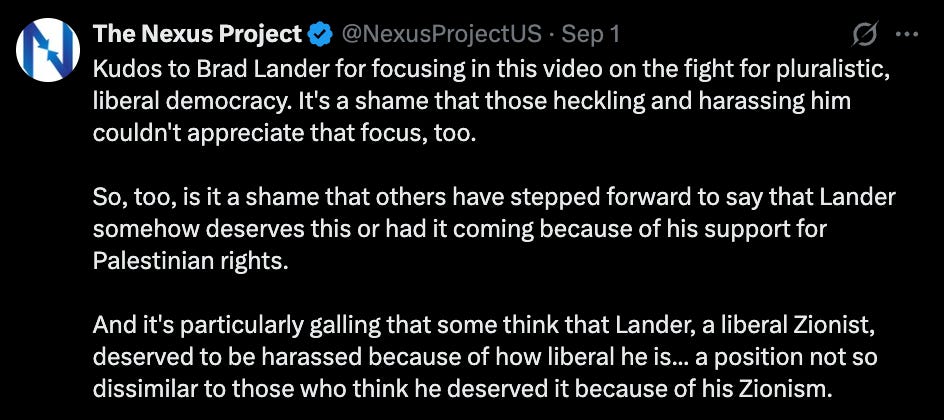
Last weekend Brad Lander, now the Democratic nominee in New York’s 10th congressional district, showed up outside Madison Square Garden to support a protest against a Hindu nationalist group. Lander was viciously heckled.
Nexus responded on Monday. The post opens with kudos to Lander for focusing on the fight for pluralistic, liberal democracy and calls it a shame that the people heckling him couldn’t appreciate that focus. A shame. It then spends two more paragraphs on Jews who said he had it coming, saving its one word of real heat, “galling,” for them. Nexus did boost Gili Getz calling the harassment antisemitic. But a glorified retweet isn’t a finding by a watchdog, and in its own name the word never came. The Indian American Muslim Council managed more: it apologized to Lander directly and said the hecklers weren’t part of its coalition. And Nexus had nothing at all to say about those, including many of Lander’s allies, who helped make the Z-word a slur.
Nexus’s record on Zohran Mamdani illustrates the same point. In 2023, speaking to a Democratic Socialists of America gathering, the future New York City mayor made “Zionist” the punchline of a joke about insufficient applause for Khader El-Yateem, a Palestinian-American candidate for local office. “If you don’t clap for El-Yateem, you’re a Zionist,” Mamdani said.
Two years later, when some Jewish New Yorkers raised that incident and many similar episodes during the mayoral race, Nexus warned that the critics were sensationalizing.
After Mamdani won, the group said it was “deeply concerned by the divisive, hyperbolic, and aggressive response” from some corners of the Jewish community, and called the ADL’s Mamdani Monitor dangerous and counterproductive. Creating a monitor dedicated to one elected official certainly isn’t pragmatic politics, but Nexus’s condemnation of the ADL makes it seem like the focus on Mamdani came out of nowhere.
When Mamdani released his video about arresting Benjamin Netanyahu should the prime minister come to New York for the UN General Assembly, Nexus dismissed the charge of antisemitism as “unfounded, inflammatory, and divisive.” Of course, Nexus’s foundational document doesn’t see undue focus on Israel as inherently antisemitic, but it could have given a nod to the fact that many American Jews were put off by Mamdani’s decision to focus on Netanyahu and not mention diplomats from Russia or North Korea. Nexus would be within its rights to conclude that Mamdani’s video, in which he conceded that he had no jurisdiction to enforce an international arrest warrant, was not antisemitic while still acknowledging legitimate disagreement over the issue.
Nexus correctly called out Hasan Piker after the firebrand streamer said that if Jews in America “keep putting this idea out there that they are singularly invested in Israel, eventually someone’s going to come around and take action, not against the State of Israel, mind you, but against American Jews.” A few days later, Nexus Scholar-in-Residence Dov Waxman wrote on X that “Israel’s actions fuel much (but not all) of the anger and hatred directed against Jews nowadays.” “It’s not victim-blaming” to make that association, Waxman wrote, noting that people make the association partly because Israel and major Jewish groups keep emphasizing the connection. Two days later, he took his argument to Mehdi Hasan’s Zeteo News.
There is something to Waxman’s argument. But Nexus condemned Piker’s threat and never engaged the reasoning underneath it.
The actions of Israel’s government don’t explain those patterns on their own. No one is asking Sudanese Americans to account for the RSF before joining a coalition. For Jewish Americans, the criteria are very different. It doesn’t stop at condemning the war in Gaza or condemning the Netanyahu government; rather, it asks for renunciation of who they are.
Those who make that demand treat Zionism as an identity: they apply the label collectively, extend it to Jews who have stated nothing, and accept nothing short of disavowal. I’ve seen it happen time and time again, in academic circles, the arts, and the music industry, and it is becoming increasingly mainstream. Nexus has already granted the disproportion. The Nexus document itself states that outsized attention to Israel has legitimate causes; I would say some are legitimate, and many are not, but whatever one makes of that, the group has never bothered to ask what all that attention does to Jews who had no say in any of it.
Nexus cautioned El-Sayed in July over a comment about support for Israel and money. What it never addressed was the association itself. The Democratic Senate nominee in Michigan brought Piker to campus rallies in Ann Arbor and East Lansing and walked into a Detroit event with him on the eve of the primary. Asked in April to disavow Piker’s views, El-Sayed said he wasn’t there to disavow anyone’s views. Following Piker’s comment about American Jews inviting violence, and after Democratic strategists warned that the association had become a liability, El-Sayed put out a statement clarifying that nobody speaks for his campaign but him. The pressure that produced even that came from the ADL, from Mike Rogers, and from Democrats worried about November.
Now, Nexus will likely say this isn’t their beat. They exist to police the weaponization of antisemitism, and the ADL and a dozen others already cover the left. I suspect Nexus fears that condemning left-wing antisemitism too loudly makes them complicit in the Trump administration’s campaign against international students and academic freedom. That is not a legitimate excuse. It’s a cop out. In many ways, it hands Nexus’s credibility to its opponents. If we end up with the only people willing to name anti-Jewish rhetoric on the left being organizations that also want student visas revoked and academic freedom restricted, the audience we care about has no reason to listen, leaving Nexus with no answer when critics say the group exists to provide cover.
Nexus must walk and chew gum. It can say that antisemitism is rampant on the far left and that antisemitic speech is not illegal.
Perhaps it’s a good time to remember the Skokie affair, in which a Jewish ACLU attorney, David Goldberger, defended neo-Nazis’ right to march through an Illinois town with a large Jewish population and a significant number of Holocaust survivors. Goldberger never argued that his clients weren’t antisemites, only that antisemites have constitutional rights too. He reflected decades later that he “still feel[s] bad about the pain” the case “caused survivors.” As the case progressed, he engaged with the Jewish communities in the area. His defense of free speech was compelling precisely because he recognized that the question of antisemitism is still emotionally fraught even when the law is clear.
Nexus fills an important niche. As the ADL’s credibility wanes outside of a narrow echo chamber, and as a cottage industry treats every criticism of Israel as evidence of Jew hatred, we need an institution that applies the serious charge of antisemitism with precision and care. Nexus can be that institution. It has to stop deciding in advance which Jews get taken seriously.
Note, added September 5. An earlier version of this piece said Nexus had been quiet on Abdul El-Sayed. That was wrong. The group cautioned him in July over a comment about support for Israel and money. The paragraph has been corrected.
Good discussion of a complicated issue. Credibility requires calling out your own side. It’s easy for a left-leaning group to point out the antisemitism on the right.
Nexus is helping no one by excusing or whitewashing antisemitism on the left.
In their defense, I believe it is harder to make the distinction between legitimate criticism of Israel and antisemitism on the left that can at best coexist with and at worst fully animate denunciations of Israel and Zionism.
Eli, you are being too kind to Nexus which I submit has given a permission slip to those who negate the legitimacy of Israel as a Jewish state. Prof. Waxman and his compatriot at UCLA, David Myers see the only threat against jews as that emanating from the right. Waxman, thus, rejected the view that Corbyn was an antisemite. The Nexus paper on campus antisemitisim rejects the view that opposition to Zionism or that chants "from the river to the sea" and "by any means necessary" are antisemitic. Nexus also rejects the importance of Jewish peoplehood. They reject the assertion that calling for an intifada is antisemitic even when the chant targets Israelis. Waxman himself has accused Israel of genocide -- an assertion that Yossi Klein Halevi and many Israelis (you would know approximately what percentage)has labeled a "blood libel." Many in the Nexus camp really embrace a pre-1948 vision -- an Israel existing primarily as a cultural center -- an Ahad Ha'am vision. They do not see the existence of Israel as a Jewish majority state as central to the existence of the Jewish people. Neither Waxman nor Myers, for example, has condemned fellow professors who praised or justified October 7. Neither professor signed the UCLA Statement Against Terroe in October 2023 nor condemned the 300 Ethnic Studies professors who justified October 7. They said nothing about Nick Kristof's dog raping piece. Most significantly, they do not see the killing of Israeli Jewish civilians as any kind of threat to the Jewish people. Waxman et al wrote no Op-eds or papers explaining the threats posed by Hezbollah, for example. Their greatest fears perhaps are to be labeled Islamophobic or to be blamed for Israel's crimes. They -- and I would say a substantial number of Jewish/Israel Studies professors in the United States -- see themselves as "the good Jews" and Israelis who generally support the IDF campaign agahsint Hamas and Hezbollah as "the bad Jews." College students taking courses offered by Middle East Studies Departments see a unified faculty condemning Israel, often rejecting claims of Hamas' rape, etc and an adherence to the Ummah - loyalty to collective Muslim community. Meanwhile, students taking courses in many, if not most, Israel/Jewish Studies Departments see no such loyalty or even membership in the Jewish collective. Most significantly, their students are offered no understanding whatever of the real concerns Israelis may have that affected their vote in the October 7 election. If I were El-Sayed's advisor, I would recommend he quote professors such as Waxman who confirm accusations of settler colonialism, genocide, etc. If a center-right coalition defeats the present governing coalition, do not expect these professors to offer anything but muted applause.