


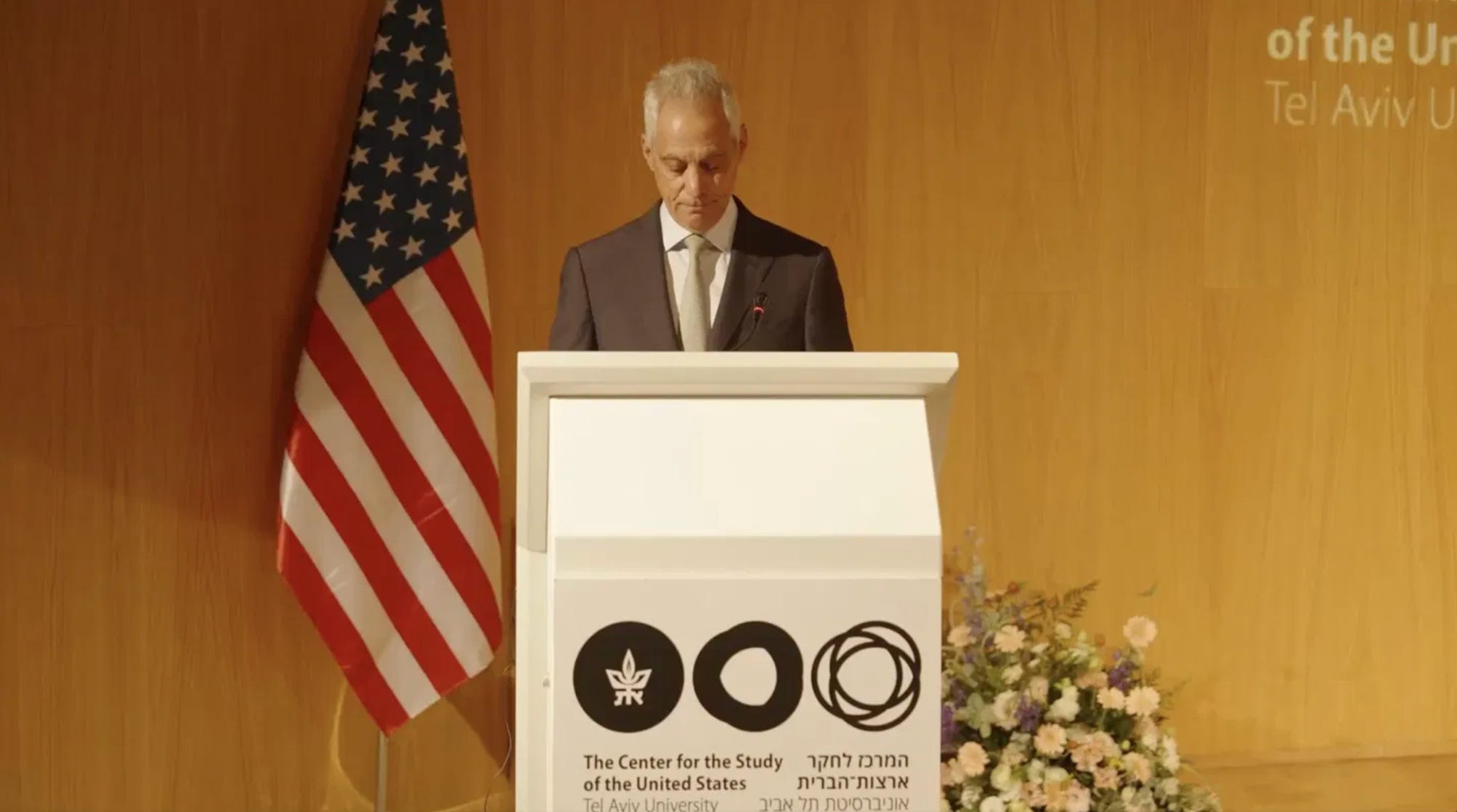
Rahm Emanuel opened his speech at Tel Aviv University this week with four words Israelis almost never hear from a visiting American: I understand your cynicism. Before a word of criticism, he granted the room what the outside world usually withholds — that their suspicion of foreign lectures is earned, that the Palestinian leadership is corrupt, that October 7 broke something that has not set back into place. Only then did he get to the point. The alliance that has underwritten Israel since its founding cannot survive as it is.
Unconditional American support was a mistake, he said, one that produced a prime minister who believed he could ignore Washington at no cost, and Israel will end up alone if it reaches for annexation and a Greater Israel. Then, telling the audience to hold their applause, he pledged to revive and expand the Biden-era settler sanctions: every Israeli who attacks Palestinian civilians in the West Bank, every official who backs them, every bank financing illegal settlements.
Inside the hall, the speech landed as what it was: the room applauded, more than once, even the call for sanctions. It was outside the room that many saw an attack. Online, the sharpest critics said Emanuel doesn’t share Israel’s fate, that he lectures from afar, that he is, beneath the surface, an antizionist pretending to be a Zionist. Many of them were themselves far away, posting, while Emanuel had come in person to speak directly to Israelis. The political left groups him with Democrats who have turned against Israel, while the right calls him Obama’s ally who clashed with Netanyahu over settlements in 2009 and was labeled, in Netanyahu’s own words, a self-loathing Jew. The language changes, but the tactic is the same: dismiss Emanuel so they don’t have to address his arguments. Interestingly, Democratic Majority for Israel, a strongly pro-Israel group, described his speech as serious and genuinely committed to Israel’s security.
None of it fits the man. Emanuel’s father was born in Jerusalem, joined the Irgun, and fought in the 1948 war. The family name honors an uncle buried on the Mount of Olives. Emanuel volunteered with the Israeli military during the Gulf War and spent years working to secure Israel’s future through peace with its neighbors.
The labels attacking Emanuel fit his proposal even less. What he asked for in Tel Aviv was not Israel’s isolation but the end of it: he called the two-state process discredited and sketched a “23-state solution” — full diplomatic relations with the entire Arab world, which would take responsibility for standing up an accountable Palestinian authority. The wish behind it is plain: an Israel normalized, integrated, secure, no longer a pariah. Yet the people reaching for the label file him in the same drawer as Zohran Mamdani and Abdul El-Sayed, as though fighting over what kind of state Israel should be and doubting whether it should exist were one position. Rahm Emanuel is as Zionist as it gets. What he practices is liberal Zionism, a brand anyone is free to argue with, and one in steady decline in Israel itself. But if that is antizionism, the word no longer describes a position someone holds. It describes a tribe they’ve been thrown out of.
The most revealing thing Emanuel said all week wasn’t in his speech. He told reporters that in 2010, when he brought his son to the Western Wall for his bar mitzvah, a fringe activist named Itamar Ben Gvir was arrested for protesting his visit. Today, Ben Gvir is Israel’s minister of national security. If Emanuel had given this speech in Tel Aviv in 2005 or 2013, it would have been seen as typical tough love from a friend. The words and the speaker have barely changed in twenty years, but the country he addresses has.
This is the predicament of liberal Zionism, both in Israel and the United States. In Israel, voters keep choosing coalitions that support gradual annexation, ongoing control over millions of Palestinians, and settler violence that has become routine, though to be fair to the Israeli electorate, they haven’t had a chance since October 7, 2023. In America, Emanuel’s party base hasn’t moved closer to him but has moved past him; now, Democratic voters support Palestinians over Israelis by about four to one. Emanuel chooses to fight on both sides, criticizing Netanyahu’s government directly while also calling out those in his own party who cheered on October 8 as morally bankrupt. Still, the middle ground he defends is the only approach that keeps all of Israel’s goals together: being Jewish and democratic, secure, and accepted by other nations. The Ben Gvir–Smotrich approach trades away democracy and the world’s acceptance for territorial expansion and Jewish supremacy. The anti-Zionist left’s one-state idea gives up the Jewish homeland. Only liberal Zionism tries to keep all four, which is why its decline is not just sad but dangerous, and why pushing out its advocates is self-defeating.
I won’t pretend the skeptics are wrong about everything. Emanuel might run for president, and a person can mean every word and still watch the polls. There is also a ceiling here. No number of Rahm Emanuels in Tel Aviv auditoriums will change a single Knesset vote. It’s a comforting myth in the Diaspora that liberal Zionism’s future is decided in American primaries or opinion pieces. In reality, it’s decided at Israeli ballot boxes, where people like Emanuel don’t have a vote.
A speech of this nature serves to sustain the argument until meaningful change becomes feasible. Emanuel could have limited himself to the op-ed he previously published, or to what he called “spitballs from across the Atlantic.” Instead, he traveled to Israel and delivered his message directly, grounding his remarks in personal and familial history before offering criticism.
Emanuel’s timing was deliberate: Israel faces elections in the fall. One possible outcome, the return of the current government, would transform incremental annexation into a permanent reality. The alternative is a coalition comprising generals, centrists, and remnants of the Zionist left. While such a government would not solve all existing challenges, it could halt or even reverse annexation efforts, protect judicial independence, restrain settler violence, and restore responsible governance. This scenario does not constitute peace, but it represents the difference between keeping options open and foreclosing them entirely.
Emanuel was on his weakest ground when he blamed Israel’s isolation on Israeli policy. Some of it is real boycott — scientists dropped from journals, performers pulled from festivals — but the committed antizionist boycotts Israel because it exists, and no government in Jerusalem will satisfy people for whom the Jewish state itself is the offense. No policy change reaches them.
What this government does is worse: it feeds the boycott it can’t cause. People of real good faith, with no animosity toward Israel, watch a Ben Gvir cabinet and a war grinding into its third year that Israel didn’t start but shows little urgency to end, and they drift — until the merely uneasy are indistinguishable from the rejectionists. Those defectors should be argued with, and where they cross into boycott, condemned. But a Bennett, a Lapid, an Eisenkot would give them far less to defect over, and strip the true antizionists of their one real weapon: the appearance of a case. That is much of what a door held open would mean — the boycott shrinking back to the fringe, its recruits from the middle harder to find.
I do not endorse every aspect of Emanuel’s proposals. I remain skeptical that the Arab world is prepared to assume the precise responsibilities he envisions, and there is legitimate debate regarding military aid and sanctions. However, friendship does not require complete agreement, and Emanuel’s willingness to deliver difficult truths directly to those most affected is uncommon. For the alliance to endure beyond the current government, Israel will require advocates with sufficient credibility to communicate its case to Americans who have stopped listening. Emanuel is roughly what a pro-Israel Democrat looks like now — aid conditioned, settlers sanctioned, annexation a red line. That is the friendly wing, and driving him out as an antizionist only speeds the party's walk toward the door.
Near the end of the speech, Emanuel mentioned the elections this fall, Israel’s in October and America’s in November, and said he was hoping for a correction. A man in the audience called back: “So are we.” It was a friendly room, students and Tel Aviv liberals — its own measure of how narrow the constituency has become. But that voice from the seats is the whole argument in three words. Many Israelis are still waiting for the correction, unwilling to concede that what they know today is all that tomorrow is allowed to be.
This is the nuance that simplistic labels overlook. Emanuel did not travel to Tel Aviv to lament Israel’s situation; he came because he believes the nation retains agency, although the opportunity for meaningful choice is diminishing. The alternative to his vision does not promise immediate peace, but it preserves the possibility for future progress. This approach maintains Israel as a nation capable of realizing Emanuel’s aspirations, rather than foreclosing that potential for an entire generation. While this hope may be more modest than the prospect of peace, it remains the central issue at stake in the upcoming elections. For a cause that is nearly without a home, the ability of a country to retain its capacity for choice is of paramount importance.
A great report on a critically important viewpoint. I take issue with only one point: I believe boycotts and condemnations of Israel will steadily diminish if Israel forswears permanent control of the West Bank and Gaza and limits her activities there to security monitoring. If the daily drumbeat of incidents continues, things will only get worse.
He is trying to buy insurance against the Scott Weiner treatment. Until the Arabs are honestly prepared to live in peace, this is all just a toxic mixture of hot air and failed past ideas. He knows all of this too. Israel tried everything he is blithering about back in the 90s during Oslo. It didn’t work.