



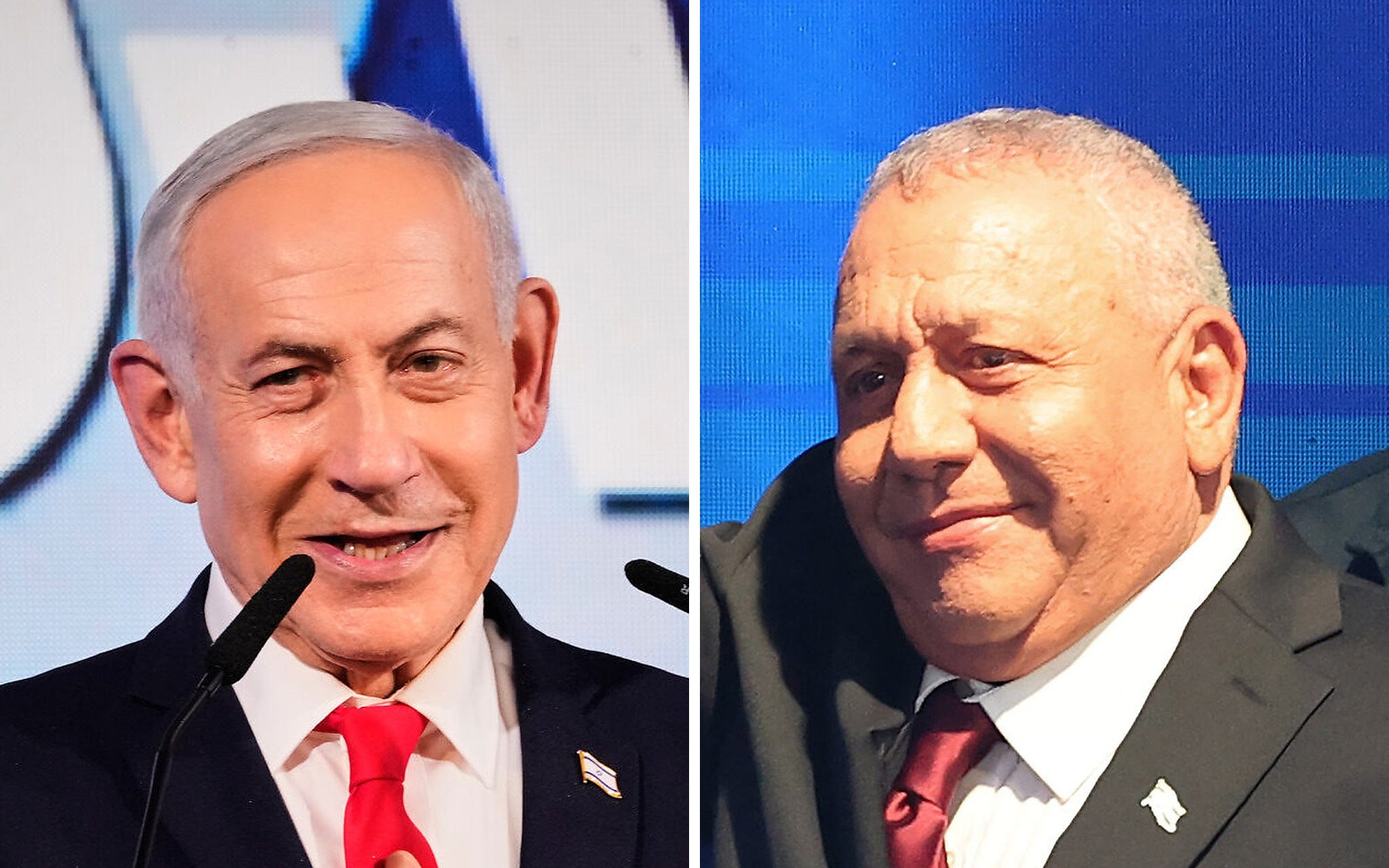
Knesset elections last week. Congressional elections yesterday. There’s a lot to keep track of, and I’m pleased to bring you analysis on the US midterms and the ongoing coalition talks. First, a piece from my friend and former Israel Policy Forum colleague Evan Gottesman on how Bibi Netanyahu is going to try to exploit the American election results to upend coalition talks in Israel. Next, I dive into Gadi Eisenkot’s dilemma, and the question of whether the Change Bloc leader will rise to the stature of Yitzhak Rabin or stoop to the level of a Benny Gantz. Enjoy, and let me know what you think!
Preempting Bibi’s Predictable Post-Midterms Meltdown
Evan Gottesman
Like a political Rumpelstiltskin, Benjamin Netanyahu is going to try to spin electoral gold out of the midterm results in the United States. Voters delivered overwhelming victories for Democrats in both houses of Congress yesterday, even electing a Democratic senator from Kansas, a seat that hasn’t gone blue since before Netanyahu was born.
Israel had its own election last week, and Netanyahu has deployed trick after dirty trick to stop rival Gadi Eisenkot from forming a coalition in the aftermath. He’s already engaging in Trumpesque election denial and inciting against Israeli Arabs. Now, the prime minister will position himself as a levee holding back the blue tsunami from America.
Israel’s favorability has hit rock bottom among Democrats. The default position among party moderates is to oppose news weapons transfers to Israel. Thus, Bibi will argue, the Democrats’ midterm victory is a national emergency, and only he can guide Israel through the storm. Liga aheret (“another league”) and all that jazz.
On Likud billboards across Israel, Michigan Senator-elect Abdul El-Sayed will succeed Zohran Mamdani as the next American hate figure framed alongside the Axis of Resistance. Netanyahu will bank on the Israeli public forgetting that the presumptive leaders of the new Congress are Chuck Schumer and Hakeem Jeffries.
Israelis would do well to ignore the fearmongering. No one is more ill suited for a moment of Democratic dominance than Benjamin Netanyahu.
The reasons that Democrats have distanced themselves are many, and not all of them can be isolated in the person of the prime minister: The war in Gaza; state-sanctioned settler pogroms against West Bank Palestinians; increasingly authoritarian politics inside the Green Line; the growing rift between Israelis and their American Jewish cousins; and, yes, rising antisemitism in following Hamas’s October 7 attacks.
Benjamin Netanyahu has accelerated every single one of these trends, though he is not solely responsible for them. And the one Israel-related factor that topped US voter concerns—the War in Iran and the accompanying surge in fuel prices—is also the issue that can be most closely tied to the Israeli premier. Bibi personally lobbied the White House to take on Tehran. Next to (and perhaps ahead of) Donald Trump, Netanyahu is the individual whom Americans hold most responsible for this Middle Eastern misadventure.
Eisenkot is a degree removed from all of this. He is not enmeshed in childish fights with the mayor of New York City. Rather than prop up fascists like Itamar Ben Gvir and Bezalel Smotrich, Eisenkot could build a coalition with genuine liberals like Yair Golan’s Democrats (not to be confused with the American party of the same name). Meanwhile, Israeli Arab parties supporting a minority government could even act as a bridge to some of the more Israel-skeptical newcomers on Capitol Hill.
We should be careful not to be polyannish. An Eisenkot premiership will not restore the status quo ante on US aid. That ship has sailed. Early on Election Day, President Trump suggested that Washington would end its assistance to Israel, and the Jewish state is increasingly unpopular with young Republicans.
Nor will an Eisenkot government in Israel wipe away the thorniest questions in that nation’s relationship with the United States: the future of Gaza, along with the occupation and de facto annexation of the West Bank. Still, with Eisenkot on one side, and Hakeem Jeffries and Chuck Schumer on the other, there is potential for Israel and the US to approach these issues in the spirit of collaboration. Under Netanyahu, it is guaranteed to be a hostile ordeal.
A new Knesset and a new US Congress present opportunities to break from old patterns, but Israel’s reactionary prime minister isn’t about to step aside gracefully. We are about to witness Benjamin Netanyahu sell himself as uniquely capable of rescuing Israel from its supposed enemies in America. In reality, he is uniquely capable of one thing: sinking US-Israel ties to new lows.
Evan Gottesman is the director of communications and special projects at the Renew Democracy Initiative and the managing editor of The Next Move, RDI’s publication on Substack. He previously worked at Israel Policy Forum and produced and co-hosted a podcast for the Israeli human rights group Terrestrial Jerusalem. Evan has been published in The Washington Post, Foreign Policy, and Haaretz.
Eisenkot has Two Paths: Gantz or Rabin
Eli Kowaz
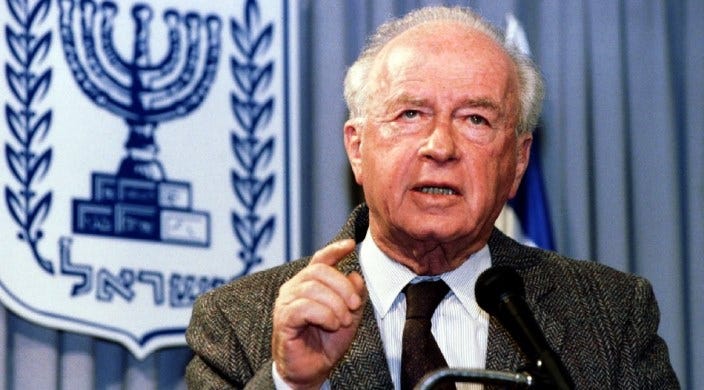
In 1993, Yitzhak Rabin lost his majority in the Knesset—but continued on as prime minister for two more years.
How did he pull it off? The answer is that Rabin embraced the support of Israeli Arab parties Hadash and the Arab Democratic Party, who voted to keep his coalition afloat from the outside without joining the coalition. This is what’s called a minority government.
Rabin would later secure the Oslo II peace agreement with the Palestine Liberation Organization by a single vote. Rabin’s opponents drummed up incitement against him for accepting Israeli Arab backing, a campaign of hate that culminated in the prime minister’s assassination 31 years ago today.
The debate over Israeli Arab participation in government hasn’t gone away in the intervening decades. If anything, it’s intensified, reaching a fever pitch following last week’s Knesset elections.
Gadi Eisenkot, the head of the Change Bloc, is in line to receive the mandate to form a government. He can cobble together a coalition—perhaps a minority government—if he is willing to work with the Arab factions Ra’am and the Joint List.
This is what a majority of Change Bloc voters want, though a sizable minority object to this tactic, and Netanyahu is inflaming public opinion over the prospect of a government propped up by people whom he disingenuously labels “terror supporters.”
The other option would be a unity government with Netanyahu. Prominent Israelis like self-appointed civilian spokesman Eylon Levy have chimed in to appeal for this option, claiming it would save Israel.
It’s a bit rich to think that Netanyahu—the man who presided over October 7 in the face of multiple reported warnings, who’s shunted responsibility, who divided Israeli society with his judicial coup, who addressed the 1995 Zion Square rally where the crowd chanted “Death to Rabin”—that this man is the one who will save Israel.
The very suggestion requires amnesia on our part. We are asked not to remember that Netanyahu tried to recruit Ra’am’s Mansour Abbas to his government in 2021. It requires us to forget how Bibi betrayed previous partners in unity governments past: Tzipi Livni, Yair Lapid, and the now-unemployed Benny Gantz.
Netanyahu has spent this week casting doubt on the result. His allies claim the vote was tainted by foreign interference, and Shin Bet chief David Zini, whom Netanyahu appointed, reportedly asked to question Ra’am’s Mansour Abbas, Ta’al’s Ahmad Tibi, and Balad’s Sami Abu Shehadeh, along with one other lawmaker, over suspected Qatari and Turkish funding. Last night Attorney General Gali Baharav-Miara said publicly that no citizen or elected official will be questioned without evidence, and, according to reports, that the Shin Bet had not handed over evidence for three of the four. This morning the Central Elections Committee announced that it had checked every complaint from the parties and reviewed the protocols of about three-quarters of the country’s polling stations, and found nothing pointing to harm to the integrity of the election or any change in the results. Election chief Noam Sohlberg had already written that no one has the authority to withhold publication, and that any claim about the results belongs in court after they are published. The investigation into the funding allegations continues, and Eisenkot’s response is that Qatari involvement is grave whether it is found in the prime minister’s office or in an election, a reference to the Qatargate investigation into Netanyahu’s own aides.
Eisenkot and the other Change Bloc leaders met to discuss their options. Naftali Bennett favors cooperation with the Ashkenazi ultra-Orthodox faction United Torah Judaism. Arch-secularist Avigdor Liberman shares the same view. UTJ is ideologically flexible so long as its community’s demands are met. But even with the Ashkenazi haredim, the Change Bloc will still need some measure of Arab support to pull together a government. Yair Golan of the Democrats has emphasized the need to collaborate with Ra’am and the Joint List.
I recognize that Eisenkot’s position is complicated. He has set forth conditions for future coalition partners: acceptance of Israel as a Jewish, democratic and liberal state; the values of the Declaration of Independence; military, national or civilian service for all Israelis; and recognition of Hamas as a terrorist organization whose military and governmental power must be destroyed or dismantled.
Ra’am’s Mansour Abbas recognized Israel’s Jewish character and condemned the October 7 attacks in the harshest terms. He’s wavered on how he defines Hamas, which is troubling, but it is very clear that he opposes the organization. The test for Abbas is whether he will say plainly what Eisenkot has asked of every partner.
Meanwhile, Eisenkot’s principle of universal national service will likely require some meeting in the middle between the Change Bloc and the haredim.
It’s worth noting that Netanyahu never set forth any conditions for his own partners. Not when he made entreaties to Abbas, and not when he included Jewish terror supporters like Itamar Ben Gvir in his coalition.
Outside observers are quick to label Eisenkot’s four benchmarks as racist, but I believe they are eminently fair. They do not apply exclusively to Arabs, and there are elements that demand compromise from any type of party—secular, religious, Arab, and others.
That compromise is democracy at work. It may be uncomfortable, but it is what’s required to govern a diverse democracy like Israel. And this country cannot move on from Netanyahu without that kind of compromise. The coalition math will simply never work out without Israeli Arabs, who represent more than a fifth of our fellow citizens.
Israel’s relationship with its most important ally is also at stake in this decision. Democrats won both chambers of Congress on Tuesday, and they did it as the party’s voters have moved sharply away from Israel. US public opinion on Israel has sunk during Netanyahu’s time in office, especially during his last term. This summer, nearly half of House Democrats voted for an amendment to cut military aid.
The current aid agreement expires in 2028, while Trump said yesterday it will end at the end of this year. Netanyahu’s closeness to Republicans, from his 2015 speech against the Iran deal to his alliance with Trump, has made that erosion worse, and even Israel’s friends in the Democratic Party aim their frustration at its leadership. Senator Chris Coons said he hopes for a change in Israel, and warned that a Netanyahu government relying on Ben Gvir and Smotrich would deeply hurt the alliance.
A unity government with Netanyahu at the helm tells Washington nothing has changed. Israel cannot afford another Netanyahu government if it wants to keep any kind of close relationship with the United States.
Last night, on the eve of the anniversary, Eisenkot said his bloc would remember what Israel learned from Rabin’s assassination about violence, incitement, and the erosion of democracy, and would “stand firm without fear.” Likud’s campaign to delegitimize this result is the kind of incitement he was talking about.
The path in front of Eisenkot is complicated, but the outcome is clear. If he can’t chart the way, Eisenkot will end up as another Benny Gantz, a forgettable cardboard-cutout general, one more discarded opposition figurehead. Still, I believe Eisenkot has the potential to be a Yitzhak Rabin, a man who bucks political taboos in pursuit of real change.