



For a few weeks this summer, Charles Clore Park was the happiest place in the country. Thousands of people in sky-blue and white, most with no real connection to Argentina beyond a post-army trip through Buenos Aires and Patagonia, gathered on the Tel Aviv shoreline to sing songs they had learned by heart. “An Argentine is born wherever he wants,” one person told Haaretz. This was the closest we have come to having a national team at a World Cup. Israel last qualified in 1970, its only appearance, and most Israelis doubt we will qualify again soon.
I remember what that feels like. In fall 2001, Israel reached the last game of World Cup qualifying needing to beat Austria at home. I was a boy in Vancouver, where we couldn’t watch the game, so my father sat at the computer refreshing the score. We were a minute away from the result we needed when Andreas Herzog drove home a free kick to make it 1-1. Austria took the playoff place, and we were left out. That draw is the closest we’ve come since 1970, and I think it was also the last time my heartbreak over this team was only about football.
This summer, Israel was not at the World Cup—it has never been in my lifetime—so I did what I could. My other country is Canada, where I grew up, and the co-hosts were the one squad nobody had assigned a meaning to, which suited me fine. When they were eliminated, I adopted Argentina, like half of Israel. Not for their pro-Israel President Javier Milei, not for Netanyahu, but for Messi, for the fans, for the true relief of ninety minutes that—after the last three years Israelis have been through—were allowed to be only about a ball. The final did not reward the devotion: a dreadful, boring 1-0 that crawled into extra time, and I am a lifelong fan who fell asleep before the only goal. The holiest war of the summer was waged over a match I slept through. Which is the point—it was never really about football.
The day of the match Prime Minister Netanyahu put on an Argentina shirt, took a ball from the Argentinian ambassador, and posed for the cameras, saying, “I don’t hide that I’m an Argentina fan. We have no greater or better friend.” Smotrich, banned from Britain over the settlements, pulled on the full Argentina kit and posed with the ambassador in his office: “I may not be able to enter the UK because I am destroying the idea of a Palestinian state, but two goals got in nicely.” Ben Gvir posted a photo of Milei and Messi at the Western Wall, writing, “we will love those who love Israel.” The foreign minister, the UN ambassador, and the transport minister all made videos with the envoy, as if a football result was a treaty they had helped negotiate. Baruch Marzel went further, filming himself burning a Spanish flag. Marzel spent a decade as Meir Kahane’s right hand in Kach, the movement Israel banned as a terrorist group, and once threw a Purim party at the grave of the man who killed twenty-nine Palestinians at prayer in Hebron.


Loving a team and claiming it are different things. The kids at Charles Clore Park loved Argentina because they could, because of Messi. The ministers loved it because Milei loves Israel, which let them recast a happy crowd as an endorsement and conscript everyone at the party without asking. Shared happiness, to this government, is one more thing to use.
I won’t pretend that only one side tried to claim the moment; the other side wasn’t any better in its own right. When Argentina beat Egypt, whose manager had waved the Palestinian flag after an earlier win and told a press conference that anyone without compassion for Palestinians “is not a human being,” roughly one in ten posts about Messi or Argentina turned antisemitic within a day, more than 300,000 of them. Someone changed the referee’s Wikipedia page to say he was born into an Orthodox Jewish family, a claim the cited source never made, and the screenshots spread faster than the correction. “Egypt lost to Zionism,” went one Egyptian YouTube video. Supporting Palestinians is not antisemitism. Making up a Jewish referee to explain a lost match is.
Neither country fits the roles they were given. Spain, cast as the villain, has under Pedro Sánchez become Israel's fiercest Western critic: it recognized Palestine in 2024, embargoed arms, and called the war a genocide. It also expelled its Jews in 1492 and didn’t recognize Israel until 1986. Whatever Spain is in this story, it isn't the good guy. But Argentina isn’t perfect either. Argentina is where Eichmann hid after the war, where the embassy was bombed in 1992, and the AMIA Jewish center in 1994—twenty-nine people died, then eighty-five, in the country’s worst terror attack, which is still mostly unpunished. It’s also where Alberto Nisman, the prosecutor who accused President Kirchner of covering up that attack to protect Iran, was found dead with a bullet in his head days after making the accusation. That’s the country we chose as our national team. To love it without seeing its flaws is also a kind of denial, just a softer version of what I’m criticizing in others.
Messi, at thirty-nine, is unlikely to be back, and for a few weeks a country this divided did gather around one player and one team.
The government made sure it didn’t last. The same week the ministers wrapped themselves in an Argentina shirt, they marched to the Gaza fence under the banner “Gaza is ours,” demanding the settlements be rebuilt. A government that cannot let a football match stay a match will not let a ceasefire, a court, or an army stay what it is either. The instinct is always the same: take what belongs to someone else and make it a campaign prop. The real contest is still ahead, and unlike Sunday’s final it answers to no referee. Election day is October 27, and the outcome is ours.
As the final approached, I found my own joy draining out. I had adopted Argentina for the relief of ninety minutes allowed to be only about the game, and watching Israel’s government and Kach activists climb into the shirt and claim the crowd as its own had taken even that.


So here is who was missing from all of it. Not the ministers, not the Egyptian coach, not the accounts inventing a Jewish referee—none of them cared about the people at the center of the story. The players were props; so were the fans. Smotrich and Marzel are not soccer fans, and never were.
If you want to see the real Argentina in Israel, it isn’t Milei’s revolution or a jersey from an ambassador. It’s the Gaza border. Start in 2014, with Daniel Tragerman — four years old, from Kibbutz Nahal Oz, killed by a Hamas mortar with three seconds between the siren and impact, not enough time to reach the safe room. His family’s photo of him showed a boy in a Messi shirt, number 10, beside a Lego tower taller than he was.
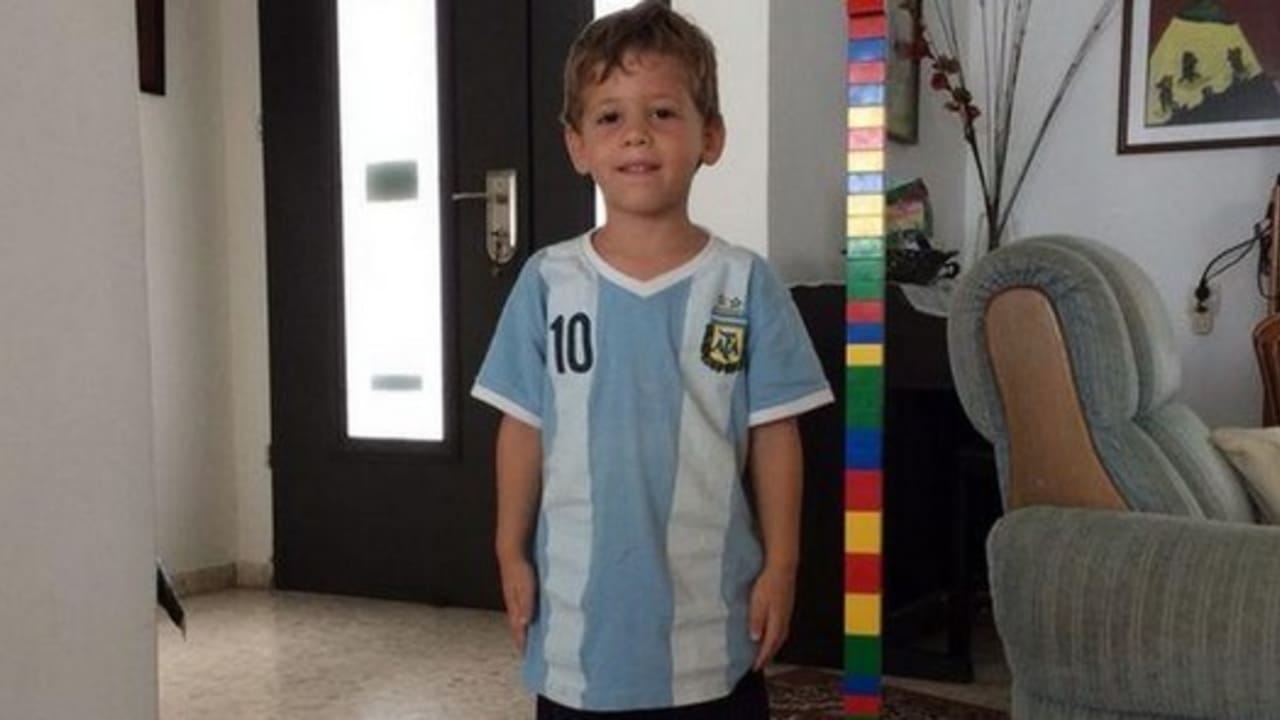
For Daniel, Argentina wasn’t geopolitics. It was football.
And it is Nir Oz. It is Yair and Eitan Horn, Argentine-born brothers taken from the kibbutz on October 7 and held in Gaza for 498 and 738 days. Yair supports Hapoel Be’er Sheva, the team I grew up supporting, and when he came home, he returned to the stadium and lifted the State Cup with the players. And it is Shiri Bibas and her two boys, Ariel and Kfir—Kfir was the youngest hostage of all, just nine months old when he was taken—an Argentine-Israeli family from that same kibbutz who did not come home. It is Shiri’s husband, Yarden Bibas, and his best friends the Cunios—another Argentine-Israeli family from the same kibbutz, kidnapped that morning and freed only last October. The bodies of Shiri, Ariel, and Kfir were returned in February 2025. Milei declared national mourning; Buenos Aires renamed a street for them. That is the real bond between these countries: not a borrowed jersey, not a political stunt, but a mother and a baby, and a kibbutz on the Gaza border.
The same week Israel's ministers posed in the jersey, Milei was greeting Yair Horn at the AMIA memorial in Buenos Aires, at the ceremony for the 85 murdered in 1994. The government spent the week calling Milei “no greater friend.” But the real friendship was already here—the Argentine-Israeli families of that kibbutz, the community that filled Charles Clore Park and then packed Menora, Tel Aviv’s main arena, for the final when the park could not hold them all. The government could have honored them. Instead, on the eve of the final, a Spanish flag went up in flames in the West Bank, held by a man whose politics this government has mainstreamed.
Oh, Daniel Tragerman. I remember him, and that photo.
It really sucks when the monsters try to hijack our joy.