


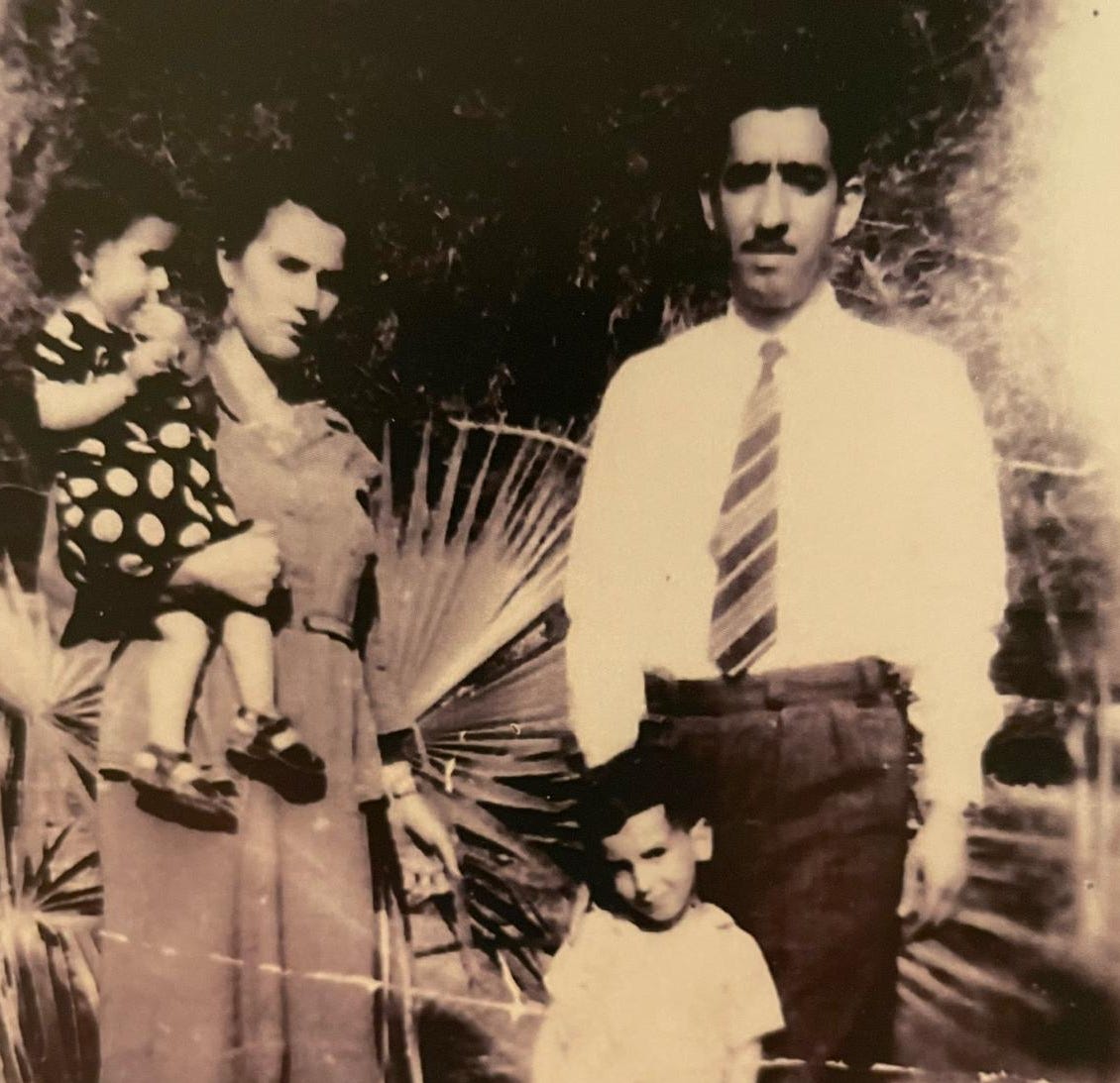
When I was a kid I preferred Savta’s apartment to my own house.
My family lived in Canada, in a big house with a backyard. Savta Aliza lived in Beer Sheva, in the apartment where my father had grown up. Seven people in one bedroom: my father, his four siblings, my grandparents. By the time I was visiting as a kid, a second room had been added.
The shower was tacky pink with a flimsy handle. The water pressure was terrible by Canadian standards. My cousins lived across the street; we played soccer in the afternoons. I’d walk to the makolet on the corner for shoko. The kitchen smelled, depending on the day, of kubba in broth, of tbit that had been cooking since the night before, of ajab jben frying in a pan. Savta called me bdalak — the Iraqi-Arabic endearment that means “I would take your place.”
I loved being there. I didn’t have words for why. I just preferred it.
That apartment sat inside a chain of events that ran all the way back to Basra and Baghdad. The claim that Israel is a white settler colonial state collapses in this apartment.
My grandparents arrived in Israel in 1951 with nothing. My aunt tells me she was dressed in seven layers of clothes.
The word “nothing” gets used lightly. I mean it precisely. Their house in Basra. Bank accounts. Savings. Furniture. Photographs. All of it confiscated by the Iraqi state on the way out. It was confiscated because they were Jews, and the Iraqi government had decided, after 1948, that Jews no longer belonged in a country where they had lived for two and a half thousand years.
Before the confiscation came the arrest.
Saba Avraham was picked up by the Iraqi authorities and accused of being a Zionist spy. This was the charge the state reached for when it wanted to break someone. Most Iraqi Jews were not, in any operational sense, Zionist spies. Saba was not. The distinction didn’t matter. What mattered was that the charge existed, and once it existed, it could be laid on anyone.
He got out because he knew a belly dancer.
The story I grew up with was compact. She knew him from a nightclub in Basra. She had connections. She used them. Saba walked out of a cell that most of the men inside it did not leave.
Nothing about that paragraph fits the white settler colonial frame. A Baghdadi Jew. A Muslim-majority country. A charge of treason for loyalty to a state he had not seen. A rescue through the intervention of an Arab woman who belly-danced for a living. This is a Middle Eastern story about a Middle Eastern Jewish family that was expelled from the country it had lived in for longer than English has been a language.
Before the arrest came the family. Before the family came the community. Before the community came two and a half thousand years.
Iraqi Jewry is older than Islam. It is older than Christianity. The Babylonian Talmud — the text that organizes rabbinic Judaism to this day — was written in the cities my grandparents were from. When the modern Iraqi state was founded in 1921, roughly a third of Baghdad was Jewish. The country’s first finance minister, under King Faisal I, was a Jew. Baghdad’s head of the chamber of commerce was a Jew. So was much of the professional and merchant class. My family was part of that world. Upper middle class, integrated, Baghdadi and Basrawi. My great-grandfather owned a pottery business. The family had moved to Basra for its port, and its access to India. My grandfather knew English and worked for a British newspaper. In Baghdad, he was a classmate of Tariq Aziz.
None of this means Iraq was a utopia for Jews, or that what happened later was avoidable. The Farhud pogrom of June 1941 had already shown them what was possible — nearly two hundred Jews killed in Baghdad over two days by a mob, while the British army sat outside the city and waited. But the community was still rooted, still confident, still there. In 1950, under pressure from riots and bombings and a worsening legal environment, the Iraqi government passed a law permitting Jews to leave if they renounced their citizenship. Between 1950 and 1952 roughly 120,000 Iraqi Jews did. The community that had survived Babylonian exile, Persian conquest, Abbasid rule, Ottoman rule, and British rule did not survive the twentieth century.
They were driven out by the Iraqi state, a nationalist government in a region where nationalism had no room for its Jews.
Saba and Savta landed in a ma’abara in Beer Sheva.
The ma’abarot were tent and shack camps set up across the country to absorb the population arriving from the Arab world and from the wreckage of Europe. Hot in summer, freezing in winter, short on water, short on work. For their first years in Israel, the roof over my grandparents’ heads was canvas.
Eventually the family was moved into a housing block. The one-bedroom apartment. My father was born there in 1955. The dishes Savta cooked in that kitchen — kubba, tbit, ajab jben — were the dishes her mother had cooked in Basra. The Arabic phrases that slipped out of Saba’s mouth were Judeo-Arabic, the dialect Iraqi Jews had spoken for a thousand years. Savta would call for my father in Arabic — Yusuf, Yusuf. He hated it when his friends heard. The furniture was Israeli. Everything else came from somewhere else.
This is what my grandparents actually found in Israel. Tents, then a room, then the beginning of a life assembled from the pieces that made it across. Colonizers don’t land in tents. The pretense that Mizrahi Jews are part of a white European project is the lie the colonial framework depends on. We weren’t.
I grew up in Canada and spent part of every visit to Israel in that apartment.
I didn’t know, then, what I was sitting inside of. I didn’t know that the smell of the kubba was a thousand-year-old smell. I didn’t know that the phrases in Arabic at the kitchen table were echoes of a Babylonian dialect. I didn’t know that the apartment in Beer Sheva was what had survived of Baghdad.
I just knew I preferred it to my own house.
Now I write about Israel from Tel Aviv. Every week I read that Israel is a white European colonial implant in the Middle East. Go back to Europe, the chant goes. I hear it in essays, on panels, in the hashtags of people who have never met an Iraqi Jew and do not know that Iraqi Jews exist.
Saba Avraham was arrested by the Iraqi state as a Zionist spy. He was released because an Arab woman who belly-danced for a living had connections. He raised my father and his four siblings in a tent, then in a tiny apartment. He spoke the Arabic of Babylonia at the kitchen table until the day he died. He never went back.
The other half of my family did come from Europe. They left for New York and New Jersey around 1900. The ones who stayed were murdered.
Tell me again where we should go back to.
Very well told Eli! I felt like I was there. Keep telling your stories, the world needs to hear.
Eli,
Happy Israeli Independence Day to you and your loved ones. Thank G_d your grandparents made it out of Iraq alive, what a harrowing experience. That Iraqi belly dancer was a true hero. And it sounds to me like those days you spent in Beer Sheva with your grandparents as a kid were the best days of your life.
Your analyses on this issue are the best I have ever read, even though I do not agree with everything that you write in them. But, as King Solomon said in Proverbs 27:17 “As iron sharpens iron, so one person sharpens another.” Please stay safe.
L’Shalom,
David Hurwitz
Chicago, IL