


When I lived in New York, I always looked forward to that September week when the world arrived. I worked near Grand Central, and the streets filled with motorcades and world leaders. For a few days, everyone’s attention was on just a few blocks of Manhattan. Zohran Mamdani knows how powerful that spotlight is.
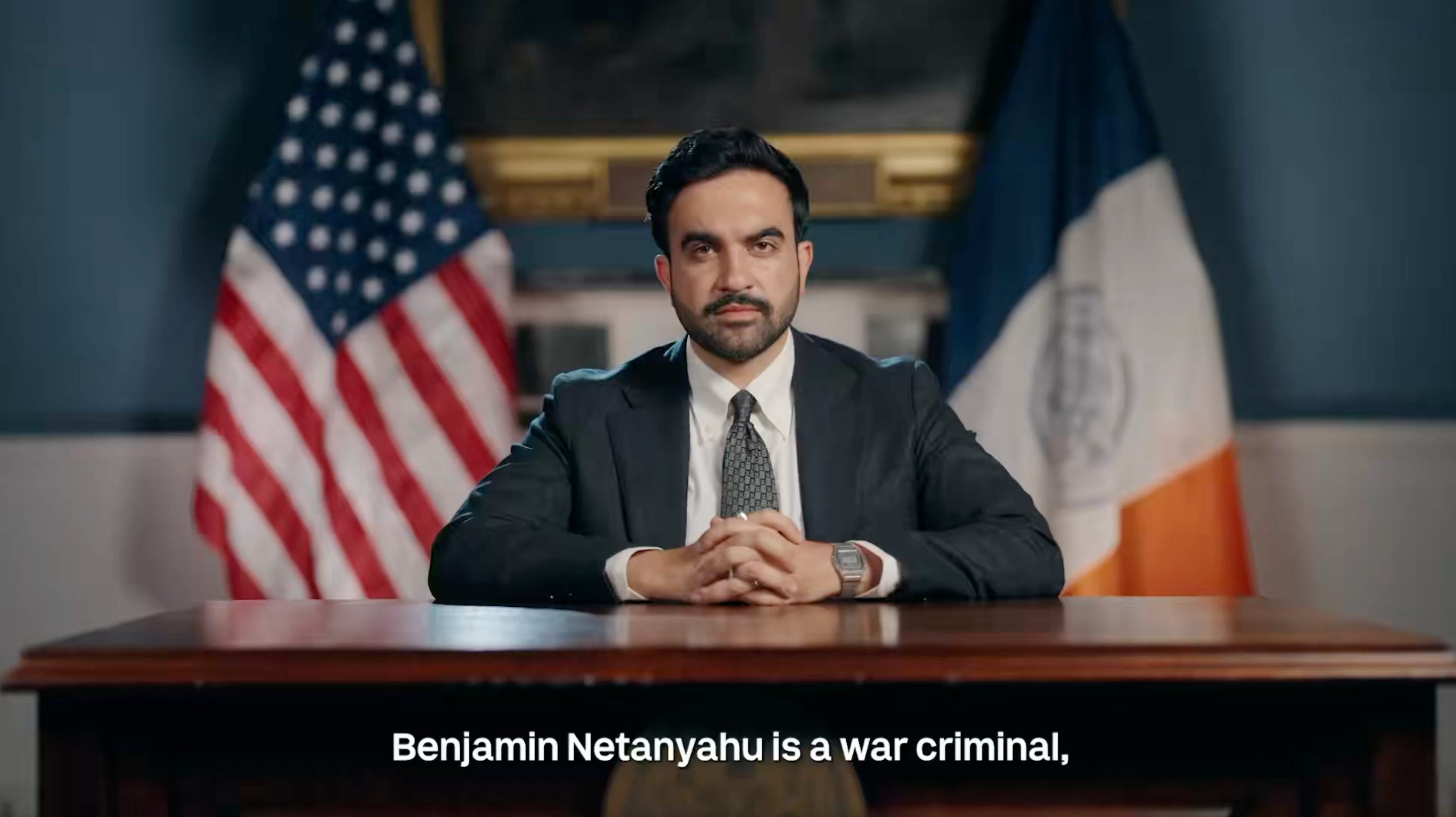
He recently told the New York Times that his administration was “in conversations” about whether it could arrest Benjamin Netanyahu when the Israeli prime minister visits for the UN General Assembly. Mamdani then made a video just over two minutes long, with an American flag behind him and soft presidential lighting. This time, there was no charming smile or warmth. Instead, he read a sentence seriously, as if he wanted you to believe he could make it happen. The video was well made. That’s the first thing to notice.
I won’t say Israel fought this war perfectly. It was long, brutal, and fought under impossible conditions. There’s a lot that deserves close scrutiny and will be debated for years. But Hamas wanted and started this war, with the largest massacre of Jews since the Holocaust. That fact is missing from Mamdani’s statement. Many of those killed were Hamas and Islamic Jihad fighters. Israel did strike hospitals, and Hamas operated from inside them, which Mamdani leaves out. I can recognize all of this at once. Mamdani cannot, or does not want to, and that’s the point. He is a committed anti-Zionist, but a sophisticated one, and that’s what makes him dangerous.
This sophistication is important to understand, because it is central to his approach. Mamdani does not deny October 7 or traffic in crude conspiracy; he doesn’t have to—he simply steps around it. He builds his case out of things that are true, or true enough to pass a fact-check, and does his real work through what he leaves out. A swastika would drive away the reasonable people Mamdani wants to reach. Instead, he reassures them. He offers a flag, a suit, the language of international law, and a number—73,000—and asks you not to notice the war that led to it. This is a much more effective approach than older forms of antisemitism, and it is why he, not the students chanting at campus rallies, is the one to take seriously.
You can see the craftsmanship in how he handles the one inconvenient truth. The video opens with its headline: “Benjamin Netanyahu is a war criminal.” This is not, strictly speaking, Mamdani’s own accusation; it is the International Criminal Court’s, supported by international law. No one can call him an antisemite or an anti-Zionist for repeating a warrant the ICC has already issued, and that is the sophistication again. He lets the institution make the accusation and stands behind it.
Then he builds up to what sounds like an announcement, but when it comes, about ninety seconds in, it is actually the opposite: “It is clear that we do not have the independent legal authority to enforce this warrant.” He has no power to arrest anyone, and he knows it. So he hides this admission in the middle of the video, beneath the production, and ends by calling Netanyahu “not welcome” in the city, which is what you say when you cannot say “not admitted.”
Mamdani is clever in his omissions. In almost two minutes about a war, the word Hamas never appears—no October 7, no hostages, no fighters shooting from beneath hospitals. I do not believe what happened in Gaza is genocide, and the film itself shows why the word needs so much help: genocide is staged with a single actor in the frame, so everything that would put a second one there is cut. But the most revealing cut is the last one. Israel is three months from an election.
Just before Mamdani released his video, Yair Golan’s Democrats held their first primary. Turnout reached 86 percent. Nearly a hundred thousand voted—reservists, protesters, Israelis who chose to rebuild the left after October 7 rather than abandon it. Golan called his group the spearhead of the camp for change. Polls put the camp for change ahead of Netanyahu’s. Mamdani never mentions a two-state solution or any vision for Israeli-Palestinian peace. An Israel that can replace its government is an Israel with a future, not one destined for disappearance. That fact undermines his narrative, so it is omitted, along with Hamas.
Netanyahu had already been dismissing the threat on New York talk radio, presenting himself as the last man standing between a Hamas-supporting mayor and the only democracy that shares American values. Here is what the coverage misses: someone as sophisticated as Mamdani knows that a war-criminal video is a gift to Israel’s prime minister. It lets Netanyahu play the last defender of a besieged nation and rally the voters who decide Israeli elections. But the same two minutes are a gift to Mamdani too: they thrill the progressive base that elected him and mark him, well beyond New York, as the one politician willing to say it out loud. What helps Netanyahu in Netanya and Beer Sheva helps Mamdani in Brooklyn — and he made it knowing exactly that. On this point, the two are not enemies. They are each other's best material, and both know it.
So notice who is disappointed when the Zionist left shows signs of life. A real two-state camp—with serious leaders, strong turnout, and a true alternative to the right—should be good news for anyone who wants this war to end. For the kind of politics Mamdani practices, it is a threat, because that approach is based on the idea that Israel can only be ended, not fixed. He is the clearest example of this: a man who can watch a hundred thousand Israelis vote to remove the annexationists from power and find nothing in it worth mentioning. The sharpest irony, which should trouble Netanyahu most, is that his own October 7 government invigorated this left. The annexation, the settler impunity, and the endless war gave the camp for change a turnout it could never have achieved on its own.
Imagine an Israel with a different government: no Ben Gvir, no Smotrich, no Netanyahu. The war in Gaza would look the same on a map, but everything around it would change. There would be no annexation minister overseeing the West Bank, and no prime minister whose survival depends on keeping the most extreme members in his cabinet. The war would simply be a war again, and hopefully it would end. Mamdani would keep all his beliefs, but lose the one thing that made them spread: the increasing sense, even among former skeptics, that he is just describing what everyone already sees.
Mamdani’s approach cannot survive an Israel that debates, corrects, and refuses to continue the path of Smotrich, Ben Gvir, and Netanyahu.
The way to answer Mamdani’s theatrics is not with a better video or a sharper rebuttal to his arguments. Mamdani is wrong about a lot, but he is sophisticated enough to make sure his arguments serve his agenda. You answer it by becoming the country he insists you cannot be.
This is something Benjamin Netanyahu understands. It is why he wants this fight, and why the mayor’s attack was a gift. He needs Zohran Mamdani. Mamdani needs Netanyahu.
Both New York City and Israel would be better off without either of them.
Yasher koach, Eli. I came at some of this from another angle earlier this week and took four times the words to get half as far.
The omissions you catalogue strike me as more than craft. A politics premised on Israel being unfixable can’t afford evidence of repair — so eighty-six percent turnout and a hundred thousand votes for the camp for change don’t get argued with. They get left out.
And your symmetry has a cost that lands on neither man. Netanyahu and Mamdani each need the other’s account of Israel to be true. The hundred thousand who turned out for Golan are the only party to the argument who need it to be false.
October is their test.
Eli- I was on the Board of Meretz USA about 20 years ago and have active on the American Left for more than 50 years. I've also been fighting - and writing - against BDSers here in Somerville Mass for a very long time. Your "Mayor of Netanyahu, not New York" essay was THE best thing I have seen about Mamdani and related issues....exactly on target! Keep up the great work!