


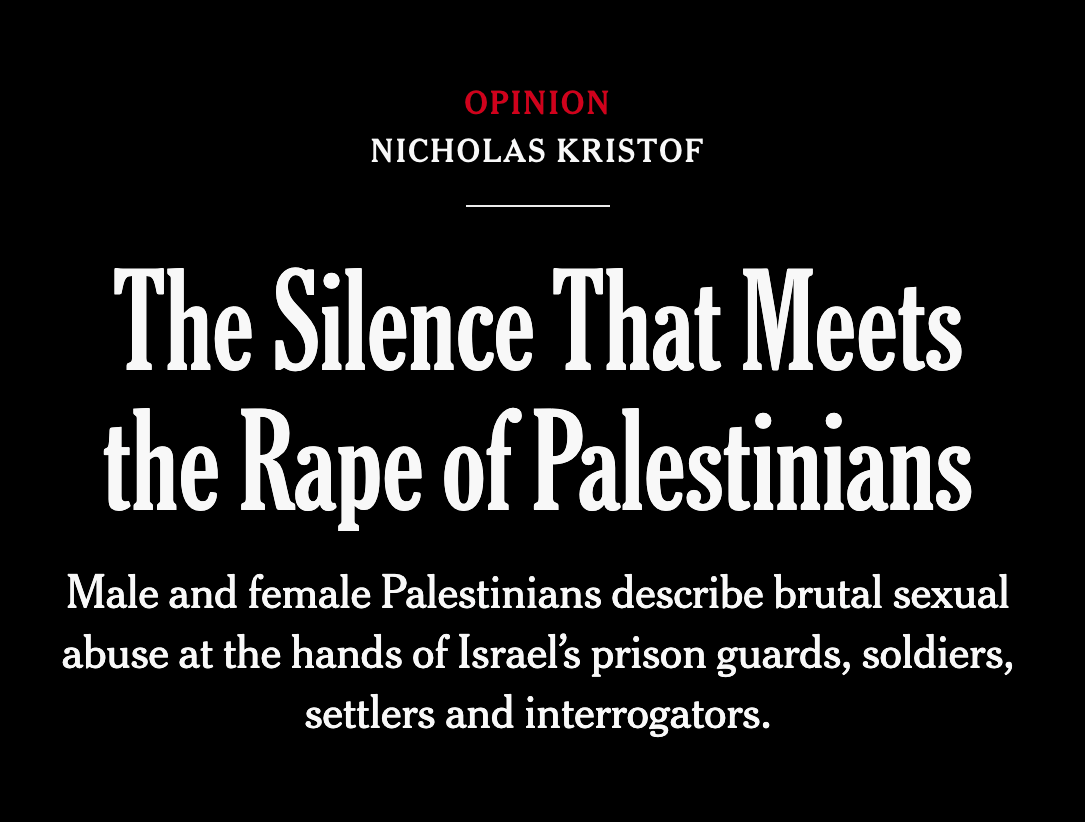
Israel’s national security minister has spent three years boasting about how much worse he’s made Palestinian prisoners’ lives. That detail — Ben Gvir’s own words, on record — is buried in a Nicholas Kristof column published in The New York Times documenting widespread sexual violence against Palestinian detainees. It deserved to be the lede.
The Samoudi case alone should have been enough. Ali Samoudi, a Palestinian journalist present when Israeli forces shot and killed Shireen Abu Akleh in 2022, was held for a year under administrative detention, never charged, never tried, and never questioned — according to a CNN interview — about the Islamic Jihad ties Israel cited to justify holding him. He was released on April 30 having lost 130 pounds. Israel’s Prison Service did not respond to requests for comment.
Israel’s own Public Defender’s Office recently determined that Palestinian security detainees have suffered severe and systematic violence from prison guards, food deprivation, and medical neglect. The findings were made public only after a year-long freedom of information battle by the Association for Civil Rights in Israel — authorities had attempted to conceal the reports. The Sde Teiman case — soldiers caught on video abusing a Gaza prisoner, charges dropped, Netanyahu hailing the outcome as the end of a “blood libel.” B’Tselem, the Public Committee Against Torture in Israel, and Breaking the Silence have each documented the pattern in detail.
Kristof also cites a UN report concluding that Israel subjects Palestinian detainees to sexualized torture with at least “implicit encouragement” from its top leadership — a credible finding from a credible source. But that report is not what anchors the piece’s central claim. The assertion that Israel employs sexual violence as “an organized state policy” comes from Euro-Med Human Rights Monitor. The UN’s language is more hedged; Euro-Med’s is more explosive. The choice between them is not incidental.
Euro-Med Human Rights Monitor, the organization Kristof relies on for that claim, is far from a neutral citation. Its track record includes publishing organ theft accusations against Israel as established fact and accusing Israeli soldiers of executing patients in cold blood at al-Shifa — without verification, after finding no Hamas military presence. This year it launched a program to train Palestinians to edit Wikipedia entries about what it describes as “the Israeli genocide in the Gaza Strip.” Euro-Med first published the dogs claim in June 2024. The sexual violence report Kristof cites — published last month — contains new detainee testimony making the same allegation through the same unverified methodology. When Kristof then cites 'human rights monitors' who have also reported it, that trail leads back to Euro-Med: the organization whose report he is already relying on, now serving as its own corroboration.
Then there is the dogs claim. Multiple Palestinian detainees have described incidents involving dogs in Israeli custody, and the accounts remain forensically unverified. I examined this specific sourcing chain last week and found it traces to a collapsed Sde Teiman case and advocacy organizations — including the originating source, Euro-Med. The claim's most prominent proponent acknowledged in the original podcast that it was 'not verified,' a caveat that disappeared as it traveled. Accounts that remain forensically unverified are not the same as documented abuse, and the difference matters when the goal is a reckoning rather than a reaction.
A real grievance sat behind Ben Gvir's rise. Before 2011, Palestinian security prisoners — including people convicted of terrorist attacks that killed Israeli civilians — were pursuing university degrees at Israeli state expense; Netanyahu officially ended the program that year, though informal arrangements persisted. The prison population Kristof is writing about ranges from Hamas operatives convicted of mass murder to journalists released without charge after months in detention — but Ben Gvir rode the grievance about the former into office and used it as cover for a system that made no such distinctions: systematic starvation and abuse that the Public Defender's Office documented and the government then tried to suppress.
The abuse is real and the documented record of it is damning. The Public Defender’s Office report, the Samoudi case, the Sde Teiman outcome, and Ben Gvir’s own public statements together constitute a serious indictment of what Israel’s prison system has become under this government. The impunity is documented and the ministerial intent is on record. Israeli lawyers have filed hundreds of complaints without a single resulting charge.
That case — traceable, Israeli-sourced, impossible to dismiss as Palestinian propaganda — is the most damaging account of this government’s treatment of prisoners available. Kristof has it and buries it beneath Euro-Med citations and testimony his targets will spend the week contesting, successfully enough to avoid the reckoning it demands.
Kristof knows how this works. A piece built around dogs and systematic state rape travels; a piece built around the Public Defender's report and one journalist who lost 130 pounds in administrative detention requires readers to sit with something less shareable. By Thursday, the conversation will be about Euro-Med’s credibility and whether unverified accounts can be trusted. The documented case — the one that required no advocacy org, no anonymous source, no unverifiable claim — will be largely beside the point. That is what this kind of journalism costs, and someone should say so.
The Kristof piece was so disturbing I could not work on the essay I’m now developing on antizionism in the Jewish community. This is the work of demoralization, and it’s effective. I’m very curious to see the follow-through in the NYT. Further investigative reporting? Additional opinion pieces by other columnists? A side question: did Kristof ever address the allegations of rape on Oct 7 in a separate column, or only in the context of this one?
You're right about the sourcing being important. And you're right that the documented case is, in some ways, more damning.
Someone told me Samoudi had stomach cancer, but I can find 0 evidence of it.
Gvir's own words are damning and I can't just ignore what he said.
After October 7, I understand the desire to make someone pay. To want the people associated with that horror to feel the worst pain anyone can imagine. The desire for vengeance is human and ugly.
i feel it myself and I'm American and I wasn't there and I don't personally know anyone who was. I can only imagine what it looks like inside people who were.
But understanding that vengeance is a human trait doesn't make any of this ok. And the job of a government, military, prison system is to have 0 tolerance for any of it.
There is plenty of evidence that Israel is failing to uphold lines that should not be crossed in Settler violence, in a broken statue, and in accusations of sexual assault, starvation, and being held without charge.
This isn't just optics, (but yeah, if they have nothing else, they should at least recognize that).
This is about whether you allow yourself to become that very thing you are fighting against.