


My abba and I both love soccer.
He played competitively in Israel, and even went semi-pro after moving to Canada. We’re season-ticket holders for the Whitecaps, Vancouver’s Major League Soccer team.
A few weeks after October 7, my mom recommended we go to a game. My dad and I had been glued to the TV since the Hamas attacks took place. A break and a game we loved would do us well, she reasoned.
Inevitably, the conflict followed us to BC Place, the Whitecaps’ home stadium. A man a few rows back spent the first half waving a Palestinian flag, chanting “free Palestine,” and high-fiving anyone who appeared to agree. There were no Israelis or Palestinians on the field. At halftime, I found an usher, a friendly Canadian who probably didn’t know much about the Middle East and may not have understood what I was asking. He went over and had a word, and the flag came down. Waving a flag is a form of expression, and I was the one who stopped it. I would do the same thing again.
Dor Turgeman scored for the New England Revolution in Montreal on Saturday. He’s only 22, from the port city of Ashdod, and is already considered one of Israel’s most promising young players.
In Montreal, he heard the crowd all game. Dor’s father, Gabi, told Sport5 that his son was subjected to chants of “death to Israel” and “free Palestine” throughout, and that Dor knew they were aimed at him.
Gabi watched the match live from Israel. He said it was both moving and infuriating, that he had spoken to his son before and after the game, and that he had not expected this to happen in Canada.
One person waving a flag in Vancouver is just one person. In Montreal, it was a whole section.
When I shared Turgeman’s story, the anti-Zionist pundit Glenn Greenwald responded by mocking him. “Poor Israeli soccer player,” he wrote. “You should hear what happens to the top Palestinian soccer players,” he continued, sharing headlines of Palestinian footballers killed by the Israeli military in Gaza.


That’s always how abuse of Israelis abroad is answered: a hand wave and a finger pointed at something the Israeli government did in Gaza or the West Bank.
I’m here to tell you that the phenomenon Turgeman faced isn’t new. It may have been energized after October 7 and the Gaza War, but it didn’t start in 2023, nor even in 1967.
Wind back the clock to 1948. The Olympics opened in London on July 29, ten weeks after Israel declared independence. The Palestine Olympic Committee—representing the Jewish community in the British Mandate—had been recognized for over a decade and had registered for the Games early that year. However, by the summer of 1948, the entity it represented had a different name.
Israel hoped to send two women to the Olympics. Its 50 qualifying male athletes were in uniform, fighting. The IOC ruled Israel ineligible on the grounds that it was not yet a member. This was an excuse: in actuality, Egypt warned it would not compete if Israel were recognized. Egypt competed, of course. So did Iraq, Syria and Lebanon, all of them at war with Israel. Israelis watched from home. The Jewish state did not appear at the Olympics until Helsinki in 1952.
When Egypt pushed Israel out of the Olympics in 1948, there was no occupation, no settlements, no Gaza war, and no Netanyahu government. Israel was only 10 weeks old.
Fast forward a decade, and Israel entered qualifying for the 1958 World Cup in the Africa-Asia zone. Turkey refused to play the Israeli team and withdrew. Indonesia, Egypt, and Sudan soon followed.
That meant Israel progressed without playing a match, which FIFA decided wasn’t acceptable. The international soccer federation created a new rule that no team could qualify without playing at least one game. So FIFA held a draw among European runners-up, teams that had already been knocked out, to see who would play Israel. Wales, already eliminated, was chosen and beat Israel.
Four years later, in 1962, Indonesia hosted the Asian Games. They refused visas to the Israeli team, and Israel withdrew. The occupation was still five years away. The Gaza War was more than six decades in the future. Itamar Ben Gvir had not yet been born.
Sixty-one years after Indonesia refused those visas, the same country was chosen to host the 2023 Under-20 World Cup. That March, six months before the Gaza war, Israel’s U20 team qualified on the field for the first time in its history. The governor of Bali refused to host the Israeli team. Indonesia’s federation canceled the draw. FIFA moved the entire tournament out of the country and fined the federation. Indonesia gave up its own automatic place as host, in a competition it hadn’t reached since 1979, rather than let Israeli teenagers play.
The tournament went to Argentina. Israel beat Brazil in the quarterfinals, and the winning goal in the 105th minute was scored by Dor Turgeman.
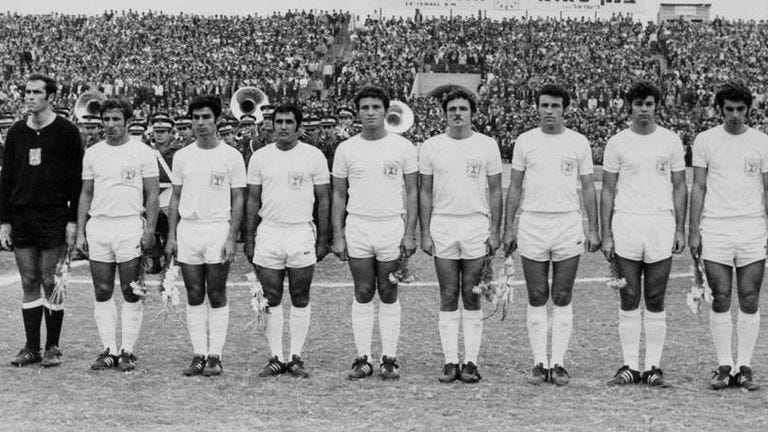
In 1974, at the Asian Games in Tehran, Kuwait—an authoritarian monarchy—and North Korea—a single-party communist dictatorship—refused to play Israel. Kuwait suggested expelling Israel from the Asian Football Confederation altogether. The resolution passed 17-13, with six abstentions. Israel had been an AFC member for two decades; they even won the Asian Cup at home in 1964. It was in Asia that Israel qualified for its first and only World Cup appearance in 1970.
For the next 20 years, Israel was homeless in international sports. Israel played competitive matches with countries in Oceania, traveling 25,000 kilometers to face teams like New Zealand, Australia, and Samoa. This continued until UEFA, Europe’s federation, accepted Israel during the hopeful years after Oslo.
Most people who call for Israel’s expulsion from European football today don’t know how Israel ended up in Europe’s leagues to begin with; the history of the Asian boycotts is simply not on their radar.
Now Europe, the Israeli athlete’s safe haven after decades of exclusion in Asia, is no longer safe. A year before Montreal, Rangers were interested in signing Turgeman. On July 11, 2025, a group calling itself Concerned Rangers Fans wrote to the club’s chief executive and board, asking them not to sign him. They weren’t judging his football, they said. He was 20 at the time. They wanted to know whether he had served in the IDF, suggested that if he had, he might be guilty of war crimes, and wrote that this “must be immediately disqualifying.” Nearly 70% of Israeli footballers serve. The rule they proposed would exclude most of them.
They also made a commercial case, urging the board to consider resale value, given that the market for Israeli players is limited and shrinking. And if the signing went ahead, they “would feel unable to continue to support the club monetarily.” That deal fell through, and Turgeman signed for New England that August. His father later said European clubs weren’t eager to sign Israeli players during the war, and that part of the decision was to send him somewhere more welcoming. A 20-year-old went to America because Europe wasn’t really an option.
Israel and Ireland play each other twice this fall. Israel’s “home” game will be held at the Nagyerdei Stadion in Debrecen, Hungary. Ireland’s home game will be played without fans at a 4,500-seat stadium in Bačka Topola, Serbia. The Football Association of Ireland, whose members voted to ask UEFA to suspend Israel, cited “operational challenges” for moving its own match out of Dublin. Neither country will play this match at home. One isn’t allowed to, and the other would rather not. I wrote in May about why Ireland, in particular, can’t stop thinking about Israel.
The war in Gaza has given the movement to isolate Israel in sports a new legitimacy. Shunning Israeli teams and harassing Israeli players is no longer confined to the Arab and Muslim world, or to the Cold War regimes that first championed it.
But that is where it started. It was there before October 7. It was there before Israel controlled East Jerusalem, the West Bank, and Gaza. It will be there after Netanyahu leaves office. It may get quieter. It won’t go away, no matter what righteous excuses the people screaming at a 22-year-old in Montreal come up with.
https://substack.com/@robertmoisescu/note/c-306796938?r=7a02yu