


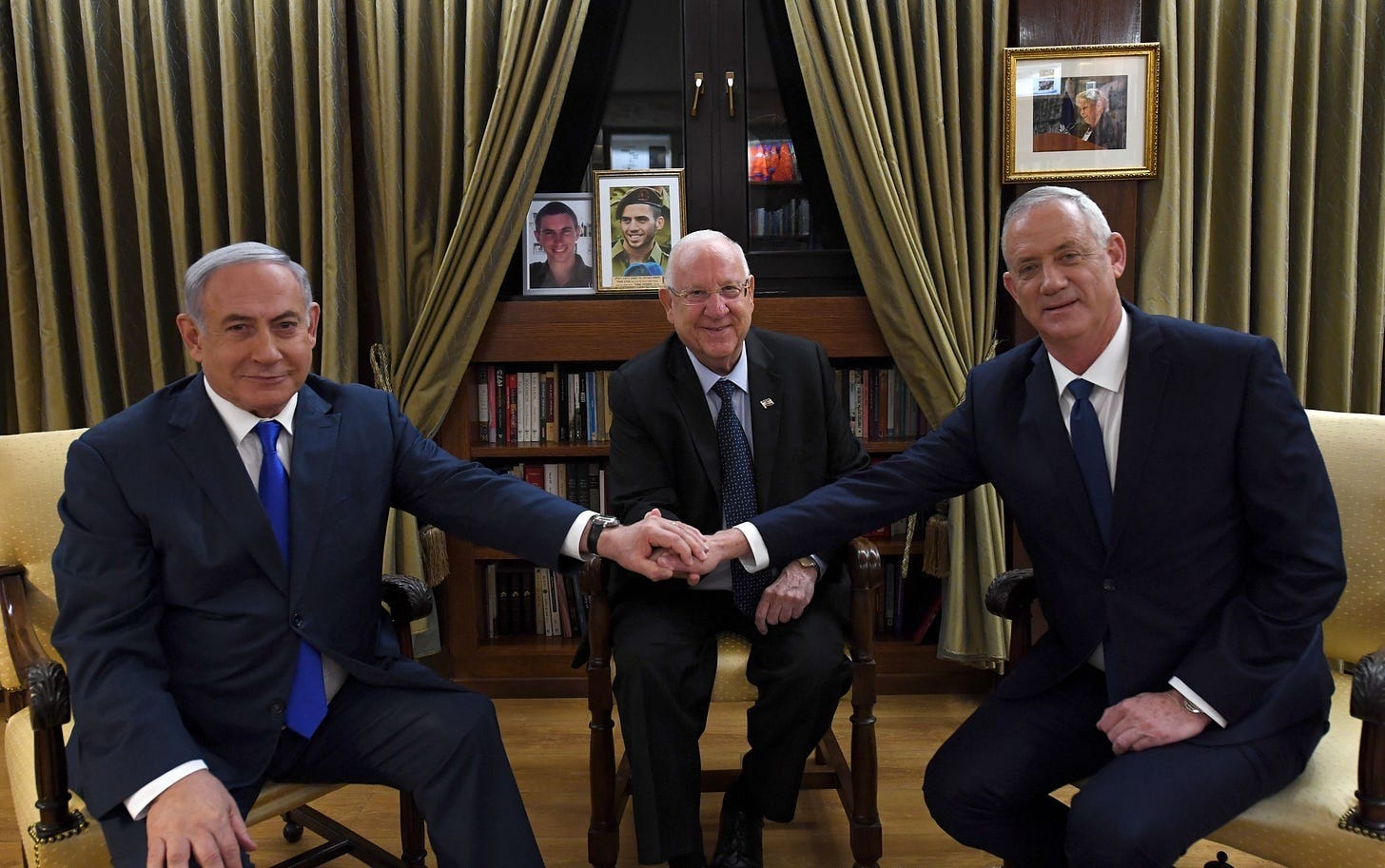
Benny Gantz was supposed to be the leader to end Netanyahu’s career. Instead, he keeps reviving it. The pundits suggested Gantz was on his way out of politics as his party remained below the electoral threshold for months. He hasn't quit, and this week he is back at the center of the race to unseat Netanyahu, which should trouble anyone who actually wants Netanyahu gone.
Gantz hasn’t gained any traction in the polls on his own, and he remains personally unpopular, as his social media posts are ratioed and mocked. His return to relevance isn’t only him and the remnants of Kachol Lavan. It is a new party altogether.
Dedi Simchi confirmed this week that he, Gantz, and Yoaz Hendel are in advanced talks to run on a single slate. The party is pitching itself as standing outside bloc warfare, part of neither the pro- nor the anti-Netanyahu camp. The Israel Hayom poll that ran alongside the talk gave it seven seats.
Before deciding what those seven seats mean, look at who is collecting them.
Gantz needs little introduction to anyone who lived through 2020, when he ran three times on a single promise: that he would not serve under Netanyahu, and then served under Netanyahu. The rotation agreement that justified it produced the most predictable broken promise in recent Israeli history. Netanyahu dissolved the government before the handoff, and Gantz was left having delivered more than a year of legitimacy in exchange for a premiership that never arrived. The episode did more than fail. It extended Netanyahu’s career at a time when three consecutive elections had been engineered to end it, and we know where the government that followed has taken the country.
Yoaz Hendel is not as well known, but his career tells a similar story. He is a former journalist and reserve battalion commander, a man of the national-religious right, who entered the Knesset in 2019 on Gantz’s slate. In March 2020, he and Zvi Hauser broke away to form their own faction, mainly to give Gantz the support he needed to join Netanyahu’s government, which the rest of Blue and White refused to do. Hendel became communications minister in that government, and later held the same post under Bennett and Lapid. He has served as a minister both with and against Netanyahu, without fully committing to either side. The party he now leads, the Reservists, focuses on ending the ultra-Orthodox draft exemption and openly says it will not boycott anyone, including Netanyahu and Ben Gvir.
Simchi is the one name in this trio Israelis recognize, and outsiders don’t, and the one the new party is counting on to launder the other two. He was chief of staff at the Home Front Command and ran the Fire and Rescue services, a serious man with no partisan history. On October 7, his son Guy, a paratrooper on leave at the Nova festival, got his friends into a shelter and, with a friend, unarmed, killed two terrorists before grenades killed him. Simchi recovered the body himself and returned to a Home Front Command situation room in Ramla during the shiva. It is an unimpeachable biography, which is precisely why it is useful. What it obscures is that Simchi’s political run was, until weeks ago, being discussed with the right; as of last month, he was considering running with Likud; and that on the question dividing these very merger talks, the inclusion of the ultra-Orthodox, he is the one least willing to exclude the Haredi parties. He has said he would join a government led by either Netanyahu or Eisenkot if it spared the country another election.
So the new force above the blocs is a man who broke his anti-Netanyahu pledge to serve Netanyahu, the man who engineered the cover for him to do it, and a general who considered running with Likud. None of the three will commit today to the only thing that removes Netanyahu.
That thing has never been complicated. It requires 61 seats willing to sit together long enough to form a government, and no poll in months has put either side within reach. The Zionist opposition sits in the high fifties, the coalition in the low fifties, and the Arab parties hold the ten seats neither bloc will touch, at least that is what they say. A party that won’t say, before the vote, whether it would join a government without Netanyahu keeps the opposition short of 61. The slate also rules out a government that leans on the Arab parties, which forecloses the one majority that doesn’t require peeling seats from Netanyahu’s own bloc.
The seven seats are not new voters, either. They are refugees from the opposition’s latest miscalculation. When Bennett and Lapid fused their parties into Beyachad in April, the joint slate immediately polled lower than its two halves had apart, landing in the low twenties where the two had separately added up to around thirty, and sinking into the teens since. The merger repelled both of its flanks. Lapid’s center-left voters, who never wanted Bennett and his right-wing record at the top of their ticket, drifted to Eisenkot, whose Yashar surged into the low twenties, and to Golan’s Democrats. Bennett’s own right-leaning voters, unhappy that he had tied himself to Lapid, went looking for a right-leaning alternative, a few to Liberman but more to Gantz’s new slate. That disaffected right-of-center vote, joined by Likud voters tired of Netanyahu, is the raw material of the Gantz-Simchi-Hendel alliance, which is why its seats come out of Beyachad and Likud rather than from nowhere. A party sold as the answer to the opposition’s fragmentation is, in fact, the newest expression of that fragmentation.
The situation has flipped since 2020. Then Gantz helped Netanyahu by joining his government; now he helps him by splitting the opposition, a partner added then, a majority taken away now.
The branding is counting on its audience to forget recent history. Blue and White did not collapse because Gantz was too rigid in opposing Netanyahu. It collapsed because he signaled he was open to him. The willingness to sit with Bibi is the very instinct that destroyed Gantz, with voters now being asked to believe he has built a vehicle to end the Bibi era.
Conscription is offered as the wedge between this new party and Netanyahu. They claim to oppose the ultra-Orthodox draft exemption, which is perceived as a threat to Netanyahu’s coalition. It isn’t. Hendel’s party has made clear it will work with anyone, including Netanyahu and Ben Gvir. Simchi backs universal conscription, but in merger talks, he is the least likely to exclude the Haredi parties. Drawing a line against the ultra-Orthodox is not the same as drawing a line against Netanyahu. None will admit it during the campaign, but the likeliest resolution is a softer exemption, something between the status quo and full conscription. That is precisely the compromise that preserves Netanyahu’s coalition.
In 2020, Gantz’s condition was that he would never serve a man under indictment. He served.
The new party draws support from both the Likud and the opposition. But the crucial fact is this: seats taken from the opposition were already pledged to the bloc seeking 61. Seats taken from Likud were not. By siphoning votes from a committed majority and adding them to an uncommitted bloc, the new party weakens the side that needs every seat and strengthens the side that only needs a stalemate.
On Channel 12’s Friday broadcast, the most-watched political panel in the country, Dana Weiss put the question that decides everything: on the day after the election, could Gantz bring himself to recommend Bennett, Eisenkot, or Liberman to the president, or would he find it easier to recommend Netanyahu? The panel reached for an explanation in personal grievance, Gantz eclipsed by Eisenkot and hunting for revenge.
Intent is irrelevant. That is why the pattern persists. Gantz and his partners-to-be present themselves as the responsible adults, above the fray, refusing to be trapped by either camp. The outcome is always the same: a centrist bloc incapable of removing Netanyahu because it will not commit to doing so. Gantz has even rewritten his promise. He no longer vows not to sit with Netanyahu, only that he will avoid the extremes. But a party that refuses to choose a side forfeits any influence over who wins and what government emerges. The promise Benny Gantz is selling is the same one he sold in 2020. He sold it once, and Netanyahu survived. He is selling it again.
I’m not the biggest fan of Netanyahu but I think a National unity government without the far right and Haredi parties is a good outcome. Replacing Netanyahu isn’t my #1 priority. If the government makes the Haredim work, stops trying judicial reform, cracks down on settler violence etc I’m happy.
Hillel Halkin, a staunch Zionist, believes that if Netanyahu wins the next election, Israel is finished.