


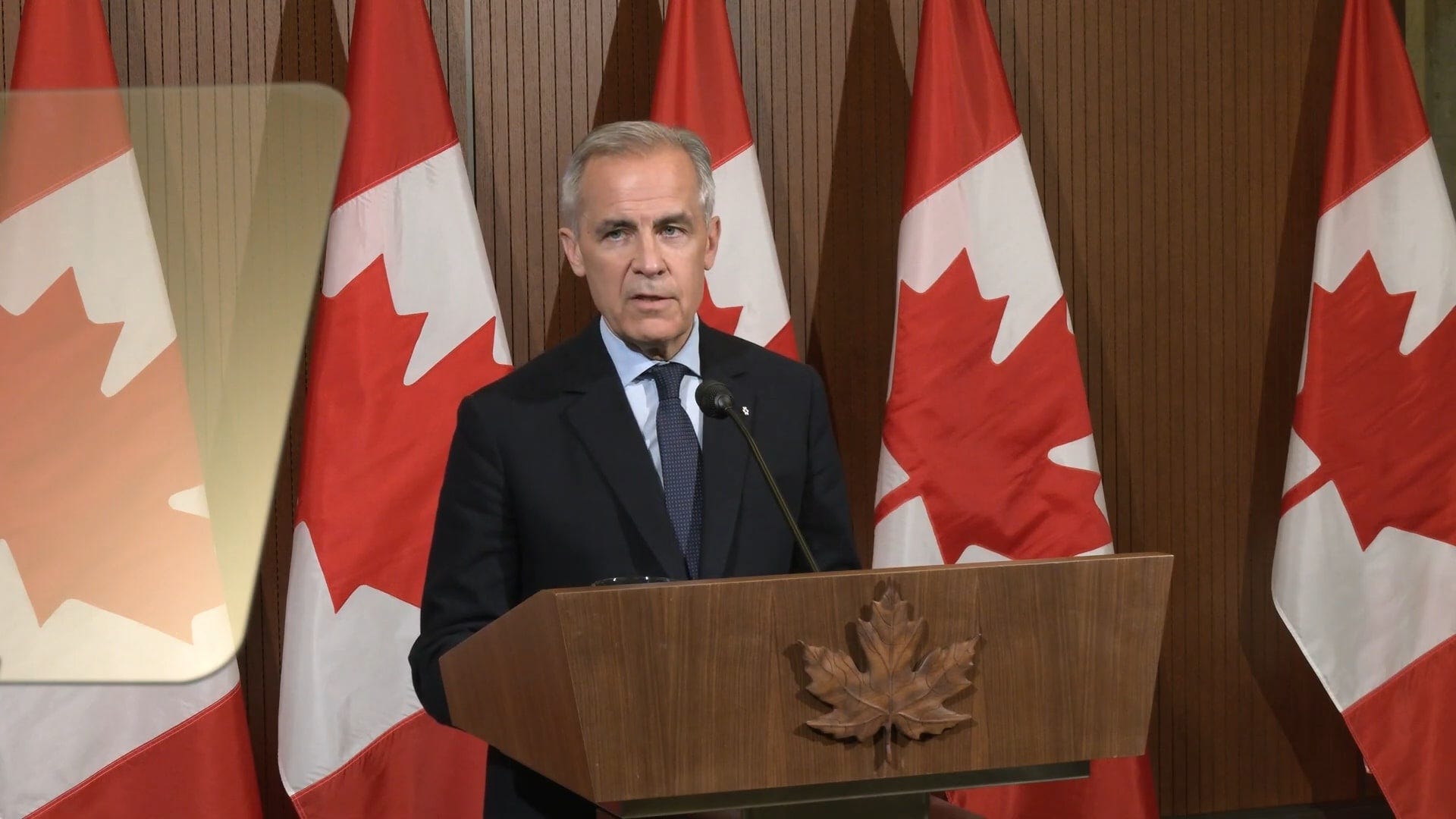
On Monday, Prime Minister Mark Carney spoke by phone with Israeli President Isaac Herzog. Both offices published readouts. Only one of them mentions the Canadian Jewish community by name, and it isn’t Carney’s.
Herzog’s readout opens with the standard exchange on security and Israel’s right to self-defense, moves through Hamas disarmament under UN Security Council Resolution 2803, Hezbollah, and the threat from Iran’s nuclear program. Two paragraphs from the end, it turns elsewhere:
During the call, President Herzog expressed his deep alarm at the mounting levels of antisemitic violence in Canada, including repeated attacks on synagogues, schools, and Jewish-owned businesses. President Herzog called on Prime Minister Carney and his government to address the growing fear and sense of abandonment among the Canadian Jewish community.
Carney’s readout is structured differently. It opens with the prime minister’s condemnation of the “appalling treatment of civilians” aboard the Gaza-bound flotilla. It condemns Israel’s Minister of Public Security, Itamar Ben-Gvir, by name. It reaffirms Canada’s support for a two-state solution and its opposition to illegal settlement expansion, settler violence in the West Bank, and violence against Palestinian civilians. It works through Iran, Lebanon, Gaza humanitarian access, and the Strait of Hormuz.

Antisemitism appears in the final paragraph of Carney’s readout, in two sentences. The first globalizes — “a devastating resurgence of antisemitism around the world.” The second describes Canada’s existing work: legislation, community safety funding, the “full force of the law,” the commitment to “protect Jewish communities,” plural and unspecified. Neither sentence engages with what Herzog raised on the call — the Canadian Jewish community’s specific “fear and sense of abandonment,” and the request that Carney address it.
The prime minister’s tweet — the public version of the call most Canadians will see — is shorter still. It mentions the flotilla, de-escalation, dialogue, peace. The word “antisemitism” does not appear in it.
What Herzog raised was not foreign policy. The institutions he named — synagogues, schools, Jewish-owned businesses — sit within Carney’s jurisdiction. The Israeli head of state used part of a bilateral call to advocate for them to their own prime minister, who declined to reflect that advocacy in either of his official communications.
I wrote earlier today about what has happened to the country my grandparents chose: 6,800 antisemitic incidents documented in Canada in 2025, the highest annual total since B’nai Brith began its audit in 1982; 781 incidents reported in Ontario K-12 schools over sixteen months, more than 40 percent involving Nazi salutes or Hitler chants unrelated to Israel; three synagogue shootings in the Greater Toronto Area in March; the dismantling of the federal antisemitism envoy this past February; the missing-person flyers for a fourteen-year-old autistic girl named Esther torn down this month because the search was being run out of a synagogue.
Canada has an antisemitism problem, and the question raised by Carney’s public statements around Monday’s call is whether he treats it as his to confront.
Carney panders to the progressive wing of his party which is fiercely anti-Israel. That is also why his government recognized a Palestinian state, it is a back and forth to keep his Liberal party united and centred. Canada's Jewish community is now paying a disproportionate price for this. It is tragic and it is unlikely to change soon.