


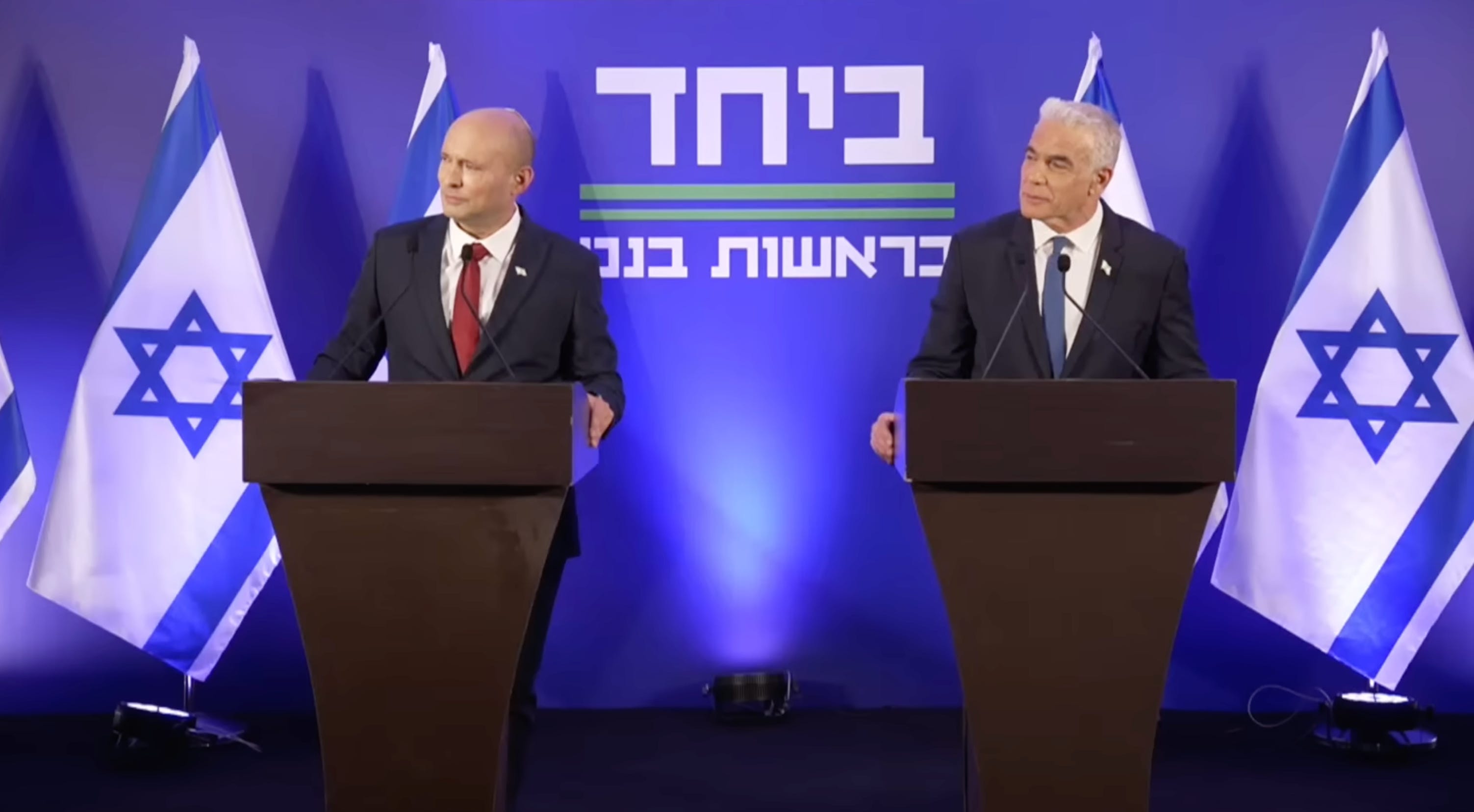
Yair Lapid and Naftali Bennett announced that they are forming a joint party, Yachad, with Bennett at the top of the list. It is the most significant opposition realignment since Kahol Lavan was formed, and may not be the last move. It is also a gamble.
Lapid had been bleeding support for months with only seven mandates in the most recent polling — close enough to the threshold that one bad election could have ended Yesh Atid entirely. Bennett, who left politics in 2022 and dissolved Yamina, returned with a new party, Bennett 2026, polling between twenty and twenty-four seats. But Bennett 2026 is a year-old vehicle. Yesh Atid has spent fourteen years building the field staff, voter data, election-day turnout operation, and state campaign funding sized for the 24-seat performance it posted in 2022 — about NIS 27 million, more than twice what Bennett 2026 was projected to receive on its own.
Lapid took the number two slot, and Bennett’s people will hold the majority on the joint list. For the leader of the larger established party and the opposition, it is a substantial concession, but with Lapid sinking in the polls, the writing was on the wall. Polling Lapid commissioned before the merger found that 62% of opposition voters preferred Bennett at the top of a unified ticket. Lapid gets the most popular candidate in the opposition camp. Bennett gets the ground operation he never built.
Yachad squeezes the same centrist-security lane that former Chiefs of Staff Benny Gantz and Gadi Eisenkot have been trying to occupy. Eisenkot, within hours, called Bennett and Lapid partners but stopped short of committing to join, saying every alliance has to be tested by whether it brings the votes to win. From the stage, Bennett extended the invitation directly: “Gadi, our door is open to you.” Bennett extended the invitation in public for a reason. Saying no now means publicly choosing fragmentation. If he joins, as still looks likely, the squeeze becomes a single bloc absorbing the entire centrist-security lane. Gantz is the harder case only on paper. He has been under the electoral threshold in nearly every poll for months, and the merger doesn’t pressure him so much as confirm his irrelevance. The arithmetic also pulls on Lieberman, who runs in his own lane but loses ground as the bloc consolidates around Yachad. Yair Golan is the exception. The Democrats sit clearly to the left, and a tighter centrist bloc helps him by sharpening the lanes; he becomes the obvious left option rather than a fourth voice in a muddled middle.
The former Yamina leader and Yesha Council director — the man who once ran the settlement movement — is now leading a centrist liberal vehicle whose number two is a former television anchor with a base in secular Tel Aviv. Bennett positioned himself plainly at the press conference: “I am right wing, I will lead.” He is not selling a move to the center. He is selling the center moving behind a right-wing leader. He framed the merger in the language of national repair: “the era of division is over, the era of repair is here.” But he also reassured his old base in the language of territorial maximalism, promising the new party would “not transfer a centimeter to the enemy.” The two quotes, side by side, are the whole project.
Tikkun, which means repair, is a deliberate word choice — drawing on a religious-traditional vocabulary rather than the polarized language of defending democracy or stopping the right. The “not a centimeter” line is the other half of the same pitch: unity in the center, no concessions on the right. Whether soft-right and national-religious voters who are exhausted by Netanyahu but would never vote Lapid will buy that combination is the gamble. Some were backing Bennett the person, not the merger. A formal joint ticket with Lapid behind him tests that theory in a way nothing before it has.
A counter-case exists. With Lapid clearly to his left, Bennett may actually have more room to court soft-right voters than he did running alone, since he no longer needs to signal to the center himself — Lapid does that work for him. But the read depends on whether soft-right voters see the merger as Bennett pulling Lapid right or as Lapid pulling Bennett left. The Likud campaign will spend every shekel making sure they read it the second way.
And the test matters more than the merger’s headline numbers suggest. The intuitive read of a merger is that two parties combining means a stronger bloc. Recent Israeli elections are decided by bloc size, not party size, and a bigger Yachad can still mean a smaller anti-Netanyahu bloc if soft-right voters who would have backed Bennett alone refuse to back a Bennett-Lapid ticket. The merger only works if the gains exceed the soft-right losses. That is the gamble.
The merger contains a disagreement that will become the central question if Yachad needs Arab support to reach a 61-seat Knesset majority. At the press conference, Bennett committed only to a “Zionist coalition” — phrasing that, in Israeli political vocabulary, signals the exclusion of Arab parties from any government he leads. Lapid built the change government around exactly the opposite, bringing Ra’am into the governing coalition for the first time in Israeli history. Arab turnout is decisive in any plausible anti-Netanyahu majority, and Ra’am is the only Arab party that has ever sat in an Israeli coalition. Ruling out Ra’am while still needing Arab voters is the same contradiction the change government managed for thirteen months before it collapsed. Bennett is now committing to the harder version of that contradiction at the start, not the end.
The Likud response was already in the field before the announcement. An AI-generated image of Mansour Abbas driving a baby-faced Bennett and Lapid in the back seat, with copy framing Ra'am as Muslim Brotherhood terror supporters — a recycled version of the same delegitimization Netanyahu has run during every election since "the Arabs are voting in droves" in 2015. The repair Bennett is offering is post-October 7 tikkun, for the divisions among Jewish Israelis. He is not offering to heal the divide Likud is exploiting here.
The repair he is offering is real, even if not complete. Yachad reassembles the only governing majority to push Netanyahu from office in over a decade — with Bennett now leading the centrist vehicle rather than joining it as a right-wing partner.
I like Bennett but his views on the Israel/Palestine issue are extreme.