


In 1984, Meir Kahane won 1.2% of the popular vote in Israeli elections and earned a single Knesset seat. These were days when the electoral threshold was just 1%, and when Kahane’s politics were considered beyond the pale.
It is no coincidence that Kahane’s slogan in that campaign, “Kahane: The man who says what you think,” is similar to what many people say about his successor, Itamar Ben Gvir.
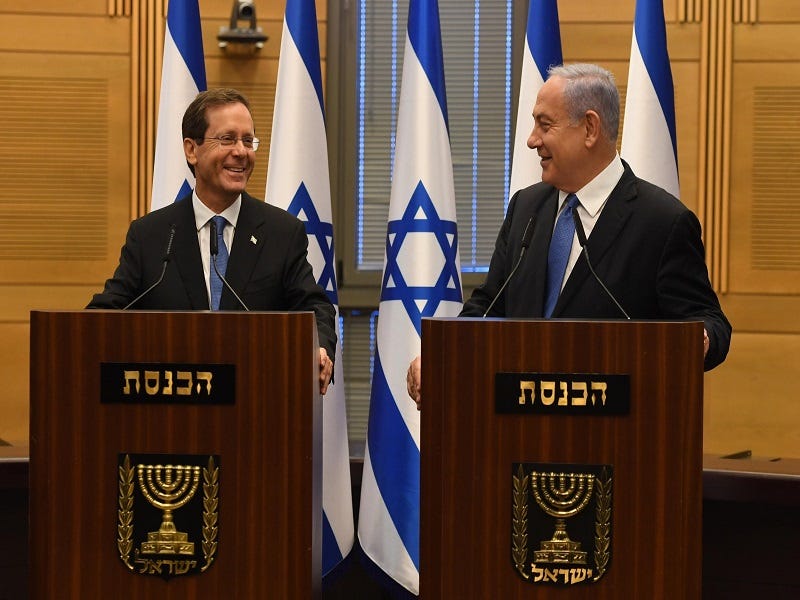
I bring this up because last week, President Isaac Herzog hosted delegations of each political party elected to the Knesset to hear them out and ask them questions as part of his decision on which candidate to task with forming the next government. Ultimately, Herzog gave the mandate to Gadi Eisenkot, but the manner in which he did so deserves attention.
In 1984, the President was none other than Isaac’s father, Chaim. Chaim Herzog refused to invite Rabbi Meir Kahane to the consultations at the President’s residence, and did not give way to the argument that Kahane had been democratically elected. His office answered critics that whoever denies democracy and threatens to destroy it, “democracy must defend itself against him and not allow him to exploit its advantages to undermine it from within.” 42 years later, not only did his son welcome the Jewish Power delegation with open arms, but he told them that Ben-Gvir’s steps in the prisons were “important” and that “their time had come.” This shows how far Israel has come but also how badly Israel needs a new government.
Herzog’s deliberations included several controversial moments. He says before each one that he is going to ask tough questions, and I admit I am not an impartial observer, but I believe he crossed the line.
The Democrats got a different session that same morning. Herzog asked them whether they regret their “refusal to serve,” a charge Likud has pushed since a 2024 Channel 14 clip of Yair Golan that left out a qualifying “if,” and he asked how they could run a government that relies on a minority. He also told them that rejecting others is the root of all evil, about an hour after telling Otzma Yehudit that Ben-Gvir’s prison steps were overdue. When the Democrats’ director-general posted during the meeting that Herzog had voted Likud, the director-general of the President’s Residence rebuked the delegation in the room for the post, and Herzog said: “right.” I found no comparable rebuke of a right-wing party’s posts during the consultations.
When Herzog said that investigations sometimes open with a big noise and end with a whimper, Likud MK Ofir Katz replied, “like the Netanyahu trial.” Herzog answered, “Correct.”
After the deliberations, Herzog took his time and announced on Sunday that he is giving the mandate to Gadi Eisenkot. It was clear all along, with 67 recommendations to Netanyahu’s 46. The president is not formally bound by the number of recommendations, but 67 to 46 left little room to give Netanyahu the mandate.
Herzog led the Zionist Union alliance with Tzipi Livni in the 2015 election. It was a hard-fought campaign where Herzog was polling neck and neck with Netanyahu until the end, and it was the campaign where Netanyahu famously posted a video on election day saying that Arabs were voting in droves, brought on buses sponsored by the left. It was a lie, but nonetheless it was picked up by Walla, part of Case 4000. Herzog has pushed for months to end the Netanyahu trial with a plea deal, and in these deliberations he agreed with Likud’s Ofir Katz that the court case against him was all noise.
Also, in these elections the Arabs did vote in droves. Herzog told Otzma Yehudit that its claims that the election was stolen were speculation and that they should be careful, but he didn’t call them out. He grilled the Arab parties on their stance vis-à-vis Hamas, while he didn’t ask questions about Ben Gvir and his support for terror and settler violence.
Ahmad Tibi was right to tell him that he was the one who attended Israeli peace activist Vivian Silver’s funeral after October 7, not Netanyahu and his ministers. The Likud weren’t questioned for their policies of strengthening Hamas, and Smotrich’s Religious Zionism party was not asked about calling Hamas an asset. Moreover, the Likud and its partners have refused to form a state commission of inquiry into the failures that led to October 7.
Tibi was also right on the math. Herzog said the results were in question, and Tibi said, “In Taibe we study math, and we know that 67 is more than 53,” referring to the 67 seats that recommended Eisenkot.
In September, Herzog cleared the criminal record of Elor Azaria, the IDF soldier who took matters into his own hands and executed a seriously wounded Palestinian terrorist. I wrote a few weeks ago about the activists outside the courtroom in support of Azaria, who yelled toward Gadi Eisenkot, “Gadi, be careful, Rabin is looking for a friend.”
Maybe Herzog thinks that cozying up to the Kahanist right and Netanyahu’s Likud is an attempt at unity. If so, he is not good at reading the room. The Likud has shown zero intention of unity, and it is disputing the election results. Then, after it was clear Eisenkot would receive the mandate and was likely on the way to forming a government, Netanyahu suddenly released a statement calling for unity, despite weeks of rejecting it and delegitimizing over 20% of Israel’s citizens. He did so in a video statement that felt like the start of his next political campaign, in which he continued, surprise, surprise, to delegitimize Israel’s Arabs.
The Knesset passed anti-racism legislation in 1985 that led to Kahane’s party being banned from running in the 1988 elections. That was a different Israel. That was an Israel that was loyal to the checks and balances of its democracy, the Supreme Court, and the Declaration of Independence.
By contrast, the Netanyahu government has waged a war on Israeli democracy, was at the helm during the worst massacre of Jews since the Holocaust, and tore Israeli society apart. The president in Israel is merely a figurehead. If Herzog wants to take a more political role, he should say so openly; otherwise, he should be a figurehead and not pick sides, let alone promote the propaganda of Netanyahu and his extremist allies or push for a unity government. He should also know better, since Netanyahu walked away from a unity deal with Herzog himself for the sake of his own coalition and political survival. Benny Gantz, Tzipi Livni, Yair Lapid, and Shaul Mofaz can tell him how Netanyahu treats his partners.
In 1984, Chaim Herzog decided that the President’s residence was not the place to give Kahane a platform; last week, his son praised Otzma Yehudit’s Kahanist policies. Isaac Herzog gave Gadi Eisenkot the mandate, because the math left him little choice. I hope he remembers, going forward, what his father’s office wrote: that the president is also the president of Israel’s minority citizens and may not forgo their dignity.
You write with a clarity that to my mind combines facts with the truth. I happen to know some of the background of the impressive Museum of the Jewish Soldier in WWII, which carries the Herzog name. Chaim Herzog was someone special, Mike Herzog was a good Ambassador, Isaac probably became President courtesy of a deal with Netanyahu. Enough said.